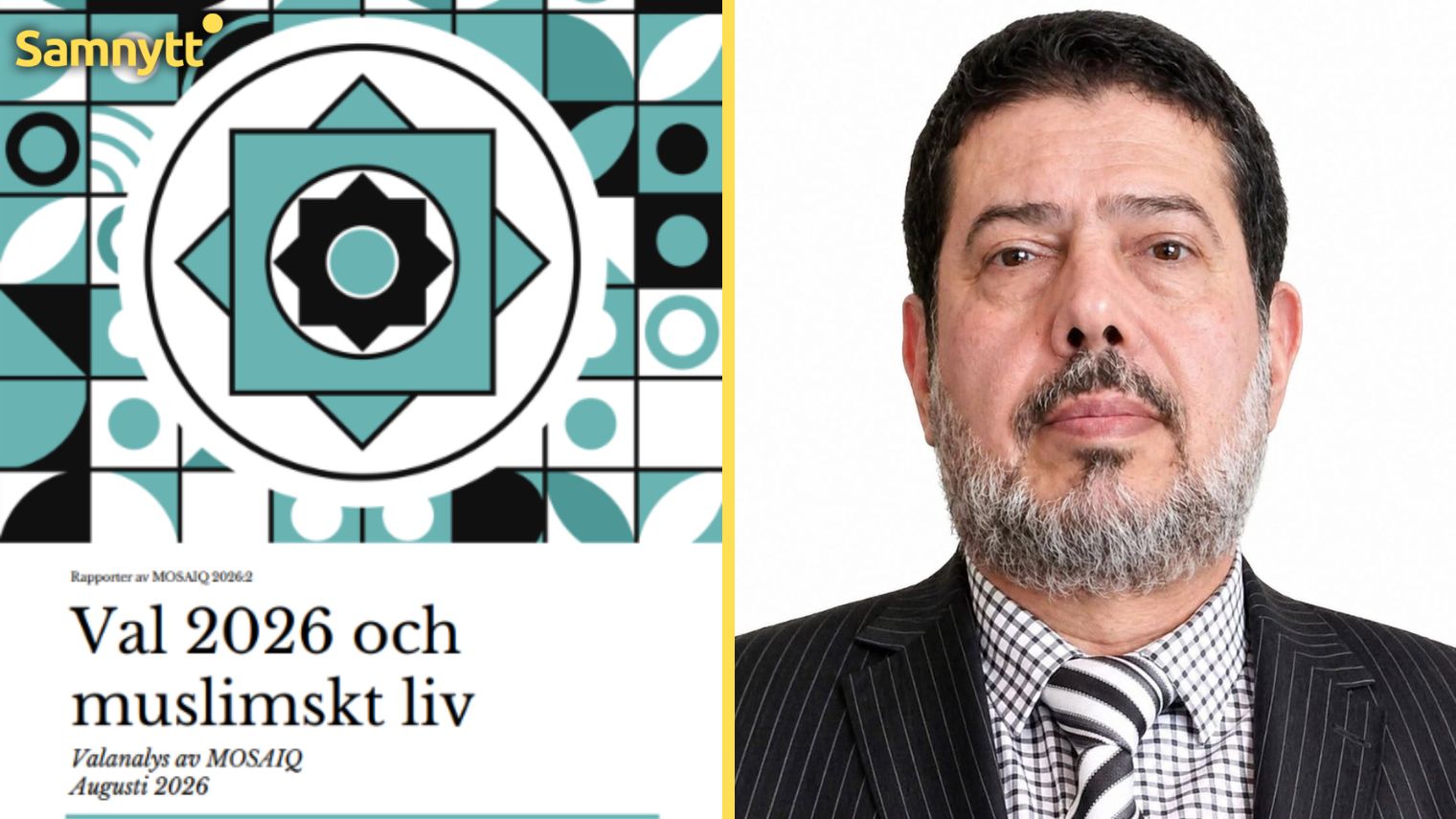
They describe themselves as a group that brings together civil society, researchers, experts, and community leaders to produce reports, training sessions, and documentation on issues important to “Swedish Muslims.” In a pre-election report, they demand, among other things, transparency in political parties’ candidate lists — “not just to get symbolic names at the bottom, but real positions where our votes can actually result in mandates.”
A relatively new player has entered the Swedish debate on Islamophobia, Muslim organizations, and politics ahead of the 2026 election. MOSAIQ describes itself as an organization working for Swedish Muslims through knowledge production, opinion shaping, and mobilization. At the same time, the organization’s own publications show that its activities go significantly beyond merely documenting discrimination and hate crimes.
MOSAIQ, which stands for “Mobilization Against Racism and Islamophobia,” states that its goal is a world free from racism and Islamophobia. The organization claims it wants to drive change through publications, public conversations, and cooperation with other actors.
On its website is a library with materials about Islamophobia and the “living conditions of Swedish Muslims.”
The organization has become increasingly political during 2026. In August, MOSAIQ published the report “Election 2026 and Muslim Life,” in which all eight parliamentary parties are assessed based on how their policies affect Muslim life. The parties’ programs, motions, interpellations, and parliamentary votes during the 2022–2026 mandate period were weighed across seven different areas.
SEE ALSO: Police Officer Maria Rosander Warns of Islamization: “Society Is Being Eaten from Within”
The result is clear. The Green Party scores the highest with 1.52 on a scale from −2 to +2, followed by the Left Party at 1.45 and the Centre Party at 0.57. The Social Democrats land at 0.02. On the negative side are the Liberals at −1.48, the Moderates at −1.74, the Christian Democrats at −1.95, and the Sweden Democrats at −2.00.
MOSAIQ notes in the report that, in their assessment, none of the parliamentary parties have a cohesive policy based on Muslims as equal citizens with their own legitimate interests. The organization further describes the difference between the political blocs as more than a matter of degree, claiming it is about two irreconcilable views on Muslim life.
In the report’s conclusions, MOSAIQ goes further. According to the organization, a continued Tidö government (right-wing coalition) is seen as a “direct existential threat to Muslim life in Sweden.” Swedish Muslims are therefore urged to organize themselves, formulate political demands, and hold parties accountable even between elections.
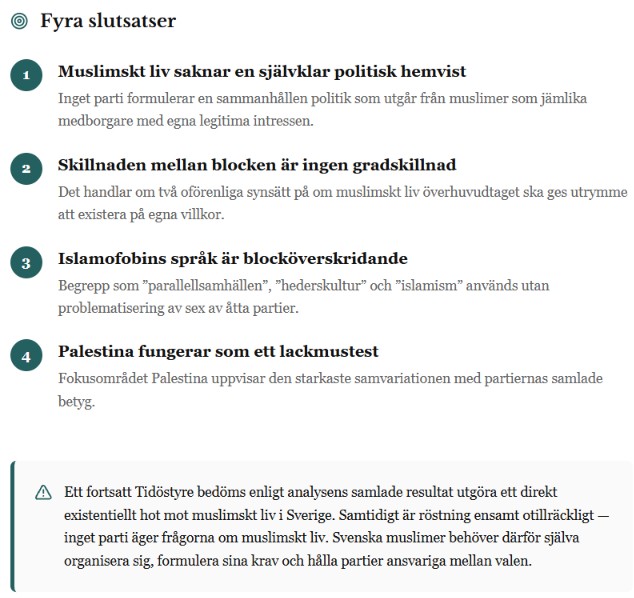
The organization describes “Muslim life” as encompassing not only an individual’s freedom of religion but also the collective and institutional conditions for Muslims to act as equal citizens in Sweden.
The organization also characterizes the policies pursued by the Liberals, Moderates, Christian Democrats, and Sweden Democrats as demonstrating a recurrent Islamophobic approach.
MOSAIQ also highlights several concrete issues it considers significant for Muslim life, including access to halal meat, the possibility to build mosques, Muslim cemeteries, circumcision, and time off during Eid.
MOSAIQ claims that restrictions in these areas could, in the long run, threaten Swedish Muslims’ ability to enjoy their basic freedoms and rights under the same conditions as the rest of the population.
Critical of Hijab Bans and Defends Muslim Organizations
The organization’s other output also shows a distinctly political orientation. In July, MOSAIQ published a policy document on hijab bans. The conclusion is that hijab bans — in any context — according to the organization, undermine rather than strengthen gender equality.
In June, they published a critique of the Swedish Defence University’s report Salafism and Salafist Jihadism 2.0. MOSAIQ claims the report contains methodological shortcomings, particularly focusing on what the organization perceives as negative consequences for Muslim organizations in Sweden.
SEE ALSO: Sweden Democrat Politician: “Islam Has No Place in Sweden”
MOSAIQ has also been involved in the conflict surrounding Islamic Relief Sweden after the aid agency Sida halted its support for the organization. In a statement from May 2026, MOSAIQ described the process as politicized and, among other things, demanded an independent investigation into how the decision was made. The organization also wrote that it is prepared to support Islamic Relief Sweden legally.
MOSAIQ claims in the statement that Muslim organizations have long been subject to scrutiny, suspended funding, and broken partnerships on vague grounds. The organization believes Muslim actors are systematically viewed with greater suspicion than other organizations.
Ties to a Network of Muslim Organizations
Another aspect is the organization’s material on the Network of Swedish Muslims in Cooperation. On MOSAIQ’s own website, there is a report from October 2025 that is, according to the organization, authored by the Network of Swedish Muslims in Cooperation. The report addresses Islamophobia in Sweden and was presented to the UN Committee on the Elimination of Racial Discrimination, CERD.
MOSAIQ’s library also contains an alternative CERD report from 2018 titled Swedish Muslims in Cooperation Network – Alternative Report to CERD 2018, with the same network listed as the author.
This does not in itself mean that MOSAIQ and the Network of Swedish Muslims in Cooperation are the same organization. However, it demonstrates a clear operational connection: material from the network is part of MOSAIQ’s knowledge library, and the network’s activities are presented on the MOSAIQ platform.
A Library Marked by Muslim Perspectives
MOSAIQ’s library contains both material from authorities and academics, as well as publications with a clear Muslim organizational and interest-political focus.
Among the names featured are Ahmad El Far, Amanj Aziz, Emin Poljarević, Abdi Hassan, and Anna Ardin. The library includes, for example, texts on the Muslim civil society, Islamophobia, securitization, and what the organization calls shrinking democratic space for Muslim civil society organizations.
At the same time, there are materials from, for example, the Swedish National Council for Crime Prevention, the Equality Ombudsman, the Institute for Human Rights, and Uppsala University. MOSAIQ thus also serves as a comprehensive knowledge library for issues concerning Muslims and Islamophobia in Sweden.
How Representative Is MOSAIQ?
A central question is therefore what position MOSAIQ actually holds within Sweden’s Muslim civil society. The organization uses terms like “Swedish Muslims” and argues that Swedish Muslims should organize politically and formulate joint demands. But that is not the same as the organization representing Swedish Muslims in any formal or democratic sense.
It is also worth distinguishing between the organization’s role as a knowledge producer and its role as opinion maker. MOSAIQ presents analyses and reports, but at the same time makes normative judgments on Swedish politics and urges Muslims to act politically.
Thus, MOSAIQ emerges as an actor that has quickly established itself in the Swedish debate on Islamophobia and the Muslim civil society, but also as an organization with a clear political agenda. Ahead of the 2026 election, it has taken the step from describing the situation of Muslims to assessing parties’ policies and encouraging Swedish Muslims to organize and demand political accountability.
Demands from a Former Centre Party Member
Mahmoud Aldebe is one of the more long-standing figures in Swedish Muslim organizational life. He came to Sweden from Jordan in the late 1970s and became, for several decades, a prominent representative of Sweden’s Muslim Association (SMF). He has also held leading roles in the Swedish Muslim Council and was involved in founding the Islamic Association in Sweden.
Aldebe attracted particular attention in 2006 when, as chairman of Sweden’s Muslim Association, he sent a letter to parliamentary parties with demands for adaptation of Swedish law and public services for Muslims. Among other things, he proposed that imams should be able to certify Muslim divorces, that Muslim children could receive separate instruction in Islam and Arabic, and that boys and girls should have separate swimming lessons. He also requested special opportunities for time off during Muslim holidays.
The letter sparked considerable debate, and the Swedish Muslim Council distanced itself from his demands. Aldebe later toned down his language, saying that he was not demanding parallel laws but wanted existing legislation adapted so the Muslim minority would feel secure in Sweden.
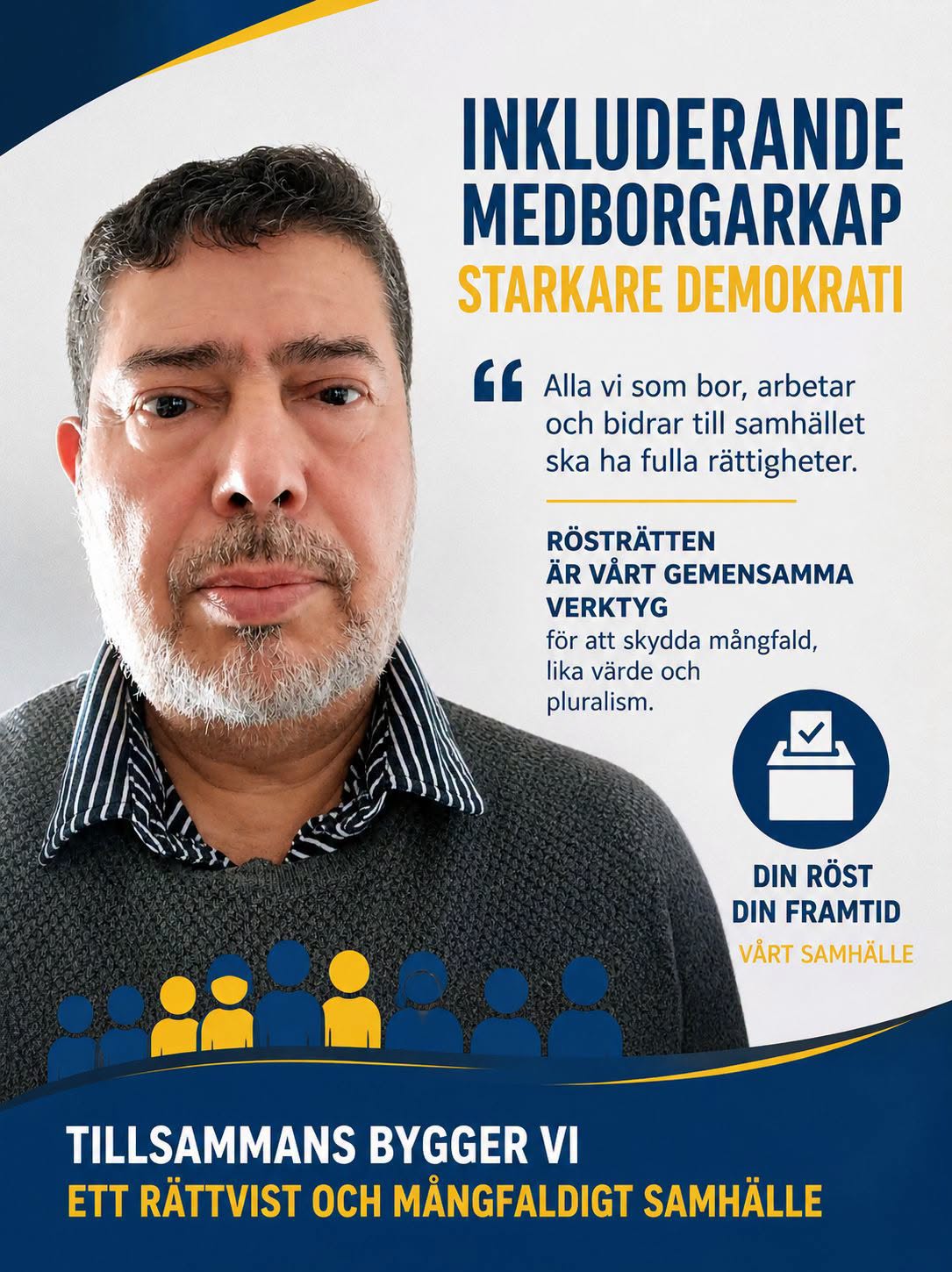
Aldebe has also had a political connection to the Centre Party. He ran for Parliament for the party in 2009 but withdrew his candidacy after criticism related to his earlier demands for special legislation. The following year he left the Centre Party, claiming that he had been opposed because of his Islamic values.
His name has continued to appear in debates about Islamism and Muslim organizations in Sweden. Researchers and commentators have, for example, noted his earlier involvement in the Islamic Association and the Swedish Muslim Council. Allegations have also been made concerning connections to the Muslim Brotherhood’s network.
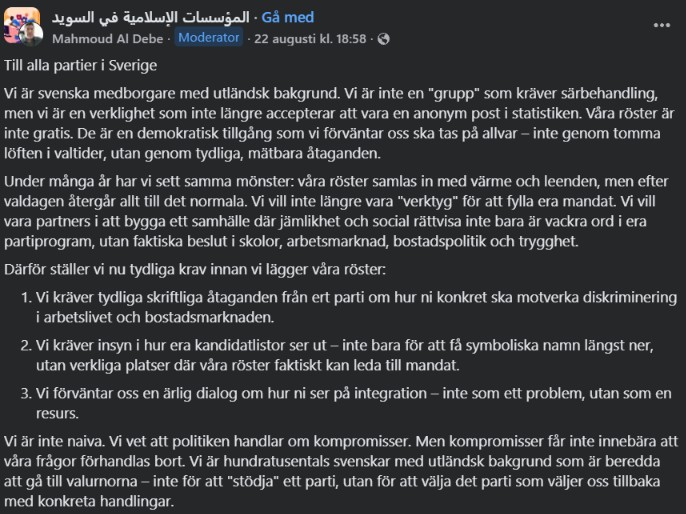
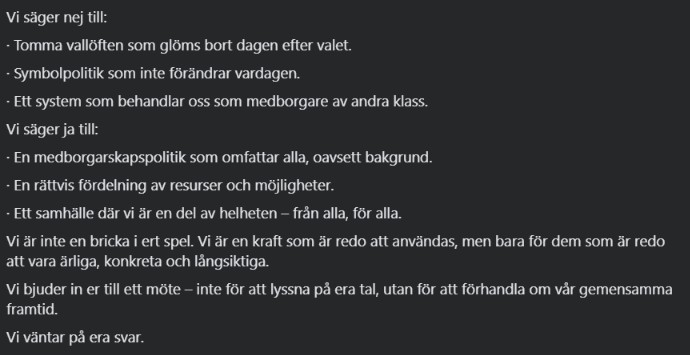
A few days ago, Aldebe posted the MOSAIQ report in a Muslim Facebook group called “Islamic Institutions in Sweden”:
SEE ALSO: Green Party Politician Behind New Swedish Sharia Court – Wants to Make Agreements with Mosques