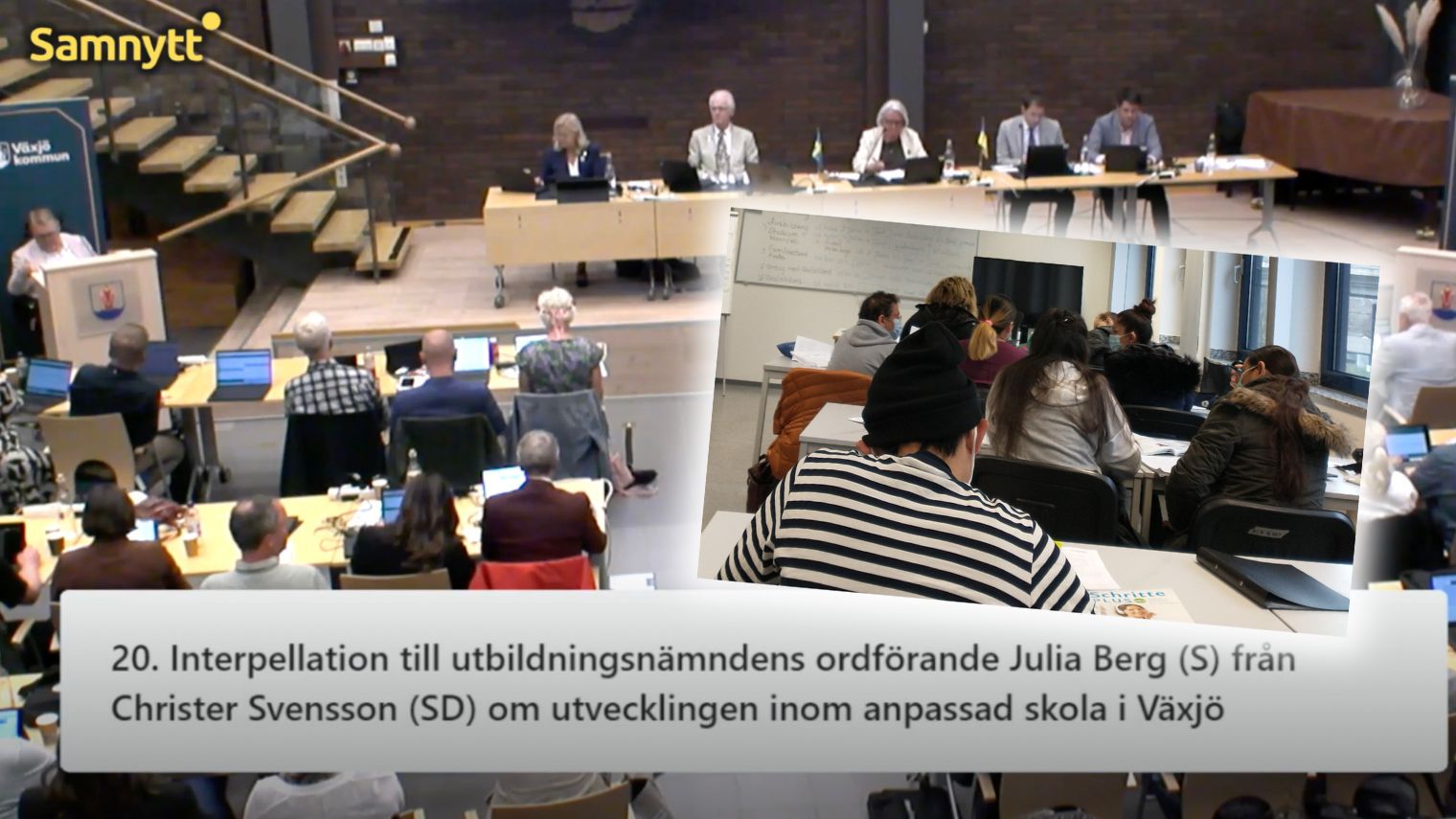
A debate in the Växjö municipal council has sparked strong reactions among politicians after representatives of the Sweden Democrats linked the increase in students in special education to migration and marriages between close relatives. The statement led to fierce reactions from several politicians, and the meeting was then interrupted after the chairperson of the municipal council chose to halt the ongoing debate, citing that it was considered bordering on incitement to hatred against a group.
The discussion arose during the council’s session on June 16 as politicians addressed issues related to developments in the school sector and the rising costs of special education.
During the debate, SD representatives presented the theory that demographic changes and certain family structures may help explain why more students are enrolled in special education today.
– Here, one might add that we Sweden Democrats rather believe that it is the result of cousin marriages across too many generations that is behind quite a lot, said the SD politician.
ALSO READ: The number diagnosed with intellectual disability is surging
The statements were immediately challenged by several other parties in the council. The criticism became especially pointed as the reasoning was elaborated on further during the debate, resulting in loud reactions from the audience and a temporary suspension of the meeting.
Several politicians described the statements as both unfounded and inappropriate. The critics argue that there is no support for drawing the conclusions put forth and instead emphasize that the increase in students in special education can be explained by changed assessment methods, improved diagnostics, and earlier identification of students’ needs.
Liberal Politician Raised His Voice at the Podium
One of the most critical voices came from the Liberal Party, whose representatives expressed serious concern about the tone of the debate. According to the party, such statements risk making future cooperation between the parties in the municipality more difficult.
ALSO READ: Children in special education are increasing – immigrant children heavily overrepresented
– To try to do this, to say we have more students in adapted primary and secondary school because of some who have immigrated here… that it’s their fault, that is astonishing and it’s offensive to have to hear this in 2026, shouted Gunnar Nordmark (L) from the podium.
“Worrying Genetics”
The debate escalated further when SD member Pernilla Wikelund defended her party colleague’s argument. Her statements were met with strong reactions in the chamber, and the discussion became so heated that the meeting was temporarily suspended.
According to Wikelund, there is reason to have a broader discussion about whether increased migration may have impacted developments within special education.
ALSO READ: Researchers warn: Sweden’s declining IQ threatens democracy
– Of course, there are gradations in the needs these children and young people have. And it’s no secret that we must be able to talk about all these needs and see the connections. If we look at animal breeding, we have to talk about troubling genetics that can arise if you cross, said Pernilla Wikelund.
Representatives of the Sweden Democrats have defended their reasoning after the meeting, stating that it must be possible to discuss all factors that may influence developments in schools.
The party maintains that their intention was to raise issues that they believe need closer analysis, not to point to a single explanation for increased costs or student numbers.
ALSO READ: Immigrant students heavily overrepresented in special primary school
S: “Borderline Incitement to Hatred Against a Group”
Rose-Marie Holmqvist (S), chairperson of Växjö municipal council, chose not to allow the debate to continue when it was time to resume, instead ending it entirely.
– I believe it has degenerated completely and I intend to end this interpellation debate now. Those on the speakers’ list will not get the opportunity since it is closed. Because I consider this a borderline case of incitement to hatred against a group.
SD politician Alexander Harréns urged Rose-Marie Holmqvist (S) to allow space for democratic conversation, even on topics perceived as controversial. The proposal, however, found no support from the Social Democrat.
– Everyone has the right to speak and everyone has the right to say what they think, but there is a limit, and here it was reached for me. That is why I have decided this interpellation debate is closed from now on.
Watch the Debate:
The discussion on this topic begins approximately 2 hours and 42 minutes into the webcast.