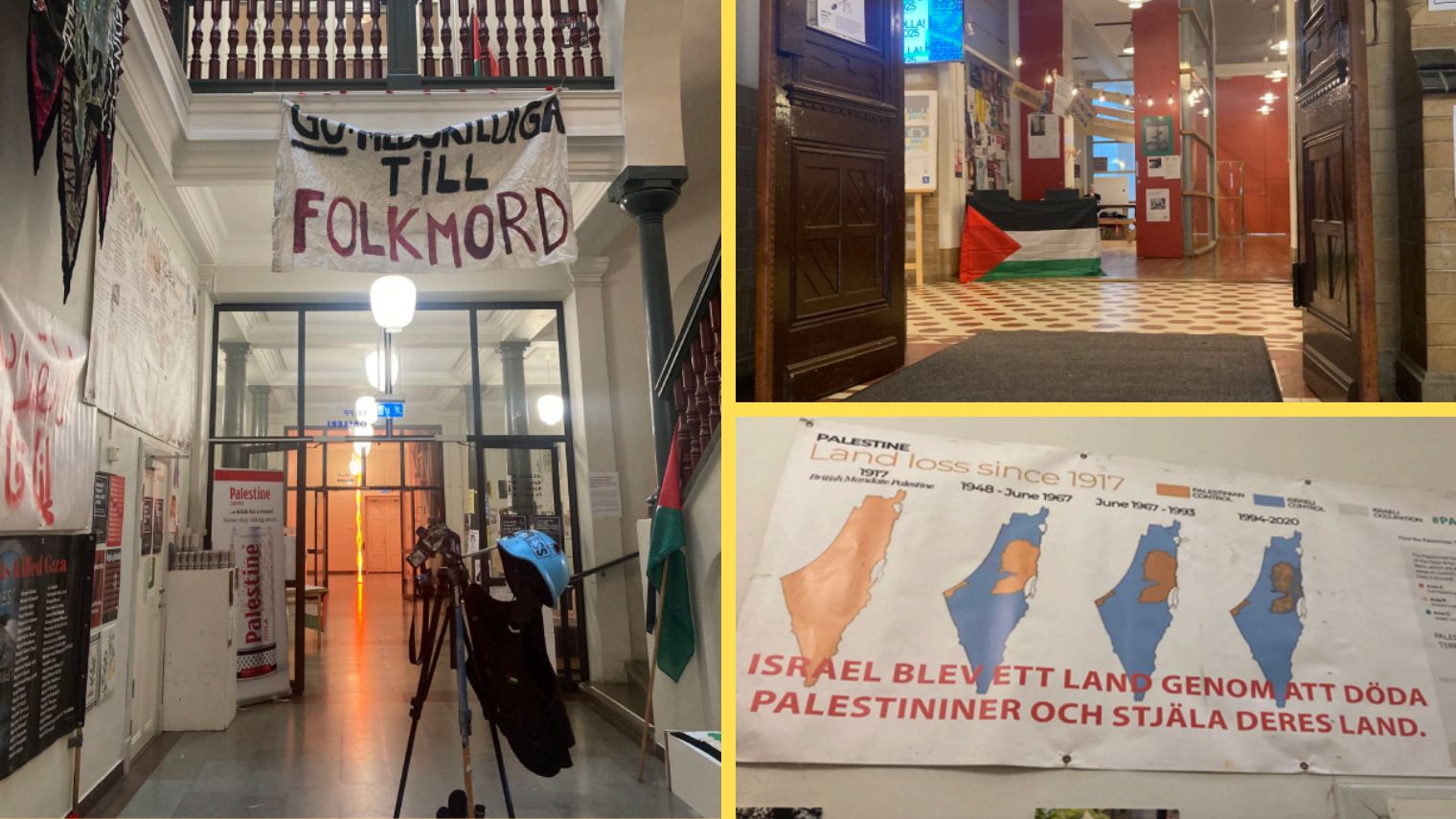
A student association at the University of Gothenburg organized an exhibition expressing solidarity with the Palestinian territories and criticism of Israel. Following a complaint to the Parliamentary Ombudsman (JO), the university has been found lacking in objectivity and impartiality.
It was in March last year that HDK-Valand, an institution within the University of Gothenburg, was taken over by the pro-Palestinian activists who had previously occupied Vasaparken. Messages relayed included statements denying Israel’s existence, claims that ‘Palestinian fighters’ participated in the massacre on October 7, 2023, and allegations that the university is complicit in genocide. ‘Kristersson’s racism kills’ was written on one of the signs.
People who regularly visited the premises testified about spaces filled with pro-Palestinian messages and slogans and a work environment increasingly characterized by insecurity and fear. Students exerted pressure and acted threateningly toward those not interested in participating in the protests.
READ ALSO: Pro-Palestinian activists allowed to take over university premises — have taken over completely
HDK-Valand describes itself as ‘one of the Nordic region’s leading environments for artistic education and practice-based research,’ where ‘design, film, photography, fine art, crafts, literary composition, and teacher education meet in an open and non-hierarchical environment where courage, curiosity, and co-creation drive both education and research forward.’
In the complaint from the Central Jewish Council, which Samnytt has reviewed, it was noted that the disturbances in the premises would not have been possible without the consent of leading officials. As a result, students, teachers, and visitors got the impression that the authority was behind these messages. Since no attempts were made to balance or nuance the messages, the impression was also that there was active approval of the statements.
The complainant questions whether the authority fulfills the requirement for objectivity and impartiality according to Chapter 1, Section 9 of the Swedish Instrument of Government (RF).
Artistic and political stance
The university stated, among other things, that it is part of the institution’s regular activities to allow the democratically structured local student union, Konstkåren, to use the premises for, among other things, gallery activities. The exhibition ‘constituted an artistic and political statement by a student group.’
To not allow student exhibitions because the exhibition involved an artistic and political statement, as part of a petition against the institution and the university, would have been a deviation from existing routines. It was considered that this could contravene requirements for objectivity and impartiality, as well as potentially limit students’ freedom of expression. HDK-Valand’s management considers that the institution acted in accordance with fundamental principles of freedom of expression, academic and artistic freedom, while also respecting the principle of objectivity and impartiality.
Not a public place
In several decisions, JO has found that a school cannot be considered a public space, and that freedom of expression does not entail any right for citizens, or associations thereof, to access a school to disseminate a message there.
The JO’s investigation found that the exhibition had been accessible to at least all students as well as teachers and other staff at the institution, and the gathering cannot be said to have been organized solely for members of Konstkåren. Thus, there was no obligation for HDK-Valand to provide the premises under Chapter 1, Section 13 of the Higher Education Ordinance.
READ ALSO: Researchers at the University of Gothenburg attack the Sweden Democrats
Even though there was no obligation, JO notes that HDK-Valand still had the right to allow the student association to use its premises. However — if an institution chooses to let, for example, student associations use its premises, it must do so in an objective and predictable manner.
Staff took a stance
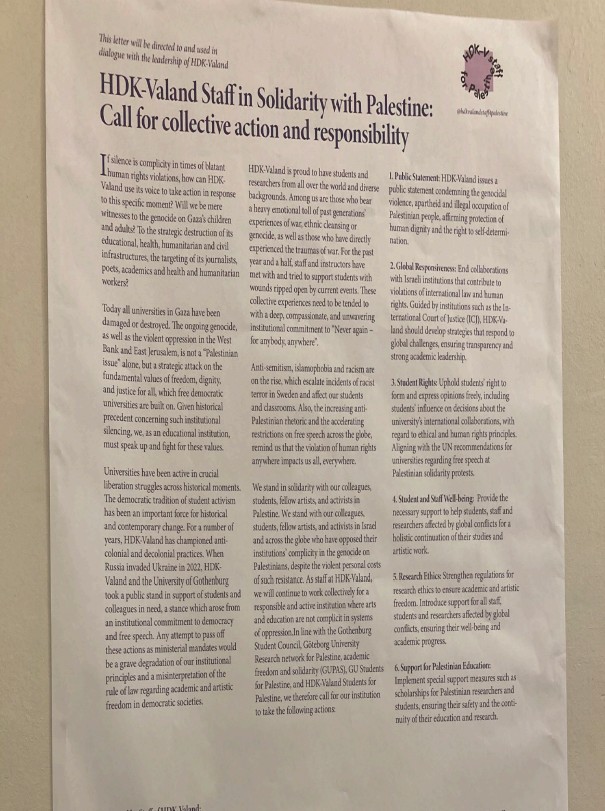
When an authority has given space for others to express opinions, it is up to that authority to clarify that the remarks expressed do not represent its own position. Adjacent to the exhibition, a letter was posted signed by around 60 members of staff from the institution. In this letter, the signatories, like the exhibitors, took a clear stance for the Palestinian territories.
Although it is permissible for some employees to put up such a notice, JO argues, it simultaneously increases the risk of misunderstanding about who is the sender of the rest of the similar messages.
Lack of objectivity and impartiality
In the decision, Chief Parliamentary Ombudsman Erik Nymansson states that there was a risk that, at least from the outside, it could appear that HDK-Valand stood behind the exhibition.
‘In my opinion, the authority has therefore lacked objectivity and impartiality. The University of Gothenburg thus cannot escape criticism,’ is the final judgment.
Nymansson adds that he wants to emphasize ‘that it is absolutely crucial for public trust in authorities that there is no doubt as to their adherence to objectivity and impartiality.’ He also points out that the constitutionally enshrined principle of objectivity ‘places high demands on authorities in this regard, and I expect the university as a whole to act with greater clarity in similar matters in the future.’
READ ALSO: University of Gothenburg offers training in Arabic writing