
As a registered job seeker, the man sent several emails to the Public Employment Service. However, the agency grew tired of the emails, considered them harassment, and urged the man to stop. Now, the Public Employment Service is facing criticism from the Parliamentary Ombudsman (JO).
The case concerns a man who was registered as a job seeker with the Public Employment Service. In April 2025, he requested access to all documents concerning himself over a specific period. The background was, among other things, that the Public Employment Service had deregistered him as a job seeker, something the man claimed had happened even though he had not indicated he wished to be deregistered.
The request for documents was sent to the Public Employment Service’s main registration office on April 25, 2025, and was forwarded the same day to a local office. But, according to the agency’s own statement, work on releasing the documents did not begin until November 14—more than six months later.
READ ALSO: Investigation: Public Employment Service squanders billions
JO concludes that the delay is unacceptable and not in accordance with the requirement for prompt handling of requests for public documents.
The man later reported that he only gained access to some of the requested documents on May 7, 2026—more than a year after his original request. JO writes that such handling would hardly be acceptable and notes that what happened is highly remarkable.
The decision to deregister the man as a job seeker is also criticized. In February 2025, the Public Employment Service notified him that they were considering deregistration and gave him the opportunity to comment. The man replied on two occasions that he wished to remain registered. Despite this, the agency decided on March 12 to deregister him, stating as justification that he himself had indicated he no longer wished to be registered.
Several Deficiencies
JO observes that several shortcomings occurred. For example, the decision lacked information about which regulations had been applied, and it had been signed by a caseworker who was not involved in the actual decision. JO describes the handling as an example of carelessness and neglect that should not occur within a government agency.
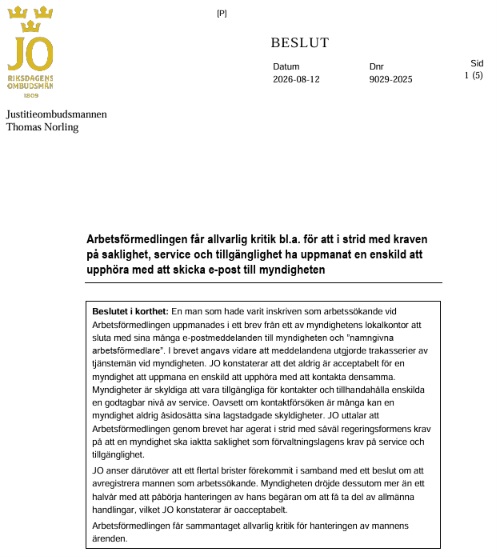
Perhaps the most noteworthy part of the decision concerns the man’s extensive email contacts. On May 27, 2025, a local office sent a letter urging him to stop sending many emails to the agency and to named employment officers. The letter described the messages as harassment of civil servants.
JO determines that it is never acceptable for an authority to urge an individual to refrain from contacting the agency. Even if someone contacts an agency many times, the agency is obligated to be accessible and provide an acceptable level of service.
Deserves Serious Criticism
JO also believes that the characterization of the man as harassing officials was inappropriate. According to JO, such a claim is likely to have caused the man discomfort and cannot be used to justify the agency ceasing contact with him.
In summary, JO concludes that the Public Employment Service, in two instances, acted in violation of the constitution and that the agency deserves serious criticism for its handling of the man’s cases.
JO also refers to two other recent decisions in which individual employment officers have been criticized for shortcomings in their dealings with job seekers and says there is a need within the agency to strengthen knowledge about the requirements for public servants.