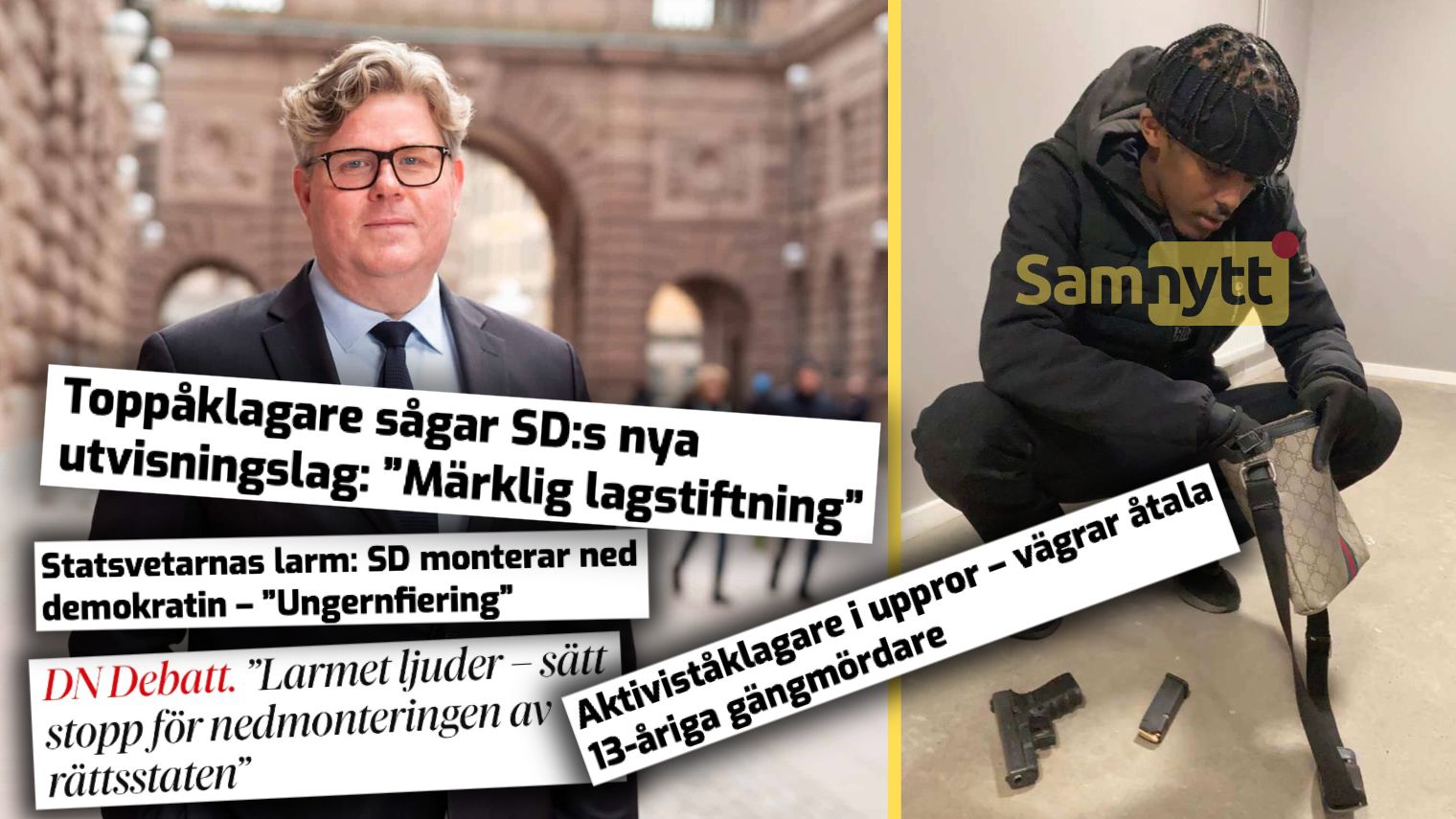
While some on the right argue that a true paradigm shift has yet to occur, voices from the left claim the opposite. Some go so far as to suggest that the Tidö government is dismantling democracy. Now Justice Minister Gunnar Strömmer responds to the criticism that has grown following the government’s many reforms, which aim to address, among other things, the growing gang crime with shootings and bombings that in recent years have spread widely on Swedish streets.
Justice Minister Gunnar Strömmer believes that the focus of the Swedish debate often misses the mark. According to him, it is not political reforms that threaten democracy, but the criminality itself.
“It is the system-threatening crime that endangers our freedom, not the shift in policy that is being made to combat it.”
READ ALSO: SD and the government will force prosecutors to deport criminal immigrants
In an op-ed in Dagens Nyheter on Tuesday, Strömmer states that this very perspective is often missing in Swedish debate. Instead, criticism has been directed at how the government pushes through reforms, with shorter investigation periods and directed inquiries pinpointed as risks to legal security.
Instead, it is claimed that the Swedish rule of law is threatened by short investigation periods and directed inquiry instructions, and that the government ignores critical points of view from referral bodies and the Council on Legislation. The criticism is sweeping and unfounded.
The government has, however, defended its approach by stating that the situation demands rapid action. One example is proposals that would make it possible for authorities to quickly remove criminal content from the internet. According to Strömmer, the work is being carried out both quickly and responsibly.
READ ALSO: Political scientists sound the alarm: SD is dismantling democracy – ‘Hungarianization’
At the same time, the government emphasizes that major reforms are being implemented in stages and with extensive preparation. Several measures are time-limited or subject to follow-up requirements, and a broad review of certain coercive measures is ongoing.
The criticism that the government is directing inquiries improperly is also rejected. According to Strömmer, investigators still have the ability to make their own assessments even when given clear directives.
In parallel, the government highlights reforms aimed at strengthening democracy in the long term, including increasing the independence of the courts, tightening protection against corruption, and strengthening protections for journalists.
READ ALSO: Activist prosecutors rebel—refuse to prosecute 13-year-old gang murderers
Despite fierce debate over whether these measures are wrong, the government points to concrete results. Deadly gang violence has decreased since 2022, and the lethal violence rate is reportedly the lowest in over a decade.
At the same time, problems remain and the work continues at a high pace to curb them. However, Strömmer is calling for a more nuanced discussion about the development of the rule of law.
The discussion would benefit from greater objectivity, fewer exaggerations, and a clearer distinction between personal opinions and the substantive issues of the government’s reforms.
According to the government, it is ultimately about protecting society—both by safeguarding democratic institutions and by combating the forces that threaten them.
The government also adapts its proposals to a high degree based on feedback from referral bodies and the Council on Legislation. But ultimately, it is the role of the government and the parliament to, within the framework of the constitution, consider the input received, weigh conflicting interests, and shape the legislation. That includes, for example, determining how high or low penalties should be in society. In this and several other issues, the government has made a different overall assessment than the Council on Legislation.
READ ALSO: Top prosecutors criticize SD’s new deportation law: ‘Strange legislation’