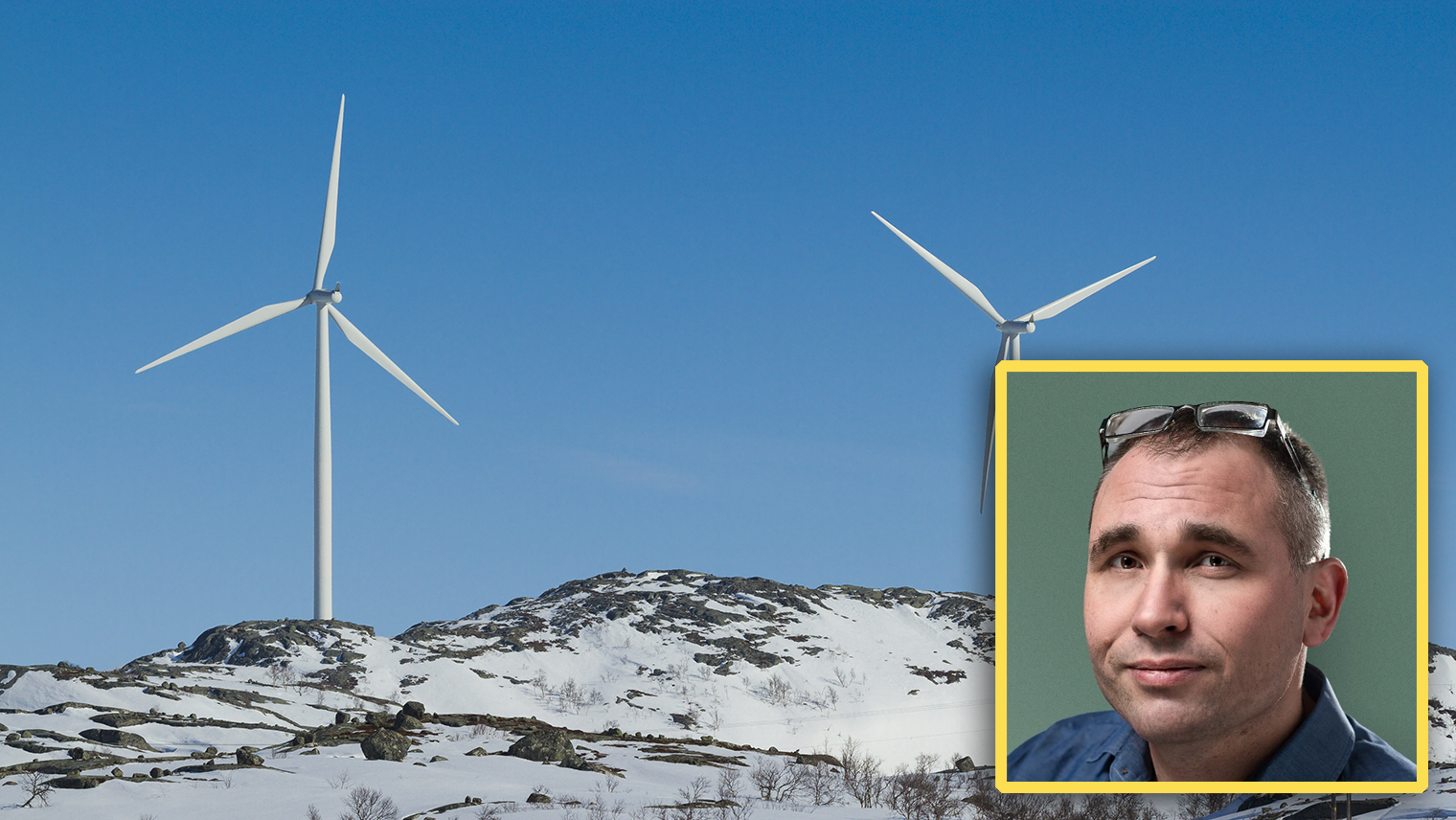
Sweden faces a massive planned expansion of wind power – but according to business economist Christian Steinbeck, it is neither necessary nor rational. On the contrary, he believes that the problems are already substantial: technical failures, economic losses, security risks, and growing public opposition. “It is hard to see why we need a single additional wind turbine,” he writes.
The expansion of wind power in Sweden has proceeded rapidly, especially in the northern parts of the country. According to business economist and wind power analyst Christian Steinbeck, the vision of ever-larger turbines has driven a development where facilities have increased both in height and geographical scope.
Highlight: Expansion is neither necessary nor rational. It only exacerbates already extensive problems.
In an opinion piece in Fokus, he points out that wind power already occupies a share of Sweden’s land area equivalent to that of the entire region of Blekinge. At the same time, the newest and largest turbines, often standing over 200 meters tall, are the ones exhibiting the worst problems.
READ ALSO: Economist: Wind power has made warmth at home a class issue
Examples Steinbeck cites include several highly publicized facilities – a turbine at Aldermyrberget that collapsed and was followed by bankruptcy, Hocksjön which only achieved just over half its estimated production, and Björnberget where extensive operational disruptions required costly and environmentally impactful replacement of rotor blades.
Technical issues and safety risks
A central part of Steinbeck’s argument concerns the limitations of the technology. The tips of the rotor blades move at speeds over 300 km/h, and according to Steinbeck, ordinary rain is enough to cause wear that, over time, can significantly decrease efficiency.
He refers to experiences from Spain where rain has reduced performance by half in just over a decade – and argues that Nordic conditions are far tougher. Snow, ice, hail, and temperature variations add further strain.
READ ALSO: Record production and record losses – researchers warn of a wind power crisis
According to Steinbeck, even minor icing can create imbalances in the up to 80-meter-long rotor blades. This, in turn, can lead to serious damages – or, in the worst case scenario, total breakdowns. He also describes risks of so-called “ice throw,” where large ice chunks that come loose can be hurled hundreds of meters.
Despite this, Steinbeck notes, wind turbines are often built close to roads and settlements. At the same time, many installations lack adequate safety features, such as sensors to detect hazardous conditions, which could have devastating consequences in an incident.
Lack of oversight and growing concern
Steinbeck also criticizes the lack of proper supervision. He believes there is no clear authority with responsibility for continuously reviewing the safety and function of wind power.
According to him, cracks in foundations appear after only a few years of operation, while local residents feel that no systematic inspections are being carried out. “Neighbors don’t wonder if, but when the turbines will fall,” he writes.
Produces electricity – when it's not needed
A recurring argument from Steinbeck concerns the fundamental logic of wind power – production is determined by weather, not by demand. When it is very windy, there is a surplus of electricity, which drives prices down. During certain periods, electricity prices have even been negative – 5 percent of the time in 2023 and 8 percent in 2024. Producers are then often forced to shut down turbines.
READ ALSO: Research alarm: Health hazardous levels of infrasound from wind power
When demand, instead, is at its highest – cold winter days – the turbines often stand still. According to Steinbeck, this creates a systemic problem where more wind power does not lead to improved electricity supply, but rather to greater imbalances.
The finances “can only be described as disastrous”
Steinbeck is particularly critical of profitability. He describes the economics of wind power as “disastrous” and points out that the business model is fundamentally problematic.
In a previous analysis with Associate Professor Christian Sandström, also referenced in this article’s background, 240 wind power companies together reported losses in the billions. The average profit margin was minus 51 percent.
READ ALSO: Politicians trained in wind power – the wind industry’s own PR agency leads the course
Even state-owned actors are running at a loss. Yet expansion continues – something Steinbeck claims is driven more by green political ambitions than genuine market demand.
He also notes that investments are often irresponsibly financed by pension capital and government funds, even though private investors are hesitant in many cases, which should signal caution with retirees’ and taxpayers’ money.
More wind power – despite declining demand
According to Steinbeck, Sweden’s electricity consumption has dropped by about 10 percent since the turn of the century. Despite this, a significant wind power expansion is planned, tied to the green transition.
However, several of the major industrial projects that would justify increased electricity production – like battery manufacturing and fossil-free steel – have faced considerable problems or delays.
Continuing to expand wind power under these circumstances therefore seems difficult to justify, according to Steinbeck – especially as the planned increase in capacity may require investments of an entire Swedish state budget in magnitude.
Growing resistance – and economic incentives
While expansion continues, local opposition is increasing. Previous reporting shows that the government now wants to introduce financial compensation for those living near wind turbines – up to SEK 38,000 per year, tax-free.
READ ALSO: Wind power is stagnating – now Swedes are to be bribed to accept the turbines
Critics see these incentives as evidence that acceptance for wind power expansion is low. According to this analysis, many local residents report noise, disturbances, falling property values, and lack of influence.
Steinbeck’s arguments on unprofitability and systemic issues reinforce the image of an energy source that is not only technically challenging, but also socially and economically controversial.
“Hard to see the need”
Although wind power today has a theoretical annual production of around 53 TWh – which according to Steinbeck exceeds nuclear power’s production – he believes the benefits are limited because production does not coincide with demand.
His conclusion is clear: “It is hard to see why we need a single additional wind turbine.” According to Steinbeck, further expansion is more likely to worsen existing problems rather than solve them – both for the electricity system and for society at large.