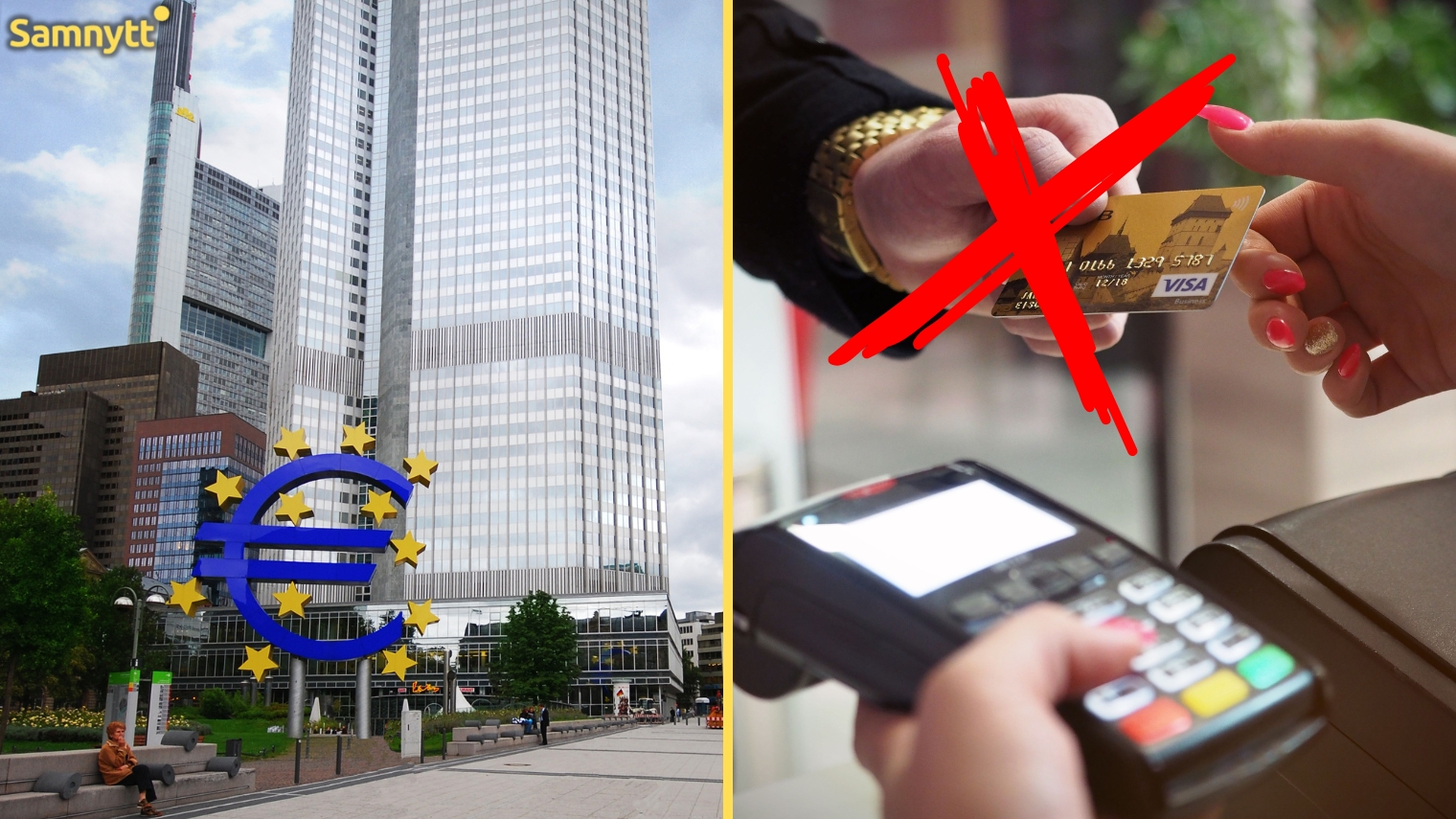
The EU wants to reduce Europe’s dependence on American payment giants like Mastercard and Visa. A digital euro and new European payment solutions are intended to give the union greater control over how people and businesses pay.
Today, Mastercard and Visa account for about 61 percent of card payments in the euro area and nearly all cross-border card payments, according to the European Central Bank (ECB).
This has made payment infrastructure an increasingly important issue for European independence. The ECB has warned that reliance on foreign payment systems can make Europe vulnerable to political pressures or disruptions.
A central project is the planned digital euro. It will be an electronic form of euro issued and guaranteed by the ECB, intended to complement cash and current banking services.
READ ALSO: EU takes a big step towards a digital euro – aiming to reduce dependence on the USA
The digital euro is intended to be usable both online and offline. According to plans, a pilot project will start in 2027, and the system should be ready for regular payments by 2029.
ECB board member Piero Cipollone has described the need for a European payment solution that can be kept under European control.
“All these potential geopolitical tensions and the transformation of every existing instrument into a weapon clearly increase the risk level,” he told Spain’s El País in January and continued:
“It strengthens the need for a European payment system that meets all needs and is built on European technology and infrastructure; in other words, a system that is entirely under our control.”
ECB president Christine Lagarde has also highlighted the issue of European independence.
“We mainly rely on American, but sometimes also Chinese, networks to process payments. We need a European solution because we want to be sovereign at home,” Lagarde told Euronews in July.

Several Alternatives Emerging
Meanwhile, private European payment solutions are emerging. The European Payments Alliance, EuroPA, and the European Payments Initiative (EPI) have entered an agreement to interconnect their systems. Together, the solutions could reach around 380 million users in 15 European countries.
Among the systems are Norwegian Vipps MobilePay, Spanish Bizum, Italian Bancomat, Polish Blik, and Greek IRIS. EPI’s payment solution Wero is used in Germany, France, Belgium, the Netherlands, and Luxembourg, among others.
READ ALSO: EU slows down the bank Revolut – because the company is growing too fast
The goal is that, in the future, users should be able to pay across borders with their regular payment apps, similar to how mobile telephony works through roaming.
Developments are also taking place outside of Europe. In Brazil, the national payment system PIX has had a huge impact and, according to the country’s central bank, accounts for 54 percent of all transactions.