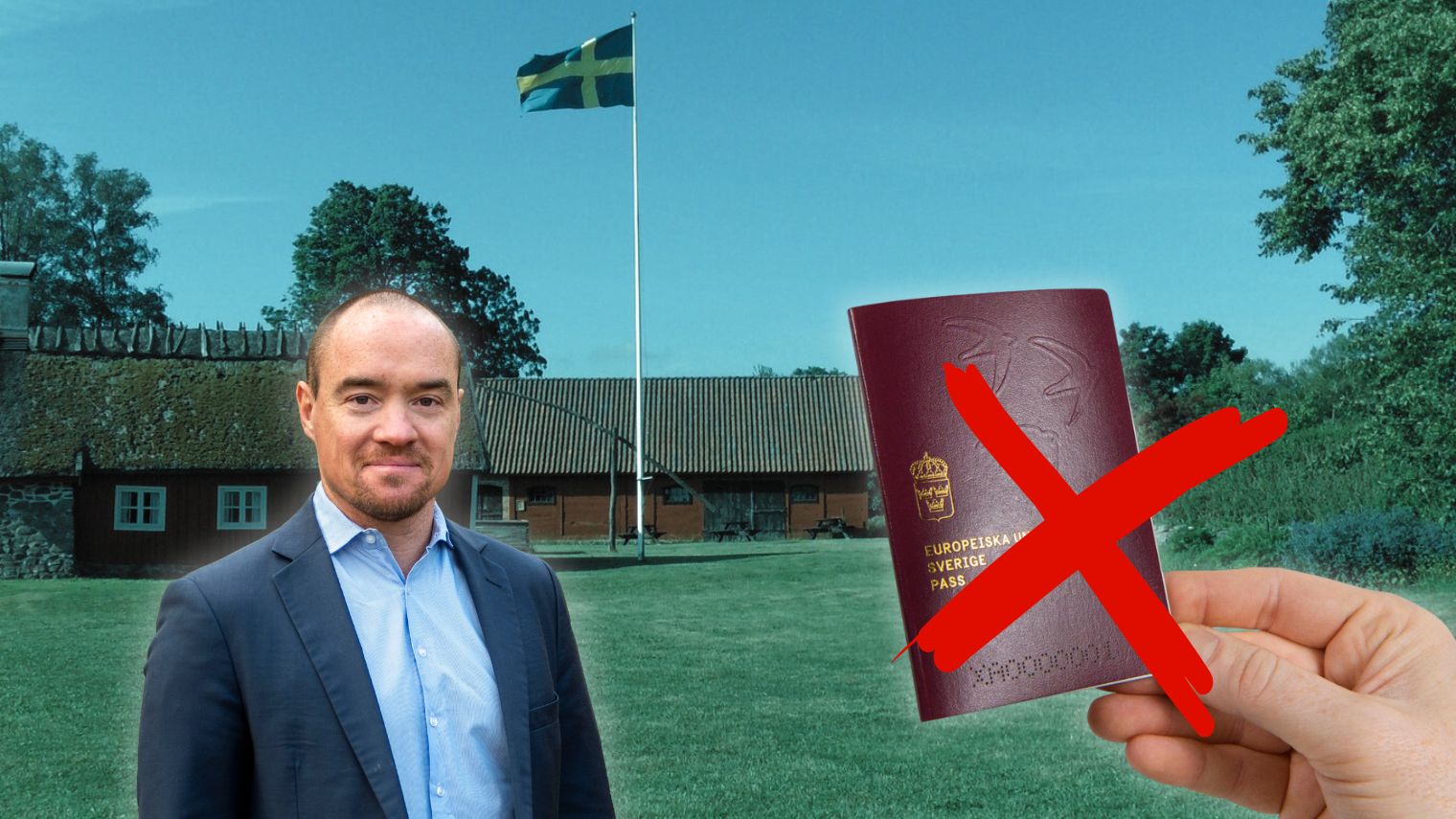
EDITORIAL • Why is citizenship handed out at all, really? In Sweden, it is seen as a right just because someone has spent a short time here, even if they come from Farfarawaystan. The only reasonable approach should be that naturalization is only offered to people within a clearly defined circle of countries where Sweden has full trust in identity, legal cooperation, and repatriation—and, in extremely rare cases, to individuals outside that circle who can demonstrate exceptional benefit to the country. Anything else is a continuation of the routine that has, for decades, diluted what it truly means to be a Swedish citizen.
Today, the passport is handed out in tens of thousands of cases every year after what is, in practice, a fairly brief stay and a superficial civics course. The result is a citizenship that no longer signals deep belonging, loyalty, or shared values, but rather is an administrative stamp for permanent residency. It’s time to break that trend. Swedish citizenship should not be an integration perk handed out on an assembly line. It should be a privilege earned under very strict, long-term conditions.
The Tidö parties, led by the Sweden Democrats, have taken welcome steps in this direction during this term, most recently in February when a number of tightened measures were introduced.
But Sweden needs to fundamentally embrace a completely new view of citizenship. A model that moves away from the reflex that everyone who sets foot here should gain ownership over part of the country.
Threshold 1 – Eligibility: Who Can Even Apply?
Sweden should introduce an official list of “states with verifiable identity and legal cooperation”—in short, a “Trusted Countries” list. The criteria should be technical and measurable:
- Stable democracy with free and fair elections (according to established international indexes).
- Low corruption and a functioning rule of law.
- Robust population registration and reliable identity documents.
- Current readmission agreement (the country takes back its own citizens when needed).
- Security vetting without systematic risks of identity manipulation or parallel loyalties.
The list is determined by the government, updated annually and presented openly. Only citizens from these countries—or, in very rare exceptional cases, individuals from outside the list who can document extraordinary benefit to society (e.g., world-leading researchers, critical expertise in defense, or strategic investors)—should even be able to begin a naturalization process.
This would exclude the majority of countries from which Sweden has, over the past 40+ years, received immigrants who became citizens. Such a change would be a pragmatic protection: a modern state governed by the rule of law must be able to trust that those who become part of the population are truly who they say they are, and that their home country will take the person back if the conditions are no longer met.
Threshold 2 – Qualification: What Does It Actually Take to Get It?
For those who pass the eligibility threshold, the requirements should be significantly raised—without compromise:
- At least 12–15 years of continuous residency in Sweden (exceptions only for special reasons).
- Documented Swedish language skills at an advanced level (B2/C1 according to CEFR), with both oral and written examination.
- A truly challenging civics test that examines knowledge of the Swedish rule of law, constitution, obligations to society, and historical values—not just symbolic multiple-choice questions.
- Full self-sufficiency for at least 5–8 years without welfare support (clear exceptions only for serious illness or accident).
- Spotless record of conduct: no serious intentional crimes, no repeated disturbances of public order, no systematic links to clan structures or honor norms that conflict with Swedish law.
- Debt-free status to the state and no major payment defaults.
- A discretionary final decision where the state may grant citizenship after an overall assessment—citizenship is a privilege, not a right.
Powerful Effect
This model would have a powerful impact: the number of naturalizations would drop dramatically, especially among groups where integration outcomes have historically been weak. At the same time, incentives for real assimilation would increase markedly. Those who truly want to become part of Swedish society at a deep level would have clear, long-term goals to strive for—and those who do not would retain their permanent residence permit without automatically obtaining political influence through the right to vote and a passport.
It is worth noting that a person can live, reside, work and thrive like anyone else even without citizenship. Access to the whole of society can still be given, as access to the welfare system is made dependent on contributions. I have met several people, including an American, who have lived in Sweden for 30 years with a residence permit but without applying for Swedish citizenship—without this being any problem at all.
Sweden is not the United Arab Emirates. We are not building a system where 90 percent of the population lives as guest workers without political rights. But neither do we need to continue with the current model where citizenship has lost its significance as a symbol of mutual loyalty and responsibility.
The government has already begun to move in the right direction with proposals for longer residency requirements, self-sufficiency requirements, and stricter conduct reviews. But in reality, we need to go much further. Stop handing out citizenships as a matter of routine. Clearly define who can even qualify. Raise the bar so high that only those who have truly integrated reach it. Other countries can do this successfully.
With a new approach, where we more clearly identify which other nationalities may be welcome, we can minimize unreasonable deportations, such as that of the Ukrainian nurse Lena, or Jonathan’s Ukrainian wife.
Swedish citizenship is worth protecting. It is worth making rare again. It is time to reclaim the privilege—before it loses all meaning.
READ ALSO: Ekeroth: “Citizenship is just a piece of paper—we can tear it up”