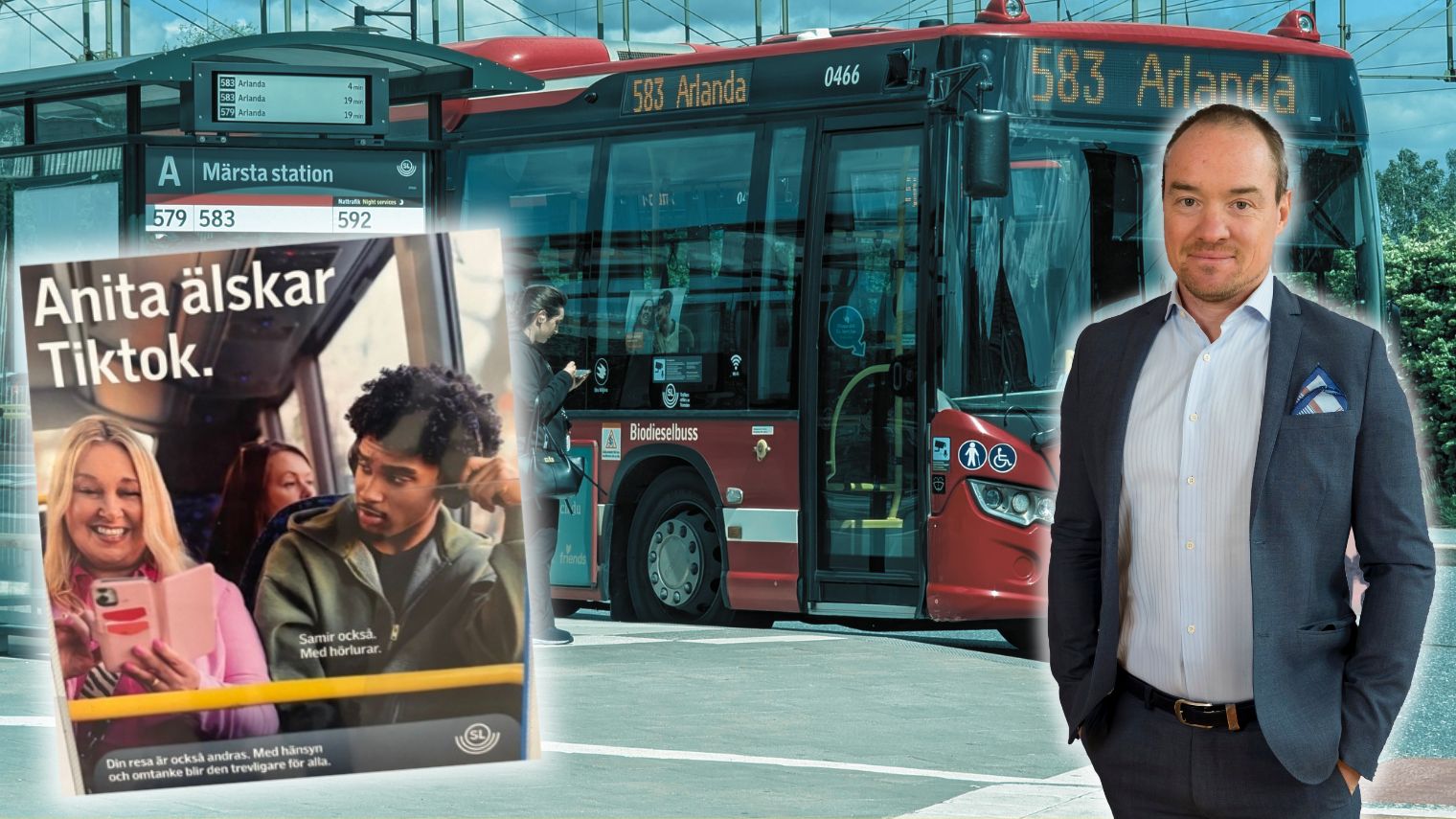
EDITORIAL • So it has happened again. A reality-detached player — this time SL (Stockholm Public Transport) — has come up with the genius idea of launching an information campaign to reduce disturbances in public transport. But instead of sticking to a version of reality that most would surely recognize, a white, middle-aged Swedish woman is singled out as the problem in this context.
Samnytt recently reported on SL’s campaign attempting to address the issue of passengers disturbing others by playing videos and such on their phones. But someone in the PR department came up with the idea of casting a white, middle-aged woman, “Anita,” as the troublemaker in the campaign, while the silent person being disturbed just happened to be a “Samir” with a migrant background.
The campaign has sparked justified indignation in Sweden, but perhaps even more so resulted in ridicule on social media, since it so clearly deviates from the image most Swedes have of public transport travel.
READ ALSO: SL Campaign: Swedes Disturb in Public Transport
The campaign has sparked justified indignation in Sweden, but above all it has led to scorn on social media, because it clearly departs from the general perception Swedes have of traveling by public transport.
“At this point it must be a joke,” one person writes.
A Norwegian journalist points out that he’s commuted on public transport in Oslo for twelve years without ever encountering an “Anita” as the problem.
Another account shared what the user claims is a “correct” image based on what people actually experience in public transport:
Erik Dahlin, who calls himself a “right-leaning social commentator,” congratulates SL’s communications director for the campaign’s international reach. Elias Linder wrote that “Goebbels would have been proud.”
And it’s easy to understand people’s reactions.
What we’re witnessing is not exactly the first time that a government agency, a politically correct company, or similar has taken a widely recognized phenomenon and tried to reshape it into something that better fits the multicultural paradise they pretend exists.
Reminiscent of a German PC Campaign
SL’s campaign is simply the latest in a long line of similar examples from Swedish authorities and big companies. Instead of describing reality as thousands of travelers experience it every day, they create an alternative narrative in which Swedes themselves are the problem.
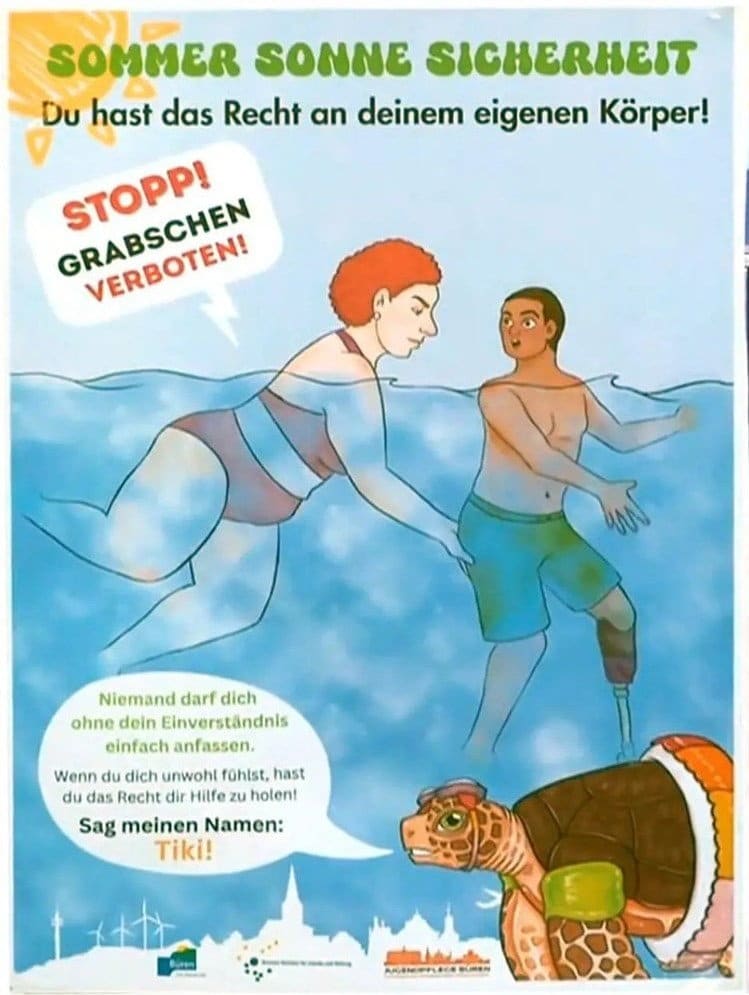
In Germany, an information sign about groping at public outdoor pools has attracted a lot of attention. In the campaign, white women were portrayed as the problem in the pools, and it was suggested that it was migrants who were subjected to abuse at these swimming venues.
READ MORE: White Woman Gropes Black Disabled Boy in Campaign Against Harassment
Anyone following the reporting knows, however, that it has often been groups of migrants responsible for such incidents — something that has, for the first time, led municipalities to put up signs to clearly display unacceptable behavior.
In a campaign from the town of Büren in western Germany, the problem was portrayed as a white woman groping a disabled migrant. The sign informs: “Stop! Groping is forbidden.”
The Emperor’s New Clothes
Just as when the police and municipalities for years have talked about “male prejudice,” “racism,” and “prejudices against suburbs” instead of openly pointing out the explosive gang crime mainly perpetrated by young men with foreign backgrounds. Or when municipalities display slogans like “Together Against Alienation” and parade nice multicultural events, while parallel societies gain strength, with their own norms, clan structures, and no-go zones where Swedish law no longer fully applies.
The same pattern shows up in commercials from large companies like H&M, IKEA, or banks, where the “typical Swedish family” is now almost always presented as a perfectly multicultural mix with a Swedish woman, a non-Western man, and children of every skin color — an image in sharp contrast to both population statistics and how most Swedes actually live. Statistics from Brå, SCB, and police reports tell a very different story about crime, alienation, and cultural divides, but that story never appears in official campaigns.
READ ALSO: IKEA’s New Islamization Campaign — Normalizing Veiled 11-Year-Olds
This is the emperor’s new clothes, Swedish public edition: everyone sees that the emperor is naked, but only the brave — or those who no longer care about being labeled “racist,” “xenophobic,” or “unconcerned” — dare to say it out loud. SL has now chosen to join the chorus that would rather blame ordinary Swedes than acknowledge the patterns of ethnicity, culture, and group behavior that actually create insecurity on our public transport, in the suburbs, and in society at large.
As long as authorities, regions, and big companies prioritize virtue signaling, diversity ads, and escapism over honest portrayals of reality, trust in them will continue to plummet. The campaign with Anita is not an isolated mistake. It is a symptom of a deeper crisis: an elite that has lost touch with the reality in which ordinary Swedes live.
READ ALSO: Ekeroth: “Culture Matters — even on the Bus”