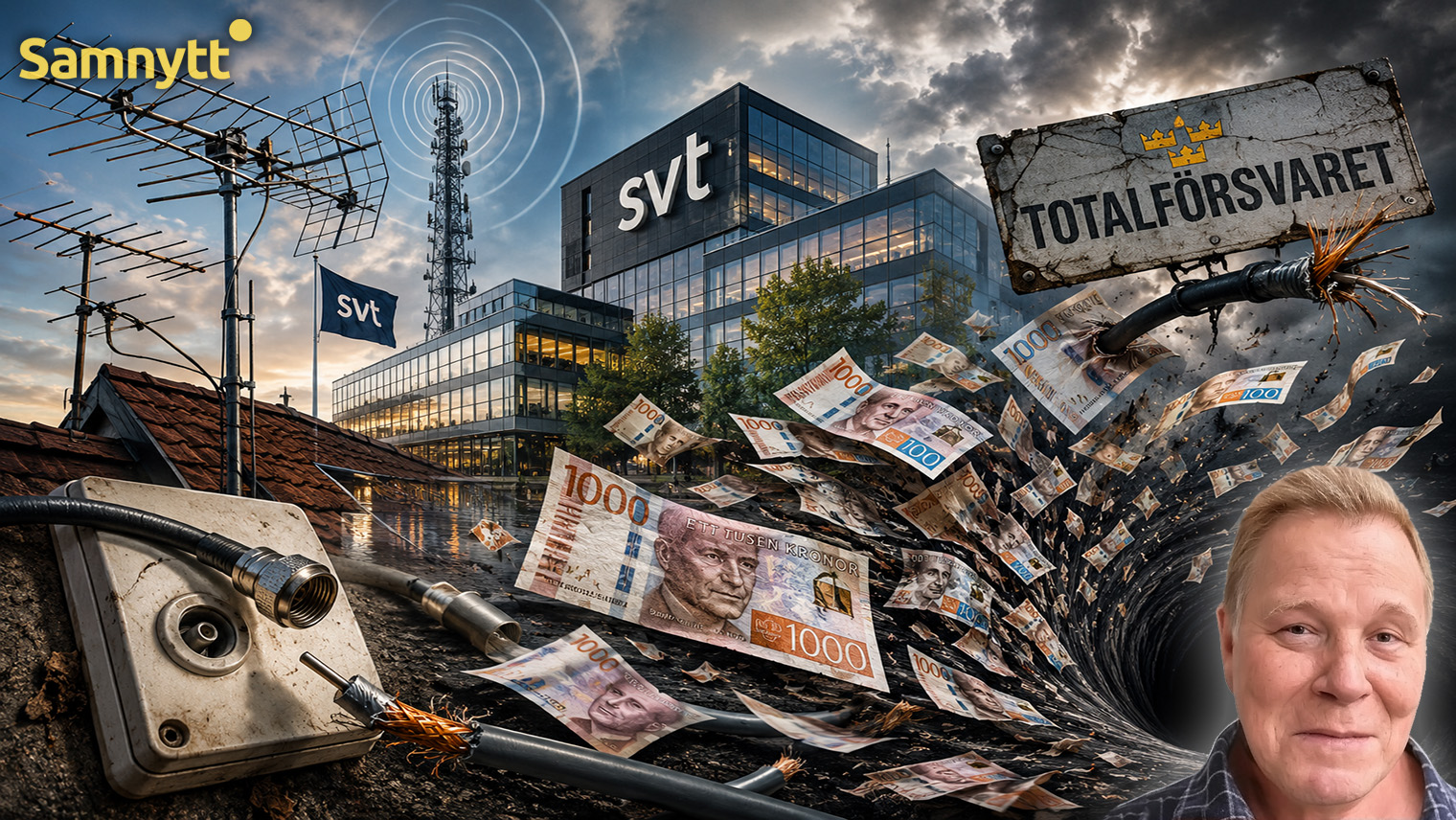
EDITORIAL • The problem at SVT is not mainly about “cutbacks” or the Tidö government betraying public service. The real problem is that the state still forces SVT to spend hundreds of millions of kronor on a terrestrial TV network that almost no one uses anymore. Politicians, public service management, and much of the media are avoiding the real discussion — why public service television should continue to fund a technically and economically obsolete system while journalism and content are deprioritized.
During the spring, Swedes have been fed alarmist reports about “cutbacks” in public service. Former SVT personalities warn in open letters about the decline of journalism, “selfie-journalism,” an eroded democracy, and a future where in-depth reporting is replaced by quick web clips and studio chat.
The message to the public is clear – the government is betraying public service and the consequence is a worse SVT. But this is a gross oversimplification and, in several respects, a directly misleading description of reality.
SVT’s fundamental problem is not that the Tidö government has cut funding – for the simple reason that it hasn’t. The root issue is that politicians, public service executives, and significant parts of the media landscape have for years refused to address a much bigger and more uncomfortable question – the money-draining terrestrial TV network that has effectively become obsolete but is still kept alive at enormous cost.
READ ALSO: SVT profiles rage over cutbacks: “It’s about democracy”
This is the construction that SVT is now stuck with, like a hot potato, at the tidy sum of 375 million kronor including VAT. And it is public service viewers who foot the bill—in the form of poorer content, cutbacks, and continued political smoke screens.
Some people might say they couldn’t care less about SVT’s finances and programming. But it is still your money being wasted on an outdated terrestrial network, and you’re misled into thinking it plays an important role in civil defense, when nothing could be further from the truth.
Savings Package – But No Funding Cuts
When SVT announced that the company had to save 355 million kronor, it was presented in practice as a result of withheld government funding. At the same time, the audience was told that “programming will be affected,” journalism is threatened, and democracy risks being weakened.
But what SVT, in its zeal to blame the Tidö government, is not clear about is that it still has an intact budget of over 5.5 billion kronor per year. So, it’s not about public service being “starved out.” It’s about the fact that hundreds of millions now need to be spent to keep alive a terrestrial network that almost no one uses anymore.
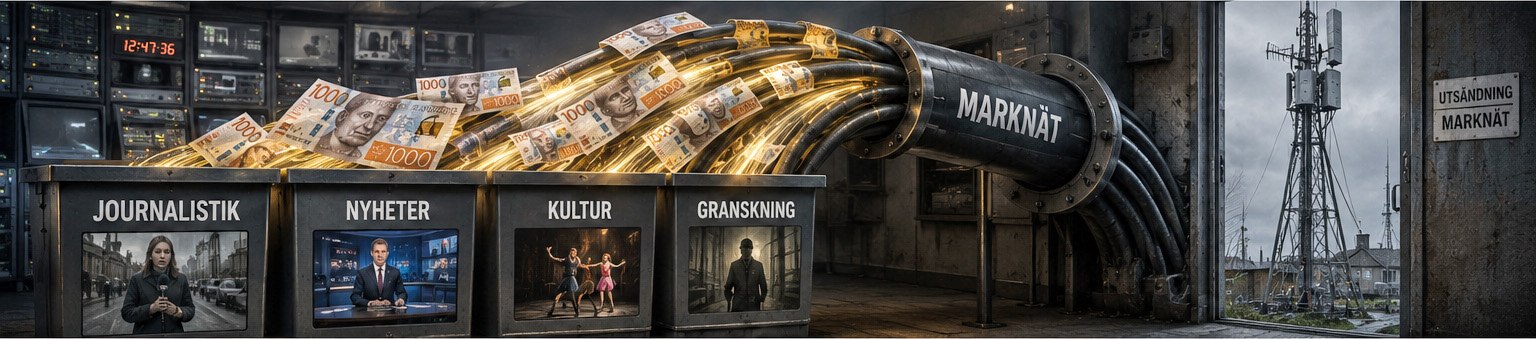
The central background is that TV4 has left the terrestrial network. As a result, the old commercial cost-sharing model—based on several players sharing the infrastructure—collapsed. SVT is left alone with the cost.
SVT management is right that this is economically unsustainable. But oddly, they do not publicly push the fundamental question—why should a modern public service company continue to finance a dying distribution system at all?
Instead, the public is treated to dramatic talk of “cuts,” creating the impression that the Tidö government has reduced funding for programming. But it hasn’t. It’s a political and communicative game aiming to create support for increased funding without seriously debating the root problem.
A Terrestrial Network That Has Served Its Time
The Swedish terrestrial network was once central social infrastructure. When the TV monopoly reigned, terrestrial television was the backbone of Swedish TV distribution. It made sense. In the 20th century, households had roof antennas, and apartment blocks had central antennas. There were few alternatives. The terrestrial network had an obvious function.
When TV4 was allowed in during the early 1990s and Teracom was created as a state-owned company, the model that shaped the system until recently was established – several players sharing the cost of the physical infrastructure.
READ ALSO: Major cutbacks at SVT
During the Boxer era, the model worked relatively well. Many commercial channels paid for spots in the network, and costs could be spread. But that world no longer exists.
Today, Swedes watch TV via fiber, streaming, cable TV, satellite, and internet-based solutions. Commercial players have gradually left the terrestrial network because the audience already did.
TV4 realized it. Boxer realized it. Other commercial players have realized it. But the state and SVT still pretend the terrestrial network is central modern infrastructure.
Less than four percent of households today use the terrestrial network as their only distribution method. Even that figure probably overstates the dependency considerably. Many are likely in groups who simply never bothered to switch—often older people or households that barely watch TV at all.
The state could solve this for a fraction of the cost via targeted support or technical help to the few who genuinely need it. Instead, hundreds of millions of kronor are spent annually to keep an increasingly irrelevant system alive.
Signals to Empty Antenna Sockets
Perhaps the most absurd aspect of this whole construction is the repeatedly cited figure that the terrestrial network reaches 99.8 percent of the population. It sounds impressive. The problem is that number is purely theoretical.
The state does not measure actual access in people’s homes. They measure that the radio waves theoretically reach geographically. If someone installs a modern UHF antenna on the roof, runs cable to the TV, and has the right digital equipment, the signal can be received. But this says nothing about how people actually live and consume media in 2026.
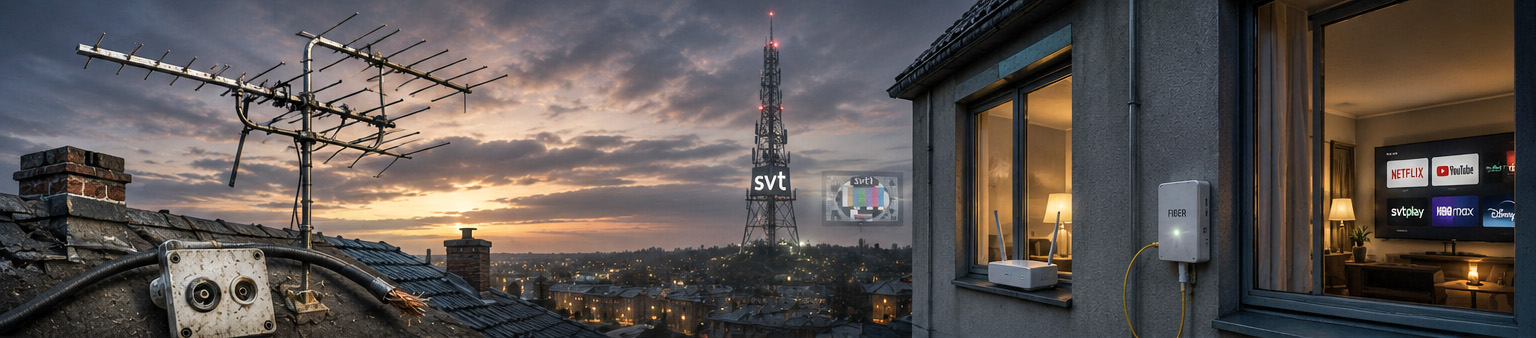
The vast majority of Swedish apartment buildings long ago dismantled or disconnected their old central antennas. Property owners have switched to fiber and cable TV. Many households no longer even have a functioning antenna socket.
Yet the state continues to talk about “99.8 percent coverage.” So, they send TV signals through the air to homes where the infrastructure to receive them no longer exists. It’s a system that persists, legally and bureaucratically, long after reality has changed.
Crisis Preparedness or Technological Nostalgia?
The strongest argument for keeping the terrestrial network is no longer TV viewership but civil defense. And that argument must be taken seriously. Proponents say the internet, mobile networks, and fiber are vulnerable to sabotage, cyberattacks, and war. The terrestrial network is described as a robust backup channel for public information and emergency alerts.
But then several very uncomfortable questions arise. If the terrestrial network is primarily a part of civil defense today—why should the cost burden SVT’s program budget? Why should journalism, culture, and content fund the state’s emergency infrastructure?
And if the terrestrial network is truly critical to society, why doesn’t the state ensure people can actually use it? The entire logic today relies on a bizarre pretend scenario where the state would hand out antennas and digital boxes to the population during war or societal collapse.
It’s hard not to see this as a case of technological nostalgia, political inertia, or simply not having anything better as a backup plan, rather than real, modern preparedness.
Societies sometimes have to accept that old technology has had its day. We no longer base the nation’s energy supply on gas generators in case oil imports stop. We don’t keep large emergency stocks of steam engines or horse-drawn farming equipment. At some point, the line must be drawn for TV technology too.
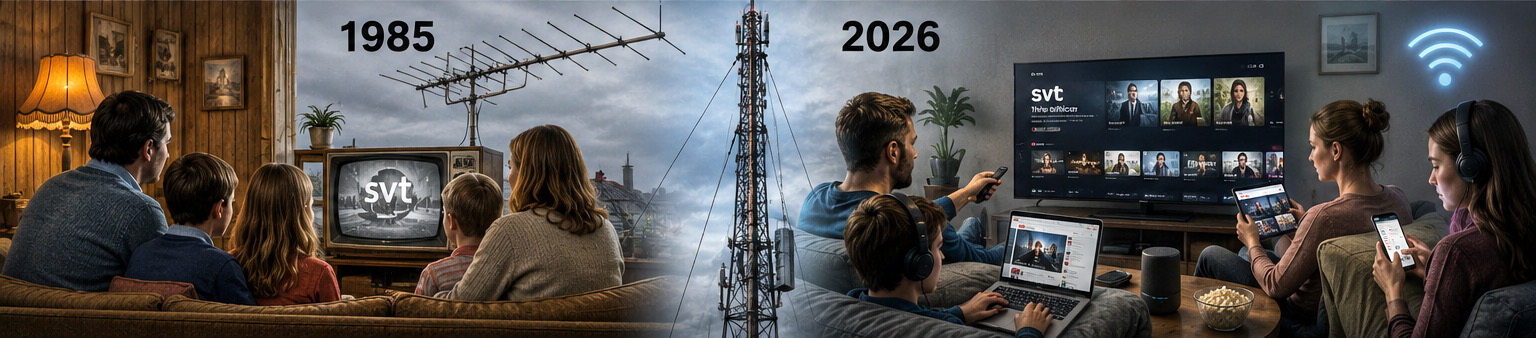
The hundreds of millions spent today on keeping the terrestrial network alive would do much more good if invested in a more robust internet, better backup power for mobile masts, safer fiber infrastructure, and modern digital redundancy. That would strengthen the whole society – not just give artificial respiration to an aging TV system.
Everyone Knows the Model Has Collapsed
What is most remarkable is that almost everyone involved seems to understand this already. TV4 left because the terrestrial network is no longer commercially relevant. The SVT management knows the cost is unreasonable. The politicians know the model is creaking. The opposition knows it. The government knows it.
Yet almost nothing happens. Instead, the problem is bounced between ministries, inquiries, and parliamentary terms. And no one says anything outside closed rooms, keeping the public unaware that they’re paying for something that serves neither media nor civil defense purposes.
The Social Democrats are now trying to use the situation to attack the Tidö government, but they were in power through the period when the collapse of the terrestrial network became increasingly apparent. They didn’t solve the main problem then either.
READ ALSO: SVT seizes the opportunity – demands more taxpayer billions
Nor have the red-green opposition parties presented concrete proposals to phase out the terrestrial network or permanently move the cost to civil defense. Maybe because a closer review would expose the terrestrial network’s inadequacy.
Meanwhile, the government seems to hope SVT will “reprioritize internally” within its multi-billion grants. They let the opposition’s blows land instead of striking back by speaking plainly and addressing the real problem.
The result is a political no man’s land where no one wants to take responsibility for officially declaring the system dead, to admit it’s a dead horse being flogged. Everyone knows the commercial logic is gone. No one wants to say it aloud.
The Media’s Strange Silence
Perhaps the most striking thing in this whole debate is how little these fundamental questions are discussed in Swedish media. When former SVT personalities recently wrote in Expressen warning of journalism’s decline, the absurd construction of the terrestrial network was not mentioned at all. Instead, there were dramatic depictions of “selfie-journalism,” posing reporters, and democracy’s breakdown.
But the real question is not whether Aktuellt and Agenda are being reorganized. The real question is why Swedish public service in 2026 should spend hundreds of millions on a distribution system the audience has already abandoned, and take on a civil defense responsibility that, when closely examined, is worthless—a waste of tax money. 375 million, to be exact.
It’s difficult to take the martyr rhetoric seriously when SVT continues to spend enormous resources—around half its budget—on entertainment, reality formats, comedy, light entertainment TV, series, and films. If public service really faced an existential threat to its core mission, the first reasonable step would be to reprioritize within the organization.
Must Public Service Do Everything?
There is also a larger principled question here which is almost never openly discussed. Why should a tax-funded public service company function as a broad entertainment concern at all?
The commercial media landscape today is enormous. Swedes have access to Netflix, YouTube, TV4, Disney+, Max, podcasts, social media, and an almost endless array of entertainment offerings.
What could possibly justify a taxpayer-funded public service today is not more lightweight game shows or reality formats. It is investigative journalism, public education, minority languages, societal coverage, culture, crisis information, and in-depth reporting.
If SVT management is serious about the threat to journalism, they should start there. You can’t simultaneously claim that democracy depends on public service while continuing to spend billions on content that commercial operators already produce in abundance.
READ ALSO: SVT demand: We must get more money from taxpayers
Nor is it at all obvious that the state should fund such a broad media operation through taxes. We don’t have state-owned, taxpayer-financed grocery stores, even though food is much more essential than TV entertainment. We don’t have public clothing chains, public mobile subscriptions, or state furniture stores.
In most areas, we accept that people use private services while society only steps in to help those who truly can’t manage on their own. But in the media sphere, it’s still treated as if it were 1975.
It Is the Terrestrial Network That Should Be Scrapped
The Swedish public service debate today is shrouded in strange smokescreens. Politicians blame each other. SVT blames the government. Former personalities warn of democracy’s collapse. But almost no one wants to speak plainly about the root problem.
The terrestrial network is no longer the distribution platform of the future. It is yesterday’s technology. And as long as politics refuses to admit this, taxpayers will continue to fund a system the audience has already left behind.
The result is that journalism, culture, and quality content are sacrificed to keep analog TV masts alive—masts that mainly exist because no one has yet dared to decide to dismantle them.
It’s not journalism that should be scrapped. It’s the terrestrial network.