DEBATE • Secret plots, hidden agendas, and “false flag operations” are themes often used for entertainment in film and literature, generally highly popular and marketable since people in general, and extremists/nerds in particular, seem to “love” uncovering underlying causal connections that overturn mainstream explanations.
In the early 2000s, the book “The Da Vinci Code” was published, selling millions of copies and catapulting author Dan Brown to stardom, with his subsequent books also becoming bestsellers. The book revolves around secret societies such as the Illuminati, Opus Dei, and the Priory of Sion, the latter reportedly comprised of blood descendants of Jesus Christ, who supposedly impregnated Mary Magdalene before his death, after which she bore a daughter whose descendants are said to be alive today.
Dan Brown’s book is based on a bestselling story from 1982 (non fictional?) about medieval French kings (Dagobert II and the Merovingians), the Knights Templar, hidden treasures, and Catholic orders, titled “Holy Blood and the Holy Grail,” which in turn originated from a fabricated myth created by the forger Pierre Plantard. So, it is all based on a hoax, yet the story remains very exciting and entertaining.
The Gulf of Tonkin Incident and Operation Ajax
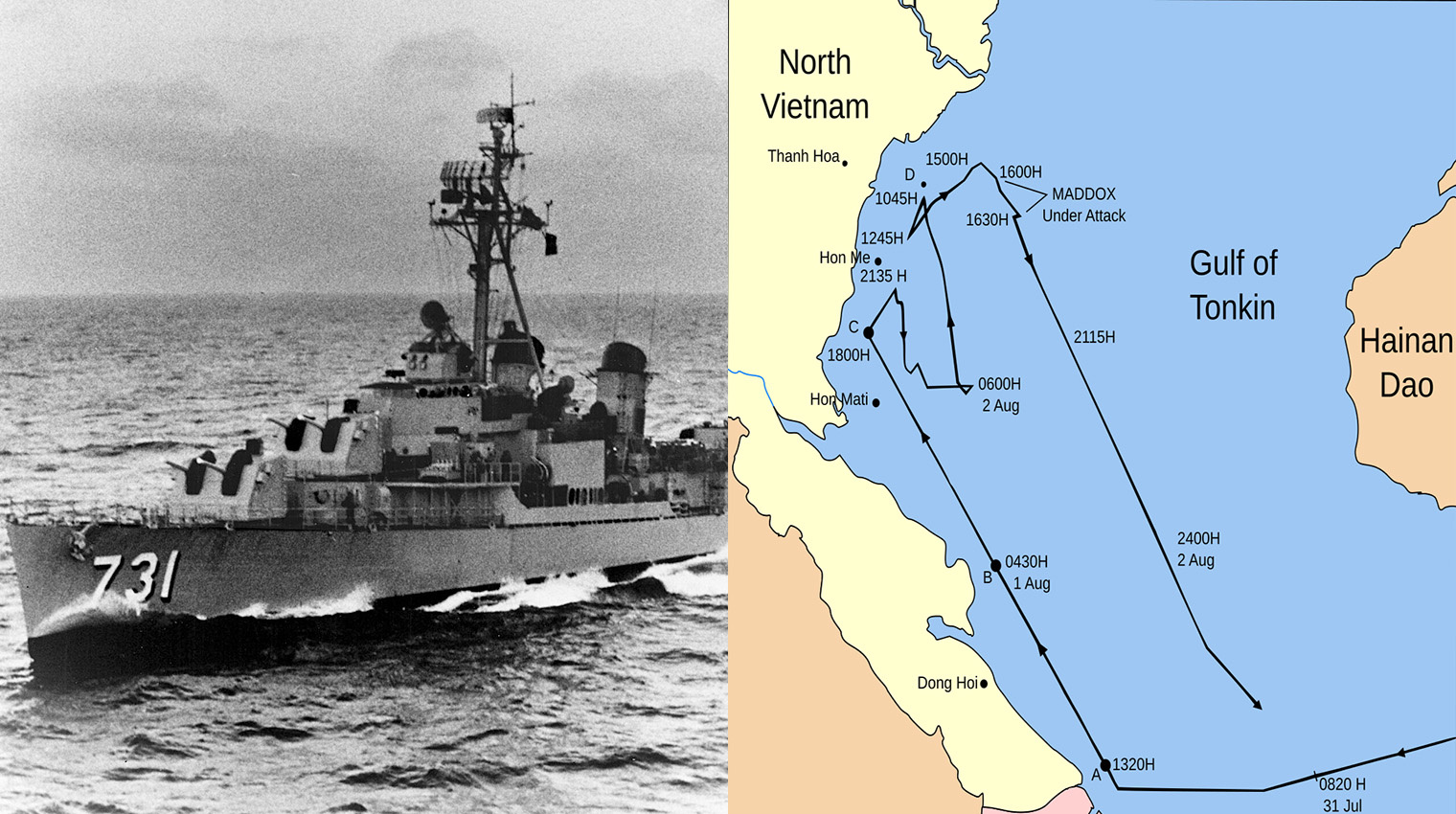
Some conspiracy theories, however, have turned out to be true, such as the “Gulf of Tonkin Incident,” where the USA lied about an unprovoked North Vietnamese attack on the destroyer USS Maddox, prompting President Johnson to escalate the war in Southeast Asia. Most recently, the COVID pandemic’s “lab leak theory” was dismissively labeled a racist conspiracy theory by the establishment, but is likely also quite true.
Are there even now, today, conspiracy theories regarding the USA’s and Israel’s war against Iran and the ongoing unrest throughout the Middle East? Regarding Iran, there was a long-unconfirmed theory that British MI6 and the CIA in 1953, through false flag operations, carried out a coup that overthrew the democratically (?) elected Prime Minister Mossadegh, who wanted to nationalize the country’s oil resources. The Anglo-Persian Oil Company (now BP) controlled 51 percent of the shares of Iran’s oil production, and the USA wanted to break the monopoly and let American oil companies into the country. Thus, they aided the British on the condition that they themselves could profit from Iran’s vast oil reserves. It took 60 years before the CIA acknowledged its involvement in the coup, which was called Operation Ajax.
Some claim that Iran finances most of the terrorist groups in the region, such as Hezbollah in Lebanon, Hamas in Gaza, and the Houthis in Yemen, and is also behind several terrorist attacks in Western states. Thus, it might be justified to try to overthrow the mullahs’ rule and allow the Iranian people to choose their own regime. Since the country did have a form of democratically elected politicians before the aforementioned coup in the 1940s and into the 1950s, there might be a chance for a similar mode of governance, unless more than 45 years of Muslim propaganda and sharia rule have brainwashed the people.

Before the 1979 revolution, relations between Iran and Israel were quite good, as Israel viewed the Persian people as more friendly, even allied against the Arab states, which had declared war on Israel three times. Although Iran voted against Israel’s founding, it was still among the first to recognize the country. Israel assisted Iran with technical support, training agricultural experts and soldiers in exchange for Iranian oil. There was also a large Jewish population in Iran. After the ayatollahs took power, however, everything changed, and Israel was then to be annihilated and erased from the map. Since then, Israel has considered Iran its worst enemy.
The Persistent Greater Israel Theory
A conspiracy theory has long circulated that Israel influences the USA to do its bidding and attack hostile Arab states in the Middle East. Is there any credibility to claims that tiny Israel dictates the gigantic USA’s military operations, especially in Muslim countries? Hardly. But there is a background that has fueled an antisemitic theory about a plan—a “Greater Israel playbook”—to achieve peace and stability in the region, primarily on Jewish terms, by taking over large parts of the Middle East. It’s useful knowledge to be aware of, since these claims persistently linger and keep gaining new life, most recently following operations Roaring Lion and Epic Fury.
The conspiracy theory claims that Jews have always aimed to establish the “Promised Land”—that is, God’s promise to the patriarch Abraham of the land reaching from the Nile to the Euphrates, essentially the entire Levant and more, now referred to as “The Greater Israel.” While Israel has recognized its borders, these have shifted with each war against surrounding Arab states—not only outward, but more often inward, with Israel returning considerably more territory than it has retained—since the 1948 war, when Israel’s neighbors aimed to annihilate it, which failed.

Since the Peel Commission’s 1937 proposal for dividing the British protectorate of Palestine—where Arabs would get 80 percent of the territory—the Jews accepted the plan and the Arabs declined. The 1948 division, which allocated Israel a somewhat larger territory than the 1937 plan, led to war the very day after Prime Minister David Ben Gurion proclaimed the State of Israel. The conspiracy holds that the pragmatic Jewish leader accepted the borders, but had an underlying agenda to expand the territory in the future.
All the borders in the region are, in fact, quite arbitrarily drawn, without the populations ever being consulted, resulting in various ethnicities and tribes ending up under one nation’s flag or split across several. After the fall of the Ottoman Empire during World War I, a secret agreement divided the area among several colonial powers, primarily Britain and France, dividing the region into spheres of interest and affecting countries including Lebanon, Syria, Iraq, and Palestine. The agreement is named after negotiators Sykes and Picot.
An 80s Article Refuelled the Debate
The plan for peace and security which contributed to the escalation of the conspiracy theory of an imperialist Israel originated in an article published in 1982 in the Hebrew journal Kivunim by Oded Yinon, a former adviser to Ariel Sharon and previously a senior official in the foreign ministry. The “Yinon Plan” (A Strategy for Israel in the 1980s) proposes fragmenting neighboring Arab states into various ethnic and religious autonomous regions, similar to what happened to Yugoslavia in the ’90s—a process known as balkanization.
In this way, Yinon argues, the threat to Israel would be reduced, as these new areas would be militarily weakened and potentially preoccupied with border and internal conflicts. Iraq, for example, would be split into Kurdistan and Shiite and Sunni states. Syria, into a Druze, an Alawite, and a Sunni-Muslim state, and so on. The article gained considerable international attention when translated into English by Israel Shahak, at which point it was given a title more inviting to conspiracy theories: “The Greater Israel: The Zionist Plan for the Middle East” and was reviewed by outlets such as Newsweek and The Wall Street Journal.

The question, however, is how this plan, if it ever truly existed outside of theoretical proposals, could be implemented in practice? It is here that all sorts of conspiracy theories begin to flourish, since Israel would not be capable of executing such a gigantic military-geopolitical project on its own, and would need outside help. Fast forward to the 2001 attack on the World Trade Center and America’s immediate response to the terrorist act and its declaration of war on terrorism.
War with Seven Countries in Five Years
When former NATO commander General Wesley Clark visits the Pentagon 10 days after 9/11, he first meets with Donald Rumsfeld and Paul Wolfowitz before heading downstairs to greet former subordinates, when he is called in by a general who is eager to talk. The general says, “We are going to war with Iraq!” prompting Clark to ask, “Why?”, to which the general replies, “I don’t know?” A few weeks later Clark meets the same general again and asks if the plan to attack Iraq still stands. The response is, “It’s worse than that, we are going to war with seven countries in five years!” First Iraq, then Syria, Lebanon, Libya, Somalia, Sudan, and finally Iran.
In 2003, the USA attacks Iraq under the false premise that the country possessed WMDs (Weapons of Mass Destruction), with the naive hope of introducing democracy into a Muslim country that demonstrably despises such governance. A completely meaningless war that destroyed the country’s infrastructure, killed millions, and incurred enormous costs for American taxpayers. The ones who profited, however, were the military-industrial complex and certain contractors such as Halliburton and Black Rock.
This was followed by U.S. intervention in Somalia (2007), Libya (2011), Syria (2014), and most recently the war with Iran and support(?) for Israel’s bombings in Lebanon. The architects of the Iraq war are said to include Wolfowitz and Richard Perle, a political adviser in the Reagan administration and later a consultant for Rumsfeld under George W. Bush, Jr. In 1996, Perle wrote a letter to Israel’s new Prime Minister Benjamin Netanyahu proposing that Israel should make “A clean break from the Oslo accords,” the peace agreement between Rabin and Arafat. Instead, Israel should topple the regimes of neighboring countries and install more pro-Western leaders to achieve peace and stability in the area. Such a massive and costly military operation could never be accomplished by Israel alone without U.S. help.
Better to Be Informed Than Shout “Tinfoil Hat”
All these claims are publicly available for anyone to review and draw their own more or less credible conclusions—depending on one’s starting point. How one then connects the dots depends on one’s propensity to look for hidden agendas. If you want to dismiss far-reaching conclusions drawn from more or less substantiated facts as conspiracy theories, you need to be well-informed and able to address the claims—using pejoratives like “tinfoil hat” won’t make them disappear.
Implementing the theoretical Yinon Plan would likely lead to enormous humanitarian suffering with civilian casualties and devastated infrastructure that would take decades to rebuild. The UN and all other peace organizations would protest, and antisemitism and anti-Jewish hatred would reach new heights worldwide. There is also no evidence that it has ever been implemented, and even less that such fragmentation, combined with Israeli annexation of weakened areas, is under way. Israel, as mentioned, has returned enormous territories after various wars. When Yugoslavia split, it led to violent conflict and great human suffering, but today, thirty years later, there are seven countries that are not particularly hostile to their neighbors. Could this type of balkanization also work in the Middle East? Kurds, Druze, and Alawites would gain long-awaited independence and escape persecution. Sunni and Shia Muslims might cease terrorizing each other if they had their own nations. Or is clan mentality so fundamental that uniting different peoples under separate flags, as happened in the divided Yugoslavia, would be impossible?
Should the Middle East Be Left to Islamists and Terrorists?
Another drastic solution to the Middle East conflict would be to let all Jews in Israel emigrate to the Western world, or wherever else they liked, dissolve the country, and let the Arabs take over and establish a “free” Palestine, which unfortunately, likely in a fairly short time, would, according to one certain president, be classified as Just another Muslim shithole country. That would be to abandon the Middle East and all hope of democratization, leaving the region in the hands of terrorists and other Muslim theocrats.

However, Israel is in the Levant to stay; nothing will make them give up their independence. The country’s function as the only democracy in the region also has :censored:6:cdd6bbaa89: significance. Yet the dream of “The Greater Israel” likely exists in no serious Jew or Zionist, no matter how much Yahweh supposedly promised such a land to the probably mythical (?) biblical character Abraham. However, the dream is very much alive among Israel’s enemies.
As the two-state solution now seems to be an almost impossible project, there is also another drastic option, contrasting with the above solution of a Jew-free Palestine: that Israel takes over the bombed-out Gaza Strip and also the West Bank—considering all the new settlements taking place. The question is, where would all the Palestinian Arabs who refuse to live with Jews go, as it seems all neighboring Arab states refuse to accept them?
The entire conflict seems to have been stuck in a hopeless deadlock for a long time, with civilian casualties on both sides, and if by some chance someone were to find a solution, a Nobel Peace Prize would surely follow, as Rabin and Arafat actually received.
There simply seems to be no final solution (no Nazi pun intended)—one must compromise, give and take. Or, as African-American economist Thomas Sowell put it: “There are no solutions. There are only trade-offs.”