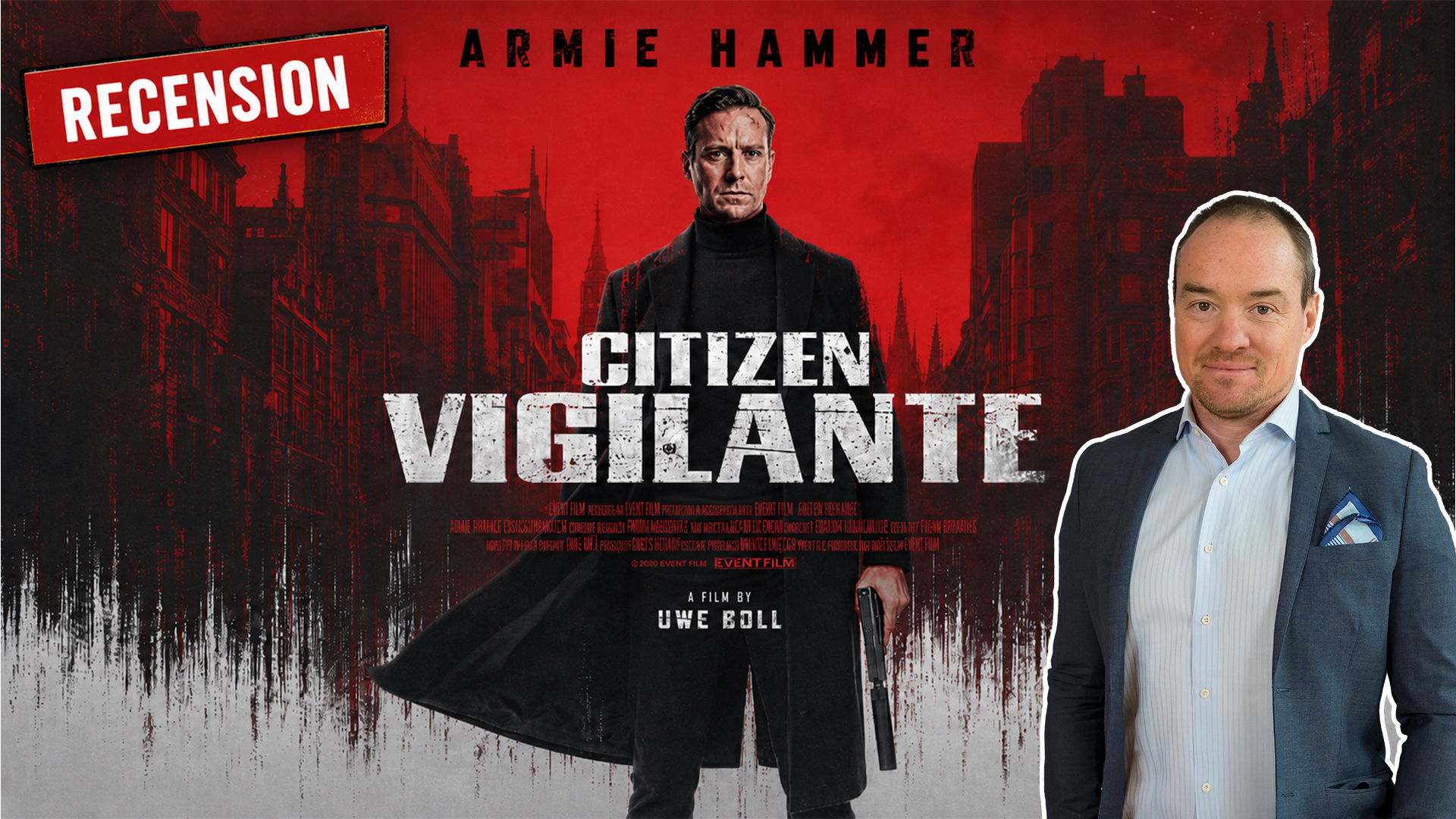
FILM REVIEW • When Citizen Vigilante was first discussed, I looked forward to a well-made revenge film with a perspective that is almost never portrayed seriously in cinema. A revenge flick from the right, if you will. A subject both unusual and potentially explosive. But when I finally started watching, it took only a minute before my hopes faded. Unfortunately, the quality is abysmal – in almost every respect. It’s a shame, because the subject deserved something better. Much better.
The film has received a lot of attention online over the past week or two, not least following reports that it was “banned” in Germany. What seems to have happened is rather that the German age rating board FSK refused to give Citizen Vigilante any classification, not even “18+” or “Keine Jugendfreigabe.”
Without such classification, the film is in practice very difficult, perhaps impossible, to distribute commercially in the usual way in Germany – for example, in cinemas or through ordinary physical and commercial sales. Therefore, several media outlets have described it as if the film has been banned.
The reason given in reports is that the authorities not only believe the film depicts extreme violence, but also that it risks glorifying vigilante groups, extrajudicial justice, and could incite violence against migrants.
This German “ban” has, of course, only fueled the hype. I too became more interested. The question was whether this could be that rare film that dares to portray the consequences of mass immigration from a completely different angle than audiences are used to.
No cinematic depiction of the consequences of mass immigration
Since its breakthrough in the early 20th century, the medium of film has repeatedly depicted the great conflicts, traumas, and societal changes of the world. Sometimes in documentaries, sometimes as dramatizations of historical events, and often through pure fiction that nonetheless clearly draws upon reality.
Nazi Germany, totalitarianism, and fascism have for example inspired countless stories and allegories. The Handmaid’s Tale is a recent example of such a dystopian fantasy—a highly overrated and, in my view, terrible series. There have also been films and series about climate change, racism, gender, class struggle, colonialism, capitalism, and basically every other politically charged issue.
Hollywood has long used film as a tool for political influence. The message is often overt: white men are frequently made to bear the blame, while non-whites, minorities, or other contemporary ideological heroes get to play the morally good.
But even though the major studios have made films about revenge, rebellion, oppression, abuse, corrupt officials, and people taking the law into their own hands, as far as I know, there has hardly been any serious film about resistance to mass immigration, opposition to the politicians who enabled it, or the societal consequences that followed.
This is actually remarkable. The subject contains everything film usually thrives on: conflict, betrayal, anger, fear, loss, powerlessness, and revenge. I’ve long thought that if someone managed to make a really strong film on this theme, without getting stuck in sloganeering or cheap posturing, it could become a big hit.
It turned out that even a poorly made film on this very topic was enough to attract attention. Because unfortunately, Citizen Vigilante is not the film I was hoping for.
It is extremely poorly made.
Plastic, cheap, and terrible
The odd thing is not that the film is criticized, but how obvious its flaws are. Even reviewers who hate the film’s political message often arrive at the same basic critique: this simply isn’t a good movie. On Rotten Tomatoes, Citizen Vigilante shows a nearly parodical gap between critics and audience—very low critics’ scores but sky-high audience ratings—which in itself says something about how many seem to reward the topic rather than the craftsmanship.
Several critics also compare it to classic vigilante films like Death Wish, Dirty Harry, and Taxi Driver, but that’s precisely where its failings become clear. Those films had, in different ways, style, intensity, acting, moral weight, and an actual cinematic expression. Citizen Vigilante mostly just has a message that is pushed right into the camera.
The problem isn’t that the film is raw, uncomfortable, or politically incorrect. The problem is that it’s clumsy. Scenes that should be impactful fall flat, the violence lacks gravitas, and the drama is never built up in any serious way. The film seems to want to be both a social commentary, a revenge fantasy, and a provocation, but fails to give any of that real strength.
Uwe Boll, who is behind the film, has long had a reputation for making films that have become infamous rather than appreciated. Among film buffs, his name is associated with turkey films, sloppy craft, and productions that feel more hastily slapped together than thoroughly worked out. Unfortunately, Citizen Vigilante does little to change that reputation.
Popular despite low quality
Normally, a film of this level would quickly be dismissed as just a bad low-budget production. The acting, dialogue, cinematography, editing, and storytelling would be trashed—and the film would probably disappear without leaving much of a mark. But that doesn’t seem to be the case here.
Instead, Citizen Vigilante has gained attention, exposure, and defenders, not because it’s good, but because many seem relieved that someone is even making a film on this subject. The topic is so absent in popular culture that the very existence of the film becomes an event in itself, and that says something.
It says there is a pent-up demand for stories that depict the consequences of mass immigration from a different perspective than what almost always dominates film, TV, and culture. For many, it seems to be enough that the film at least “says something” they feel almost no one else dares to say.
In a way, that’s understandable. When a topic is sufficiently underrepresented, even a weak attempt can take on disproportionate significance. A bad film can then become a kind of symbol—not for quality, but for a missing voice. But that’s precisely why the film is also frustrating.
The power of the subject
Just think what could have been done with this. Imagine what a dark, serious, and well-crafted revenge film could have been made about people who feel society has betrayed them, that the state has abdicated, and that justice no longer exists. A film about rage, loss, powerlessness, and moral collapse. A film that dares to ask what happens when ordinary people feel they are no longer protected by the institutions that supposedly exist for them.
This is where Citizen Vigilante becomes both interesting and unsuccessful at the same time. It shows the power of the subject, but does almost nothing worthwhile with that power. The fact that something so plastic, cheap, and badly executed still manages to spark attention doesn’t attest to the film’s greatness. It speaks to the explosive power of the topic itself. Therefore, the film I was hoping for is still to come.
Citizen Vigilante is not a brave masterpiece stopped by a nervous establishment. It is a bad film that has become interesting simply because it happens to touch on something that almost the entire film industry has consistently refused to tackle.
The topic is unusual. The perspective is unusual. The reaction to the film is interesting. The film itself, unfortunately, is not.
The film, which has attracted considerable media attention, is available to watch, among other places, on social media.