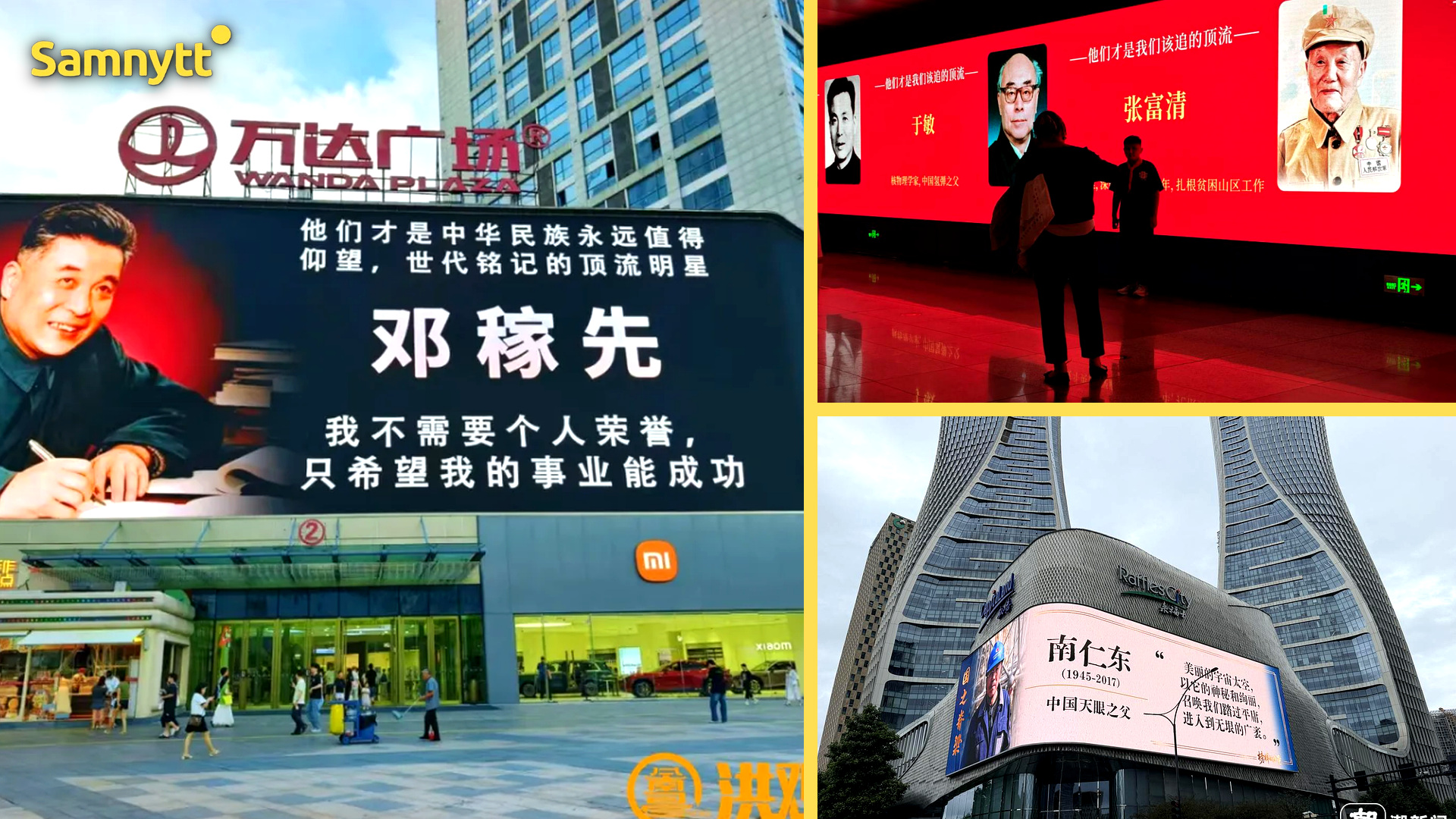
An increasing number of shopping centers and public transit hubs in China have begun replacing commercial advertisements for celebrities and consumer goods with giant portraits of the nation’s leading scientists. The initiative aims to shine a spotlight on science and technology so that children and youth have different everyday role models than entertainment figures and influencers.
Attention surrounding the campaign picked up during China’s National Day celebrations in October, when Nya Dagbladet, citing the state news agency Xinhua, reported that some of the most sought-after digital advertising spaces in several cities had been reserved for both historical and contemporary scientists.
In locations where fashion houses, beauty brands, and movie stars normally dominate, passersby are now met with the faces of, among others, rocket scientist Qian Xuesen, nuclear physicists Deng Jiaxian and Yu Min, crop breeder Yuan Longping, and Nobel Laureate in Medicine Tu Youyou.
The movement began already in the summer at the Yinzuo department store in Shanxian, in the city of Heze in Shandong province. There, the shopping center put up an outdoor poster almost eight meters wide and over five meters high on its facade, featuring a portrait of Qian Xuesen, regarded as the father of China’s space and missile programs.
Chose to forgo advertising revenue on the facade
The poster in Shandong features a well-known quote from Qian Xuesen about perseverance and belief in the future, along with the message that the country’s scientists are the real top stars that the nation should look up to and remember through generations.
According to operations manager Zhu Wei at Yinzuo, there was initially concern among staff about what the move would mean financially, as one of the building’s most prominent advertising spaces would no longer be sold to commercial advertisers.
After internal discussions, the management ultimately decided that a large shopping center is also a public space in the middle of the city, and that its most prominent screens should convey more than just goods and consumerism.
According to the newspaper People’s Daily, similar initiatives have since spread voluntarily among shopping center operators and local authorities to a number of cities across the country, including Zibo in Shandong, Hangzhou in Zhejiang, Hefei in Anhui, Zhengzhou and Hebi in Henan, and Hulunbuir in Inner Mongolia.
700 showings a day in Hangzhou
In the metropolis of Hangzhou, the large screen ceiling at the Raffles City commercial complex as well as the Yinlong department store have started playing fifteen-second video portraits of prominent scientists.
According to local news portal Hangzhouwang, the scientist portraits are shown about 700 times per day between 8 a.m. and 10 p.m. in one of the city’s busiest shopping districts.
In the provincial capital Zhengzhou, a long digital wall at the Exhibition Center subway station was dressed with portraits and biographies of five scientists during the National Holiday weekend.
Chinese media and posts on social media describe how commuters and families paused during rush hour to photograph the screens, and how parents took their children to stations and shopping centers to tell them about the scientists’ achievements.
Nuclear physicist lived anonymously for 28 years
One of the scientists given the most exposure in the campaign is nuclear physicist Deng Jiaxian, who in 1958 was tasked with the secret mission of leading the development of China’s first nuclear weapon.
To complete the work, he left public life and lived under strict secrecy for 28 years until shortly before his death in 1986. The agronomist Yuan Longping, who developed high-yield hybrid rice that secured food supplies for hundreds of millions, is also highlighted as a central role model.
The focus on highlighting scientists and engineers is also evident in other parts of Chinese society. In the provincial capital Jinan, public transport has introduced a special scientist-themed subway train on Line 4, and in Beijing, the Science Association has organized 165 lecture groups in which university students travel around giving presentations about the scientists’ contributions.
During the autumn, the images of the scientists at Chinese shopping centers have also been widely shared internationally on platforms like X, Instagram, and Reddit, where many users in the West have contrasted China’s campaign for scientific role models with Western advertising and influencer culture.
READ ALSO: Watch as the robot breaks Usain Bolt’s world record
READ ALSO: The EU wanted a green transition—now Brussels wants to slow China’s car boom