Norway and Finland Phoned Putin - Kristersson Warns of European Split
Finland's president and Norway's prime minister held a 90-minute call with Vladimir Putin about ending the war in Ukraine. Sweden's Ulf Kristersson, in the same city, was left out - and says words do not bite on Putin, only money and weapons do.
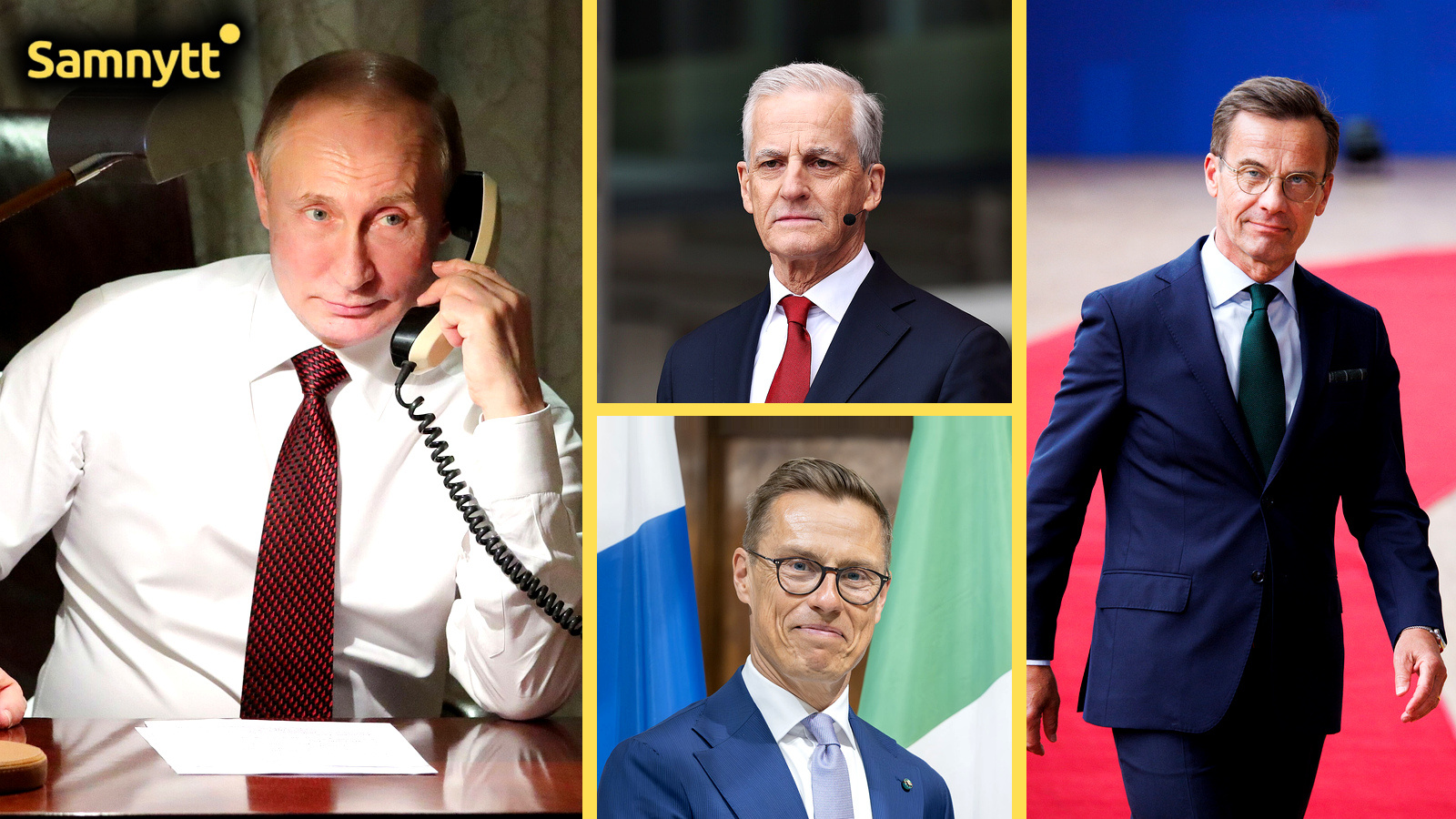
HELSINKI - The leaders of Finland and Norway spent 90 minutes on the phone with Vladimir Putin on Tuesday, discussing peace talks and ways to wind down the war in Ukraine. Swedish Prime Minister Ulf Kristersson was in the same city at the time - but was not on the call. Afterwards he made clear he thinks little of talking to the Kremlin at all.
Finnish President Alexander Stubb and Norwegian Prime Minister Jonas Gahr Støre made the call from Helsinki, where Nordic leaders had gathered for the Nordic Council session. It was a joint Finnish and Norwegian initiative, coordinated with Ukraine. According to a statement from the Norwegian government, the aim was to deliver messages directly to Putin about future negotiations to end the war, ahead of planned talks between Russia, Ukraine and the United States in Abu Dhabi.
"It was a direct and substantive conversation. We are Russia's neighbours. The outcome of this war will directly affect our security and Europe's security. Talks are needed to end the war," Stubb said afterwards.
Støre told the Norwegian broadcaster NRK that the war carries enormous human and material costs, and that both Nordic leaders had stressed the need for steps towards de-escalation. The Kremlin confirmed that the three leaders had agreed to stay in direct phone contact.
Told an Hour Before
Kristersson was in Helsinki for the Nordic summit but took no part in the call. According to Euronews, he was only told about the Finnish-Norwegian initiative about an hour in advance.
He was quick to distance himself from his neighbours' diplomacy, arguing that money and weapons for Ukraine are what count.
"I don't think it is words that bite on Putin right now, but our determined ability to deliver money, weapons and support to Ukraine. So I have fairly low expectations of this kind of conversation," Kristersson said.
He also warned that direct contacts with Moscow could split Europe's common voice.
"Holding talks that risk splitting Europe's common position is risky. I'm not saying they have done that. I don't yet know what the talks were about," he said.
Danish Prime Minister Mette Frederiksen also openly criticised Norway and Finland for not coordinating the call with other countries.
Missiles and Drones
While Sweden's Nordic neighbours have now opened a direct line to the Kremlin, Kristersson's government has stuck to a hard line throughout its term.
This autumn, after meeting Swedish Defence Minister Pål Jonson in Stockholm, Ukraine's Defence Minister Denys Shmyhal said Sweden was actively helping Ukraine strike targets deep inside Russia. On Telegram he thanked "friendly Sweden" for helping finance weapons that had allowed 400 long-range strike missiles to be delivered to Ukraine's armed forces.
On a visit to Estonia around the same time, Kristersson called the Baltic Sea "our sea" and said Sweden and the EU must prepare to isolate Russia for the long term, even after the war in Ukraine is over.
In May, visiting a civil defence agency facility in Revinge in southern Sweden together with NATO Secretary General Mark Rutte, Kristersson went further and said Sweden should help Ukraine keep its drone strikes inside Russia on target.
According to Kristersson, Russia uses electronic jamming to throw Ukrainian drones off course. In some cases the drones have crashed or come down in NATO countries, including Finland and Latvia, where the government collapsed this spring after Ukrainian drones came down and exploded at an oil depot.
"I am convinced that the Ukrainians definitely do not want their drones to end up on friendly territory, for obvious reasons. Sometimes it is jamming and sometimes other kinds of interference. Of course they don't want it to happen, because it can cause damage and create fear," Kristersson said.
"I also think we have to understand Russia's wish to give the impression that other countries are doing things that are not legitimate. We should not fall for the Russian narrative here, but instead help Ukraine as much as we can to make sure their attacks are aimed in the right direction."
Simon Kristoffersson · Responsible Publisher & Senior Editor (Ansvarig utgivare)
Simon Kristoffersson is the Legally Responsible Publisher (Ansvarig utgivare) and Senior Investigative Editor of Samnytt and Samnytt News under Sweden's Constitutional Freedom of the Press Act, specializing in courts, organized crime, municipal governance, and public-sector investigations.
Follow @SamnyttNews on 𝕏 ↗