Right Bloc Surges Past Left in Sweden Poll After Post-Election Chaos
The Tidö parties overtake the red-green bloc for the first time since October 2022 in a new DN/Ipsos poll as the Moderates hit an eight-year high of 24 percent and the Sweden Democrats climb to 19 percent.

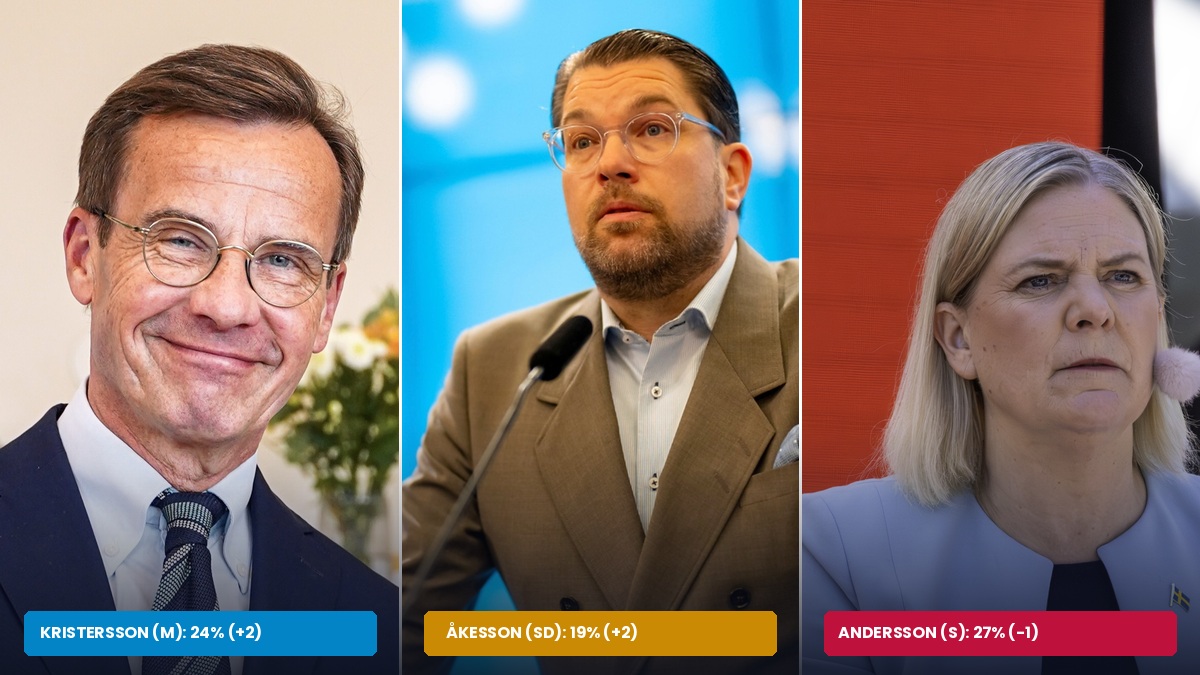
STOCKHOLM - Swedish voters are turning on the left-wing parties after six weeks of post-election paralysis. According to the October voter barometer from Dagens Nyheter and Ipsos, the right-wing Tidö bloc has overtaken the red-green camp for the first time since October 2022, opening up a lead of nearly four percentage points.
In the September 13 general election, the four red-green parties won a narrow 176-to-173 seat majority in the Riksdag and declared that Prime Minister Ulf Kristersson's government was finished. Six weeks later, Sweden still has no new government, and the public squabbling among the election winners has triggered a rapid swing in public opinion.
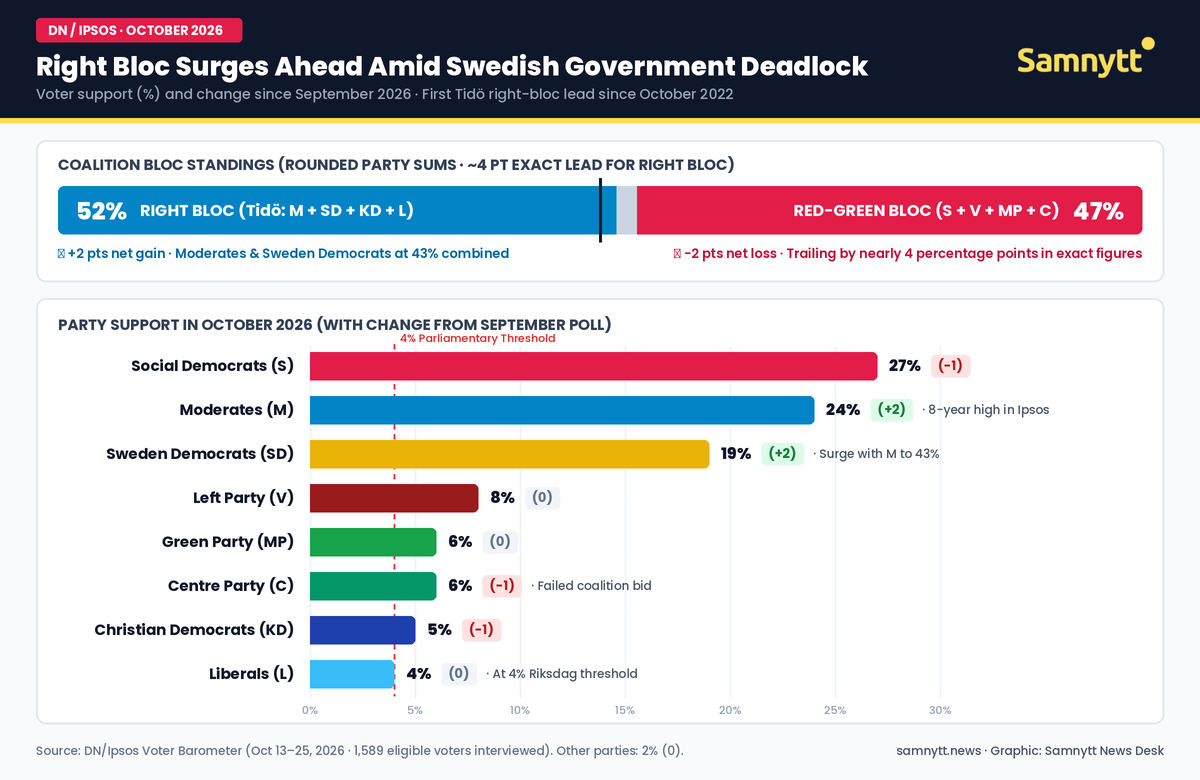
Moderates hit eight-year high as Sweden Democrats surge
In the new poll, conducted between October 13 and October 25 among 1,589 eligible voters, the four Tidö parties gather 52 percent in rounded figures against 47 percent for the red-green bloc. In the unrounded figures reported by Ipsos, the right-bloc lead stands at nearly four percentage points.
The biggest winners are Prime Minister Ulf Kristersson's Moderates, who jump two percentage points since September to 24 percent, their highest rating in DN/Ipsos in more than eight years. Jimmie Åkesson's Sweden Democrats also climb two points to 19 percent, giving the two largest conservative parties 43 percent of the electorate between them.
Among the smaller Tidö partners, the Christian Democrats slip one point to 5 percent, while the Liberals hold steady at 4 percent, right on the parliamentary threshold required for seats in the Riksdag. According to Ipsos, the Liberals have lost roughly a quarter of their election-day voters to the Moderates since September.
Red-green lead turns into a deficit
On the left, Magdalena Andersson's Social Democrats drop one point to 27 percent, and the Centre Party falls one point to 6 percent. The Left Party remains unchanged at 8 percent and the Green Party stays at 6 percent, with other parties at 2 percent.
Ipsos polling analyst Nicklas Källebring said the failed government talks have clearly hurt the parties that claimed victory on election night.
"The process surrounding the formation of a government has so far benefited the Tidö parties. It is a warning signal to the red-green bloc if a snap election is called," Källebring told Dagens Nyheter.
"Overall, there has been a very clear shift in public opinion since election day. The red-green parties lead has turned into a deficit," he added.
Sweden, Ipsos poll:
— Poliwave (@PoliwaveEU) October 27, 2026
S-S&D: 27% (-1)
M-EPP: 24% (+2)
SD-ECR: 19% (+2)
V-LEFT: 8%
C-RE: 6% (-1)
MP-G/EFA: 6%
KD-EPP: 5% (-1)
L-RE: 4%
+/- vs. September 2026
Fieldwork: 13–25 October 2026
Sample size: 1,589 pic.twitter.com/V0y2N8c4yO
Six weeks of parliamentary deadlock
Most of the interviews were carried out after October 15, when Social Democrat leader Magdalena Andersson was voted down as Prime Minister by 248 of the 349 members of parliament. Only her own Social Democrats voted yes, while the Left Party, the Greens, and the Centre Party all joined the right bloc in voting against her.
The poll closed just before Centre Party leader Elisabeth Thand Ringqvist abandoned her own attempt to form a centrist government on October 26 after failing to bridge the divide between the Centre Party and the Left Party. With senior Social Democrats now warning that even passing a joint red-green budget by November 12 looks almost impossible, a snap election would find the Tidö parties firmly in the drivers seat.
Simon Kristoffersson · Responsible Publisher & Senior Editor (Ansvarig utgivare)
Simon Kristoffersson is the Legally Responsible Publisher (Ansvarig utgivare) and Senior Investigative Editor of Samnytt and Samnytt News under Sweden's Constitutional Freedom of the Press Act, specializing in courts, organized crime, municipal governance, and public-sector investigations.
Follow @SamnyttNews on 𝕏 ↗