They Won the Election - Six Weeks Later Sweden Has No Government
The red-greens won 176 seats and celebrated with cake. Six weeks on, 248 MPs have voted against Magdalena Andersson, even the Left Party said no, and a vote-fraud probe is under way.

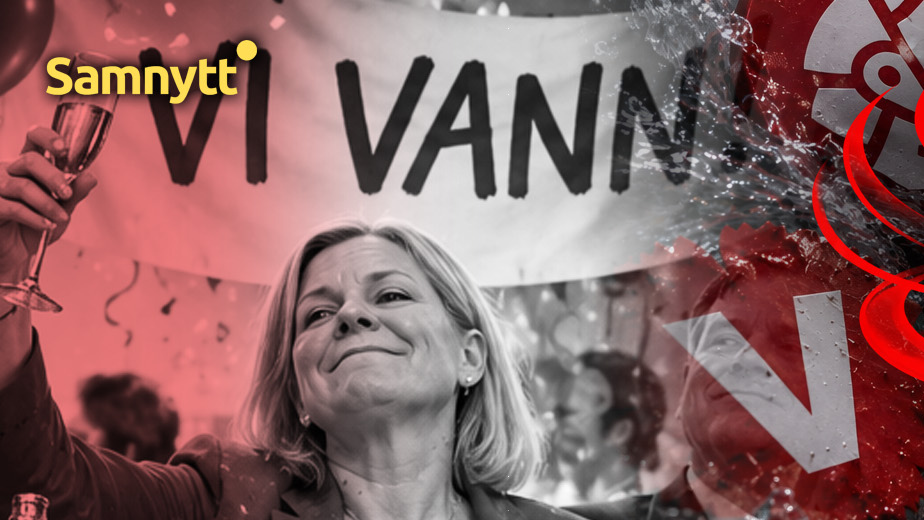
COLUMN • It was supposed to be a change of government, a new political direction and Magdalena Andersson back in the Prime Minister's office. Instead, more than six weeks after the red-green election victory, Sweden still has no new government. The parties behind the 176 seats are quarrelling in public, 248 members of parliament - including the would-be partners - have voted against Andersson as Prime Minister, and even left-wing commentators now call the whole process a humiliation and apologise to voters.
Remember election night. When the votes were finally counted, the Social Democrats, the Left Party, the Greens and the Centre Party together held 176 seats against 173 for the parties of the outgoing Tidö coalition. Ulf Kristersson would step down. Andersson gave a victory speech. There was even a cake.
There was just one small problem. The people who had "won" the election had apparently forgotten to ask each other what they had won together.
Everyone wants Magdalena - so everyone votes no
What followed would have been rejected as too far-fetched if anyone had pitched it as a farce. Andersson was asked to sound out the parties. She handed the task back. She was asked again. The red-green leaders retreated to a manor outside Stockholm to find a "shared picture of the situation". Afterwards, Andersson concluded she still could not form a government.
Then, on October 15, came the high point. Parliament voted on Andersson as Prime Minister. The result: 99 yes, 248 no. Only her own Social Democrats backed her. Every other party voted against - including the Left Party, which says it wants her as Prime Minister.
The Centre Party voted no because there was not yet a "concrete political programme anchored in the centre". The centre - that mythical place in Swedish politics everyone wants to travel to, but no one can give the coordinates for. Centre leader Elisabeth Thand Ringqvist was then handed the task herself, trying to build a centrist government with Andersson at the top. On October 26 she reported back to the Speaker: no such government exists.
When the left starts apologising
This is no longer just something right-wing writers laugh at. On Aftonbladet's own editorial page, left-wing columnist Daniel Suhonen wrote on October 16 that "the red-greens are behaving like losers". Eight days later he went further: "I apologise on behalf of the red-green parties."
Meanwhile, senior Social Democrat Mikael Damberg admits a joint red-green budget looks "almost impossible" by the November 12 deadline - and the Social Democrats, Centre and Greens have pointed to Kristersson, the man they just defeated, as the one who should now try. Voters were told the election meant Kristersson had to go. Six weeks later, the winners are discussing whether he can come back and clean up the mess.
The problem was there before the vote
None of these contradictions appeared after election day. The Left Party did not want to be an obedient support act again. The Centre Party refused to govern with the Left. Everyone knew the Centre Party's red line against the Sweden Democrats. Yet Andersson was sold as the natural, stable alternative, and the question of how her majority would actually work was treated as secondary.
During the last term, the media covered every crack in the Tidö cooperation as a possible sign of collapse. How much of that scrutiny was spent, before the election, on how the Centre and Left parties could ever back the same government?
And then came Borlänge
As if the autumn were not absurd enough, a vote-fraud probe is now under way in Borlänge. Somali-born Left Party member Mohamed Abdukardir Ali, ninth on his party's list and a member for less than a year, received 648 personal votes and jumped straight into parliament. Even local party colleagues seemed caught off guard. "I don't really know who that is," the Left Party group leader in Borlänge said.
Reports followed that pre-marked ballots had been handed out and people urged to vote for Ali, along with claims that money had been offered. Three people are suspected of improper conduct at an election, and the police National Operations Department has carried out searches in Borlänge. Ali was refused Swedish citizenship as late as 2024, partly because of debts, but was granted it by the Swedish Migration Agency in February 2026. He says he has not been notified of any suspicion and will keep his seat.
The victory no one could use
Politicians failing to agree is part of democracy. What is humiliating is that almost every problem now presented as a surprise was visible before election day. The winners drew the map themselves, drove straight into the swamp, and now stand waist-deep arguing about who should have said the road ended - while Sweden needs leadership in an increasingly unstable world.
This column was first published in Swedish on Samnytt.
Jonas Andersson · Political Columnist
Jonas Andersson is a political columnist at Samnytt, writing on Swedish politics, the media, and the post-election crisis in Stockholm.
Follow @SamnyttNews on 𝕏 ↗