EU Wants Billions to Teach You the Right "Values" - Swedish Green Leads Push
European Parliament committees want to double spending on "democracy, rights and values" to 3.2 billion euros. Swedish Green MEP Alice Kuhnke wants even more, plus a rapid fund for activist groups.
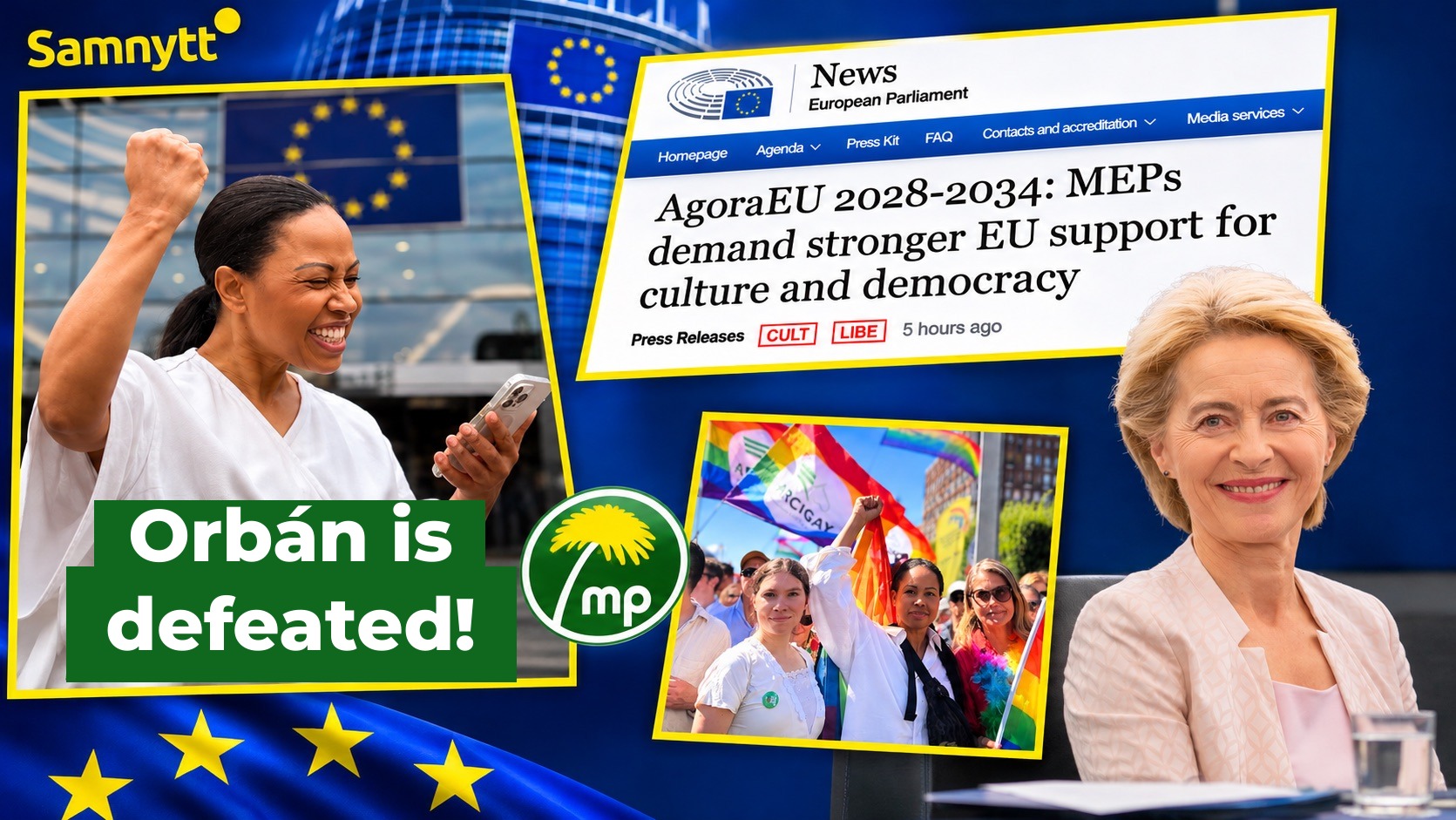
BRUSSELS - Committees in the European Parliament want to spend about 3.2 billion euros on "democracy, citizenship, equality, rights and values" between 2028 and 2034. That is roughly twice as much as today.
One of the MEPs leading the push is Swedish Green Alice Kuhnke. She wants the whole programme to get more money than the European Commission proposed, plus a new rapid fund for organisations "under threat".
On 12 November, Parliament's culture committee and its civil liberties committee, LIBE, adopted their position on AgoraEU, a new EU grant programme, by 64 votes to 17 with two abstentions.
A new umbrella for the money
AgoraEU is a new umbrella programme in the EU's next long-term budget. It merges two existing programmes: the culture fund Creative Europe and CERV, the "values" programme that hands money to organisations and projects working on EU values, rights and equality.
The committees want to give AgoraEU 10.72 billion euros. That is almost 25 percent more than the 8.58 billion euros Ursula von der Leyen's Commission proposed last July.
The money is split into five fixed parts. The biggest, 29.5 percent, goes to what is called CERV+ - democracy, citizenship, equality, rights and values. That comes to about 3.16 billion euros.
What the committees want
Compared with the Commission's plan, the committees want to raise the budget by just over two billion euros.
They want news and journalism to get its own slice of 13.5 percent, with the "fight against disinformation" and promoting "reliable sources of information" online singled out as priorities.
Work against gender-based violence, domestic violence and violence against children, known as Daphne, would become its own strand with 11 percent.
They also want money for "free, fair, accessible and inclusive elections" and "democratic dialogue", for whistleblower protection and for judicial independence, along with a fast-track fund for civil society groups and human rights defenders "under threat".
The rapid fund is partly based on an amendment from the Greens, Kuhnke's group. The committees' text notes that the EU supports human rights defenders outside the bloc but has "nothing similar" for those working inside it. The support could cover protection, assistance and, if needed, relocation.
The committees also want organisations to receive multi-year operating grants, money for day-to-day running and not just for individual projects. Their lobbying and litigation are highlighted as an important part of their role.
Two safeguards were written in. The Commission must ensure the money is not used as a tool to push its own legislative proposals, and the programme must not fund groups that do not respect the EU's fundamental values.
Blaming Putin
Kuhnke justifies the spending by pointing to Russia - a country under sweeping EU sanctions with no formal say in how the Union makes decisions.
"While Putin and others try to divide our societies and silence democratic voices, Europe's response starts at home," she said.
"Our goal is to give independent journalism its own budget, quickly get support to civil society and human rights defenders under threat, and help artists create and share their work across borders. That is how we strengthen Europe's democracy from within, not just by funding defence."
Double today's budget
The current values programme, CERV, has 1.56 billion euros for the whole 2021-2027 period, according to the Commission. The committees' line would roughly double that.
And that is with Daphne counted separately. Put CERV+ and Daphne together and the figure is about 4.3 billion euros. In the Commission's proposal, the same total was 3.6 billion euros, according to the European Court of Auditors.
LGBTQI projects and the legacy of colonialism
The programme's calls for funding show where the values money goes.
One 12-million-euro call for networks of towns and cities seeks projects to fight racism and boost participation among "racialised people, migrants and LGBTIQ people". The projects are also meant to prevent "LGBTIQ-phobia".
Another call, worth 28 million euros, funds remembrance projects. These include the persecution of LGBTIQ people and "the legacy of colonialism, slavery and migration" and how it shaped today's "multicultural European societies".
A further 26 million euros goes to civil society organisations, including groups that bring so-called strategic litigation - court cases designed to change practice and policy. The call is also meant to spread "positive narratives" about the organisations.
Auditors saw no analysis
Even the Commission's proposal was a steep increase. The European Court of Auditors found that AgoraEU would get 100 percent more than the two programmes it replaces in current prices, but that the rise was not backed by any quantitative analysis and lacked a clear explanation.
The auditors have also said there is no reliable overview of how much EU money goes to civil society organisations. Those handing out the money mostly rely on recipients' own assurances and do not actively look for cases where recipients break EU values.
On Monday, a scrutiny group in Parliament's budgetary control committee presented a working document with 23 recommendations. It was led by Carlo Fidanza of the conservative ECR group and Dirk Gotink of the EPP. The Socialists, Renew and the Greens boycotted the work.
The group wants to ban EU money from being used to lobby against the EU and national parliaments, and to shut out organisations that break that rule for at least five years.
The document says there are "clear indications and evidence" that EU decision-making has been influenced by organisations that received EU money, and that the money was used for that.
Nothing decided yet
The committees' line is so far only Parliament's negotiating position. They also voted 65 to 19 to open talks, a decision to be announced in plenary.
Negotiations with member states in the Council only start once governments agree on the EU's 2028-2034 long-term budget. Only then will AgoraEU's final size be settled.
Resistance is waiting. In October, Ireland, which holds the Council presidency, proposed cutting AgoraEU by about 30 percent, from 8.58 to 6 billion euros.
In a joint letter, Kuhnke and her co-rapporteur, French Socialist Emma Rafowicz, called that a major setback for the future of European democracy.
Simon Kristoffersson · Responsible Publisher & Senior Editor (Ansvarig utgivare)
Simon Kristoffersson is the Legally Responsible Publisher (Ansvarig utgivare) and Senior Investigative Editor of Samnytt and Samnytt News under Sweden's Constitutional Freedom of the Press Act, specializing in courts, organized crime, municipal governance, and public-sector investigations.
Follow @SamnyttNews on 𝕏 ↗