Denmark Wants Hizb ut-Tahrir Banned - Sweden Lets It Operate Freely
Denmark's governing Social Democrats and the right-wing parties want to ban the caliphate movement Hizb ut-Tahrir, which is outlawed or terror-listed from Britain to Germany. In Sweden, where the Stockholm truck terrorist shared its posts, the group operates entirely legally.
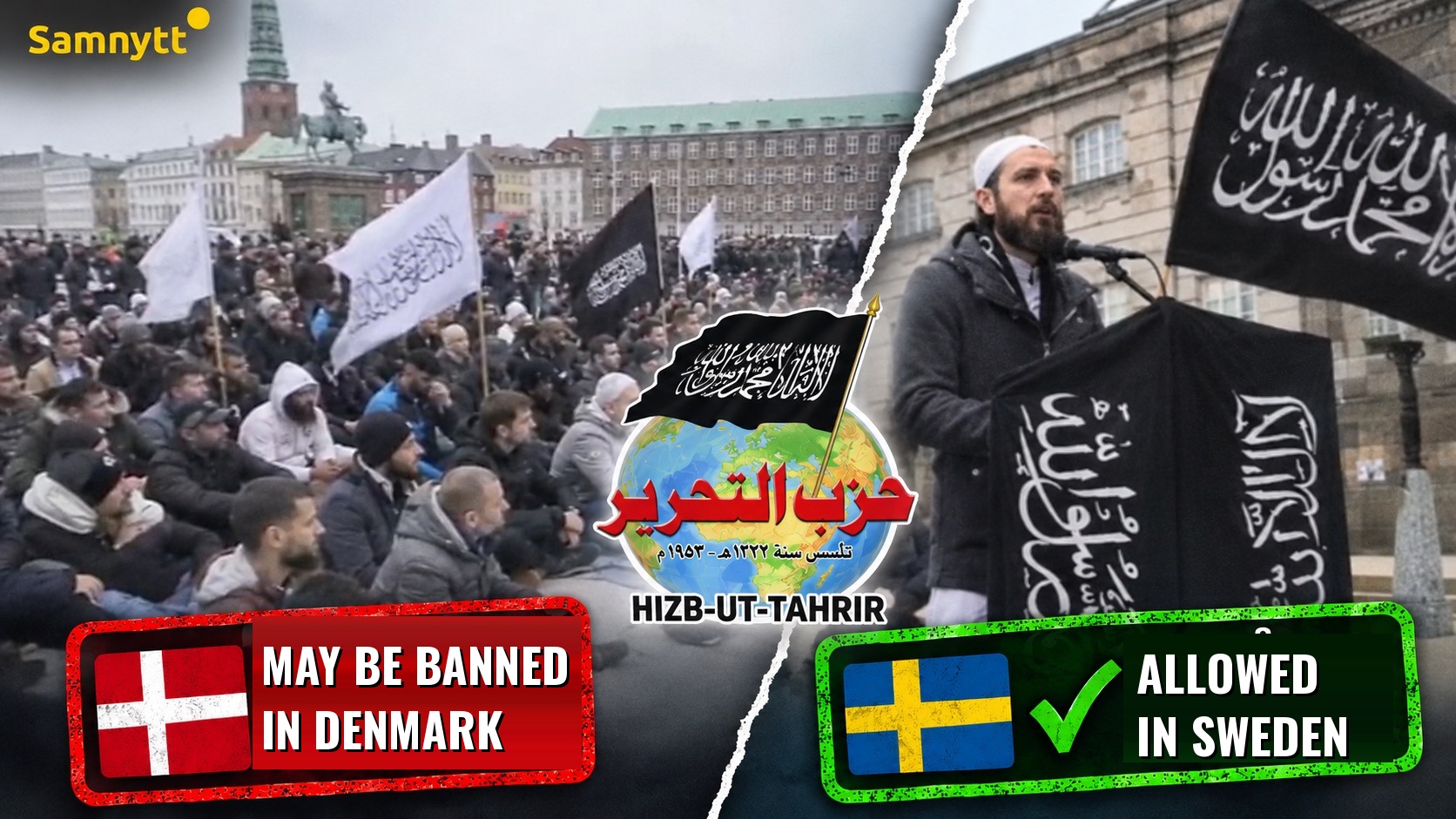
COPENHAGEN - In Denmark, both the governing Social Democrats and the parties on the right now want to ban Hizb ut-Tahrir, the Islamist movement that seeks to establish a caliphate and tells Muslims not to vote. The group is banned or listed as a terrorist organisation in a long list of countries. In Sweden, it operates entirely legally - and the government has shown no interest in a ban.
In August, Hizb ut-Tahrir handed out leaflets to Muslim students at upper secondary schools in Copenhagen and Odense. The students were urged to hold on to their Islamic identity in a youth culture the movement described as "shameless and without limits".
The campaign led Thomas Skriver Jensen, the Social Democrats' integration spokesman, to demand that a ban be looked into.
"It is no secret that if there were a real possibility of banning Hizb ut-Tahrir, I would think it was a good idea. I consider it an anti-democratic association," he told the Danish public broadcaster DR.
Justice Minister Nicolai Wammen, also a Social Democrat, has taken an equally hard line.
"There is no doubt that Hizb ut-Tahrir should be banned as soon as the authorities judge that there are grounds for it," he wrote in a reply to Radio IIII, adding that he feels only "contempt" for the organisation.
READ MORE: Danish Social Democrat PM: I Want a Denmark That Is Danish
Two ban proposals in parliament
On November 13, both the Danish People's Party and the Denmark Democrats tabled motions in the Danish parliament calling on the government to have the Director of Public Prosecutions, Denmark's top prosecutor, bring a case to dissolve Hizb ut-Tahrir. The Denmark Democrats also want the movement banned temporarily while the case is heard.
The motion points out that ahead of the 2025 local elections the movement told Muslims not to vote, and that a member of the group's podcast has defended a marriage between a 50-year-old man and a nine-year-old girl.
The Social Democrats have not yet taken a position on the motions. On Monday, Skriver Jensen confirmed to TV 2 Fyn that the party still wants a ban if it is legally possible.
"I think their values are disgusting and medieval," he wrote in a text message to the channel.
The constitution has blocked a ban twice
The obstacle is Section 78 of the Danish constitution. An association can only be dissolved by a court ruling, and the prosecutor must prove beyond reasonable doubt that it has an unlawful purpose or uses violence.
The Director of Public Prosecutions examined a ban on Hizb ut-Tahrir in both 2004 and 2008, concluding both times that the evidence would not be enough. Since 2008, police and prosecutors have reported on the movement on an ongoing basis. As recently as January 9 this year, the prosecutor said nothing new had emerged, and the government rejected a similar proposal from the Denmark Democrats.
The right-wing parties now point to the gang Loyal to Familia, which Denmark's Supreme Court finally dissolved in 2021, and to Bandidos MC, which a district court dissolved in 2025. That ruling has been appealed.
Banned or listed as terrorists around the world
Hizb ut-Tahrir claims to be non-violent, but the United Kingdom listed it as a terrorist organisation in January 2024, with membership carrying up to 14 years in prison. Russia's Supreme Court did the same in 2003, and India followed in October 2024.
Germany has banned its activities since 2003, and in November 2025 also banned Muslim Interaktiv, which the authorities count as part of Hizb ut-Tahrir's circle. Australia banned it as a hate group in March 2026, with up to 15 years in prison for membership. It is also banned in Indonesia, Bangladesh, Egypt, Jordan, Saudi Arabia, Turkey, Pakistan, China and the Central Asian republics, while Austria banned its symbols in 2021.
Free to operate in Sweden
In Sweden, Hizb ut-Tahrir is completely legal. Sweden has no terrorist list of its own, and when Sweden Democrat MP Richard Jomshof asked in early 2024 about a ban along British lines, he got no such commitment.
Justice Minister Gunnar Strömmer of the Moderates instead pointed to the new offence of participating in a terrorist organisation. "Whether an organisation is to be considered a terrorist organisation is decided in each individual case," Strömmer wrote.
The Swedish Security Service has described the movement as radical Islamist, antisemitic and anti-democratic. Yet when the Legal, Financial and Administrative Services Agency stripped an interpreter active in the movement of his authorisation, an administrative court overturned the decision in 2019. Freedom of expression and association weighed heavier.
The movement also runs an Uzbek media office in Stockholm. In autumn 2025, an Uzbek member was detained at the Swedish Migration Agency to be deported, the investigative site Doku reported.
Hizb ut-Tahrir has also surfaced in reporting on several terror attacks in Scandinavia. Rakhmat Akilov, the Uzbek Islamic State terrorist who drove a stolen truck down Drottninggatan in central Stockholm on April 7, 2017, killing five people and injuring around 15, had liked and shared the organisation's posts on Facebook. He was later sentenced to life in prison.
"Democracy is haram"
In May, Samnytt reported that a Muslim activist known as a front figure for Hizb ut-Tahrir was giving lectures on Islam to young people in Sweden, teaching them that democracy is incompatible with their religion.
In a video clip that has since been taken down but spread widely on social media, he claimed democracy is a "kufr idea" - kufr meaning unbelief - and that it is religiously forbidden for Muslims to believe in it, because "democracy and Islam are completely different".
"Democracy as an idea and democracy as a system is a kufr idea. It is haram to call for democracy and it is haram to believe in democracy," he said.
He went on to call democracy both a "great haram" and a "great sin", since voters thereby hand politicians the power to decide what is permitted and forbidden instead of Allah.
Simon Kristoffersson · Responsible Publisher & Senior Editor (Ansvarig utgivare)
Simon Kristoffersson is the Legally Responsible Publisher (Ansvarig utgivare) and Senior Investigative Editor of Samnytt and Samnytt News under Sweden's Constitutional Freedom of the Press Act, specializing in courts, organized crime, municipal governance, and public-sector investigations.
Follow @SamnyttNews on 𝕏 ↗