Sexual Crime Alerts in Ceuta Jump 650 Percent After Migrant Wave
Emergency calls about sexual offences in the Spanish enclave of Ceuta have risen 650 percent since tens of thousands of migrants crossed from Morocco in late July. Knife attacks and break-ins have soared too. The mayor says Madrid abandoned the city.

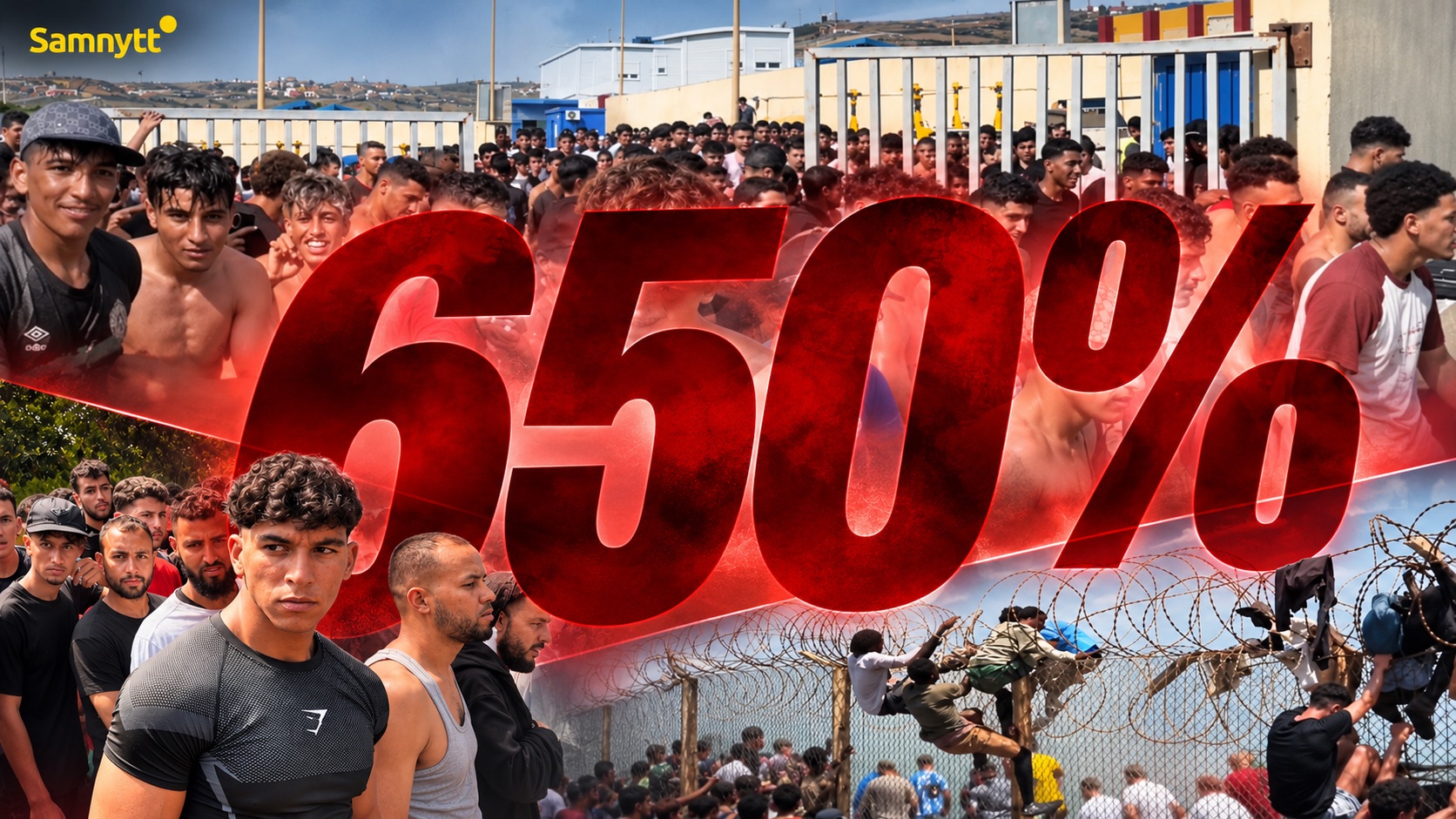
CEUTA - Emergency calls about sexual offences in the Spanish enclave of Ceuta have risen 650 percent since tens of thousands of migrants crossed from Morocco in late July. In a separate category for sexual crimes involving minors, the emergency number logged 16 cases. In the same period a year earlier, there were none. Reports of knife attacks, shootings and break-ins have soared as well.
In the category for ongoing sexual assaults and sexual exploitation, cases at the emergency number 112 in Ceuta went from four to 30 between 30 July and 29 October, compared with the same period the year before. That is a rise of 650 percent.
The figures come from an internal 112 document obtained by the Spanish newspaper El Español.
These are emergency calls and opened cases, not necessarily crimes proven in court. In a separate category for sexual offences involving minors, 16 cases were registered. During the same period in 2025, there was not a single such case.
Already in August, Samnytt reported that the Civil Guard had identified 15 reported rapes in Ceuta after the mass entry, including a case that Spanish media said involved a 10-year-old girl.
Euronews reported at the time that at least five girls, none older than 14, had been treated at the city's hospital after suspected sexual assaults.
The prosecutor's office said on 31 August that 23 sexual offences had been reported since the mass entry. Nine of the victims were between 14 and 17, and five cases were classified as rapes. Of eight identified suspects, four were Moroccan, three were Spanish and one was Belgian. Other suspects had not then been identified.
Later in September, the prosecutor's office had counted at least 35 reports of sexual offences after the mass entry, according to El Confidencial.
Break-ins, knife attacks and shootings
Over the same three months, 112 cases of attacks with firearms rose from eight to 56, and attacks with a knife or other stabbing weapon from 23 to 268.
Unlawful entries into homes jumped from 35 to 1,018. Robberies with violence or threats in public went from 11 to 115, and public order disturbances from 85 to 618. The general category of violent assaults registered 1,777 cases, against 209 the year before.
Calls about children left without protection also rose sharply, from 15 to 265. Altogether, emergency cases went from 2,233 to 11,286.
Local officials speak of serious decay
A source in the local government called the 112 figures extraordinarily worrying and saw them as a sign of the serious decay the city is going through.
"We are not just talking about irregular immigration. It is an emergency that directly affects citizens' safety and well-being and the city's normal functioning," the source said.
On 30 and 31 July, tens of thousands of migrants entered Ceuta from Morocco. The Spanish government has put the number of entries at around 72,000, while other estimates have been higher. The great majority went back, but thousands stayed.
READ MORE: EU Return Hubs a 'Game Changer' - But Sweden Isn't on Board
Tensions between residents and migrants have several times spilled over into open violence. In late August, people from Ceuta attacked migrant camps, destroyed belongings and set fire to makeshift shelters.
Mayor: the state abandoned Ceuta
Ceuta's mayor, Juan Jesús Vivas, on Tuesday launched a sharp attack on Prime Minister Pedro Sánchez. He said Sánchez's abandonment during the "invasion" must have a fundamental explanation.
"He decided not to act, not to use the deterrent means the state had at its disposal, and it was Morocco that decided how many came in and when the flow was shut off," Vivas said.
"The security of Ceuta's residents must come before every other consideration. It is an unavoidable duty of the state to guarantee it."
Spain goes to parliamentary elections on 29 November. The migration crisis in Ceuta has become one of the campaign's main issues.
READ MORE: Danish Social Democrat PM: 'I Want a Denmark That Is Danish'
Mats Dagerlind · Senior Political Columnist
Mats Dagerlind is Senior Political Columnist at Samnytt and Samnytt News. A veteran Swedish political commentator and essayist, he covers Swedish domestic politics, free speech, cultural identity, and media accountability.
Follow @SamnyttNews on 𝕏 ↗