Swedish Agency Report: Looks at Headscarves Can Be Islamophobia
A new Swedish government agency report says looks, tone of voice and questions about the headscarf can count as anti-Muslim racism. Samnytt's review finds hand-picked participants and little attention to the honour-based oppression the government asked it to examine.

STOCKHOLM - A teacher asks a pupil whether she chose to wear the headscarf herself. To a girl who is constantly asked to defend that choice, the question can feel like suspicion. To a girl living under her family's control, the same question can be her chance to speak up. A new report from a Swedish government agency gives plenty of room to the first girl. The second is much harder to find.
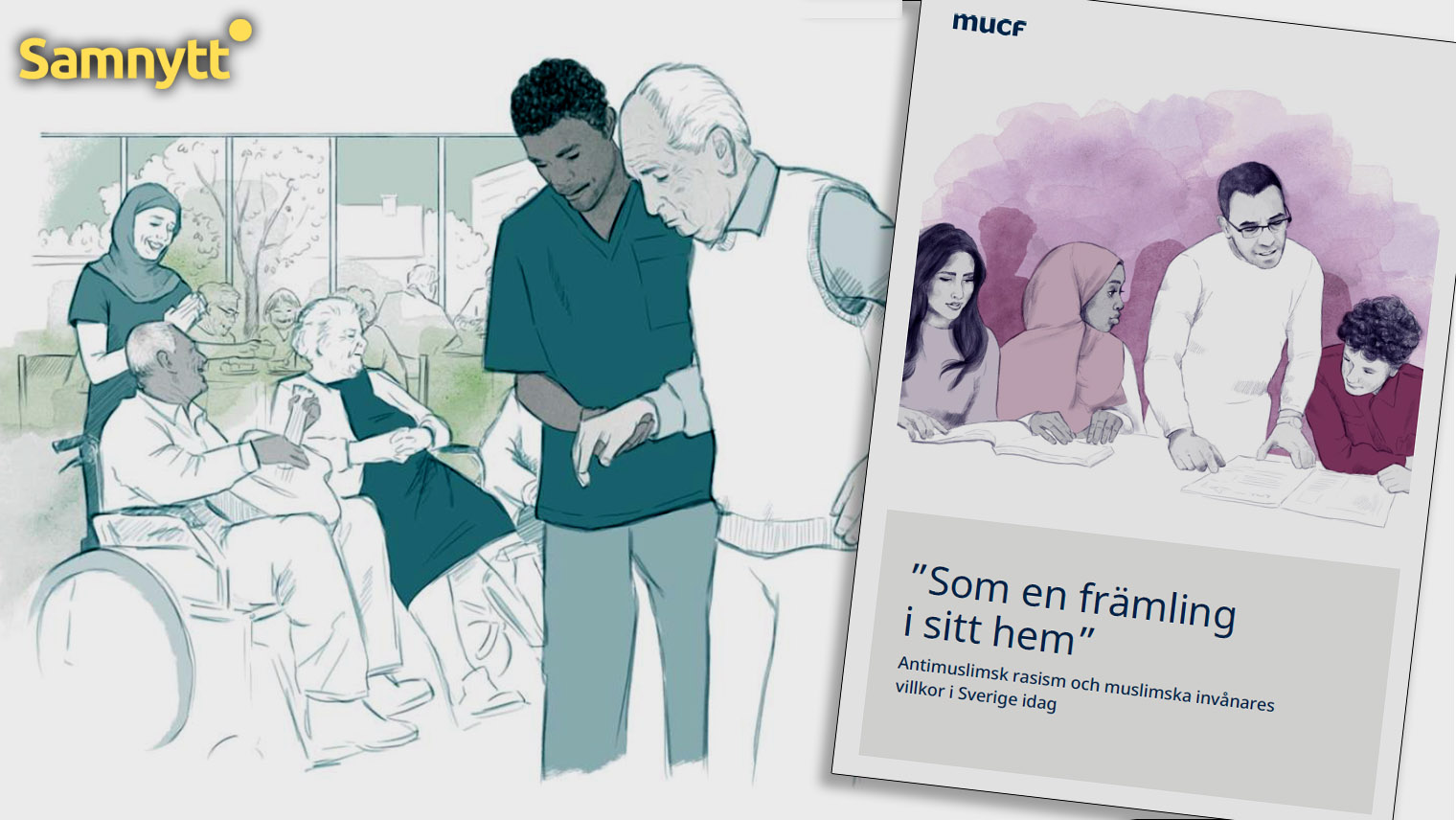
The report, "Like a stranger in your own home", was published by the Swedish Agency for Youth and Civil Society and first highlighted by the news site Riks. It is meant to form the basis of guidance to Sweden's municipalities on what it calls anti-Muslim racism. And it goes far beyond crimes. Looks, tone of voice and curious questions can all count.
Questions about the headscarf
In the report, girls describe how teachers and classmates asked whether wearing the headscarf was their own choice. Some were asked whether they were beaten at home. Parents say they worry school staff are too quick to link a child's low mood to problems in a Muslim family.
At the same time, participants say schools must dare to ask and act when a child is at risk. Their objection is about which pupils get the questions, on what grounds and how they are asked.
That leaves municipalities with a dilemma. A pupil can be singled out if a teacher assumes her family forces her to wear the headscarf. Another can be left alone with that pressure if the teacher, afraid of looking prejudiced, never asks. The report gives several examples of the first mistake. It offers far less help on how schools should spot the second.
The government asked for more
The project goes back to a government decision in December 2024. The then Swedish Agency for Support to Faith Communities was tasked, together with the youth agency, with raising awareness of anti-Muslim racism. The decision included an explicit instruction: "The vulnerability of girls and women to anti-Muslim racism and other forms of oppression shall be given particular attention."
Other forms of oppression would mainly mean those that come not from Swedish society but from the Muslim community people live in. Honour-based oppression is the obvious example.
Yet in the report's section on girls, schools and social services, several of the examples are not about actual oppression. They are about how participants feel others suspect them of it. Participants stress that honour violence must be taken seriously, but describe being assigned values or family situations they do not recognise.
The same government that ordered the report has backed estimates that close to a quarter of a million young people with immigrant backgrounds live under honour-based oppression in Sweden. Samnytt's review finds the report treats much of this as Swedish prejudice, which sits poorly with the brief it was given.
The study does not compare the two kinds of experience and therefore cannot rank them, for girls or for young men. When the findings are passed on, the key question is whether municipalities hear the young person who needs help to defy her family or religious community, or only the one who feels Swedes are looking at her.
Hand-picked participants
The agency highlights that the report draws on the experiences of more than 400 people. That figure is meant to suggest breadth, but it is small next to the roughly 200,000 young people with a Muslim immigrant background living in Sweden today.
The methods chapter shows how they were chosen. The ten municipalities were deliberately picked from a network of councils that already worked with religious communities. Councils without such ties were not included at all.
The municipalities then invited participants, often through interfaith councils, religious communities, ethnic and cultural associations, youth groups and Muslim employees. In some places, those invited were asked to bring friends and acquaintances. Someone active in a Muslim association had a natural way in. A young person who keeps away from that association, perhaps after a conflict over religion or family expectations, did not. How well that group was reached, if at all, is not stated.
National Muslim religious organisations also had several roles, including a reference group that commented on the design, took part in a focus group and later discussed the results and conclusions.
The scientific lead was the report's author, Linnea Lundgren, an associate professor of sociology of religion at Marie Cederschiöld University. Samnytt considers her more of a left-leaning identity politics activist than an impartial researcher.
Young voices filtered through adult notes
Of an estimated 405 Muslim participants, around 300 attended regular municipal dialogue meetings, 75 attended two special youth meetings and 30 took part in national focus groups. The youth meetings were arranged because few young people had turned up to the regular ones. Most who came were upper secondary pupils, and many were active in local associations.
For research ethics reasons linked to the participants' age, Lundgren did not attend the youth meetings herself, and the conversations were not recorded. She was later given the project group's notes on general themes. There are therefore no direct quotes from the two meetings set up specifically to capture young people's views.
At the regular meetings, too, only a selection of table conversations was recorded. Why is unclear. The rest of the documentation was based on council officials' notes, oral summaries and group discussions. The officials were told to listen without arguing, defending their services or questioning participants' emotional experiences.
From looks to conclusions
The accounts include stories of hostile insults, threats and vandalism. Independent data shows that people are in rare cases targeted by crimes with an Islamophobic motive. The Swedish National Council for Crime Prevention identified such a motive in 199 police reports from 2024. That should be set against more than 50,000 reports of unlawful threats and close to 175,000 of criminal damage every year, and a report that has not been tried in court is not proof that a crime took place.
The report goes much further than what can be prosecuted. Looks, tone of voice and curious questions can all be labelled Islamophobia. On page 24, Lundgren acknowledges that there is a line between legitimate criticism of religion and racism, but that line is barely reflected in the rest of the report. Most of what it describes is filed under Islamophobia and anti-Muslim racism.
The bias is particularly clear on page 114. There Lundgren notes that the section on alleged anti-Muslim racism in elderly care rests mainly on relatives' accounts, or on experiences passed on by friends and acquaintances. She herself calls for more knowledge from those directly affected.
Samnytt has repeatedly reported on a very different problem in Swedish elderly care: its growing use as a job market for migrants, largely from the Muslim world, and the resulting failures for the elderly, from poor language skills and carelessness to neglect, theft and abuse.
One story gave the report its title
The title comes from a participant describing how someone born, raised or long settled in Sweden can still be seen as an outsider. Elsewhere in the report, participants describe their own municipality as safe and welcoming, take pride in living there and speak of belonging to a "common us". Both experiences are in the material. The study says nothing about which is more common. Yet it is the sense of being a stranger that greets the reader on the cover.
Lundgren is clear that the study makes no statistical claims, but does not draw the obvious conclusion that its value is then very limited. The agency's task becomes harder when participants' experiences are to be turned into advice for public employees.
For the school nurse alone with a pupil, it is hardly enough to know that a question about the headscarf can be taken as prejudice. She also needs to recognise the pupil who has been waiting for someone to ask. How municipalities are supposed to manage both is the question the government's brief raised, and the report leaves it unanswered.
The report reads like something a left-wing government heavily influenced by the Greens and the Left Party might have ordered. That it was commissioned by a right-wing government in which the Sweden Democrats are a leading force is harder to understand. The party has made clear that it sees Islam and Muslim immigration as one of the biggest threats to Sweden.
Mats Dagerlind · Senior Political Columnist
Mats Dagerlind is Senior Political Columnist at Samnytt and Samnytt News. A veteran Swedish political commentator and essayist, he covers Swedish domestic politics, free speech, cultural identity, and media accountability.
Follow @SamnyttNews on 𝕏 ↗