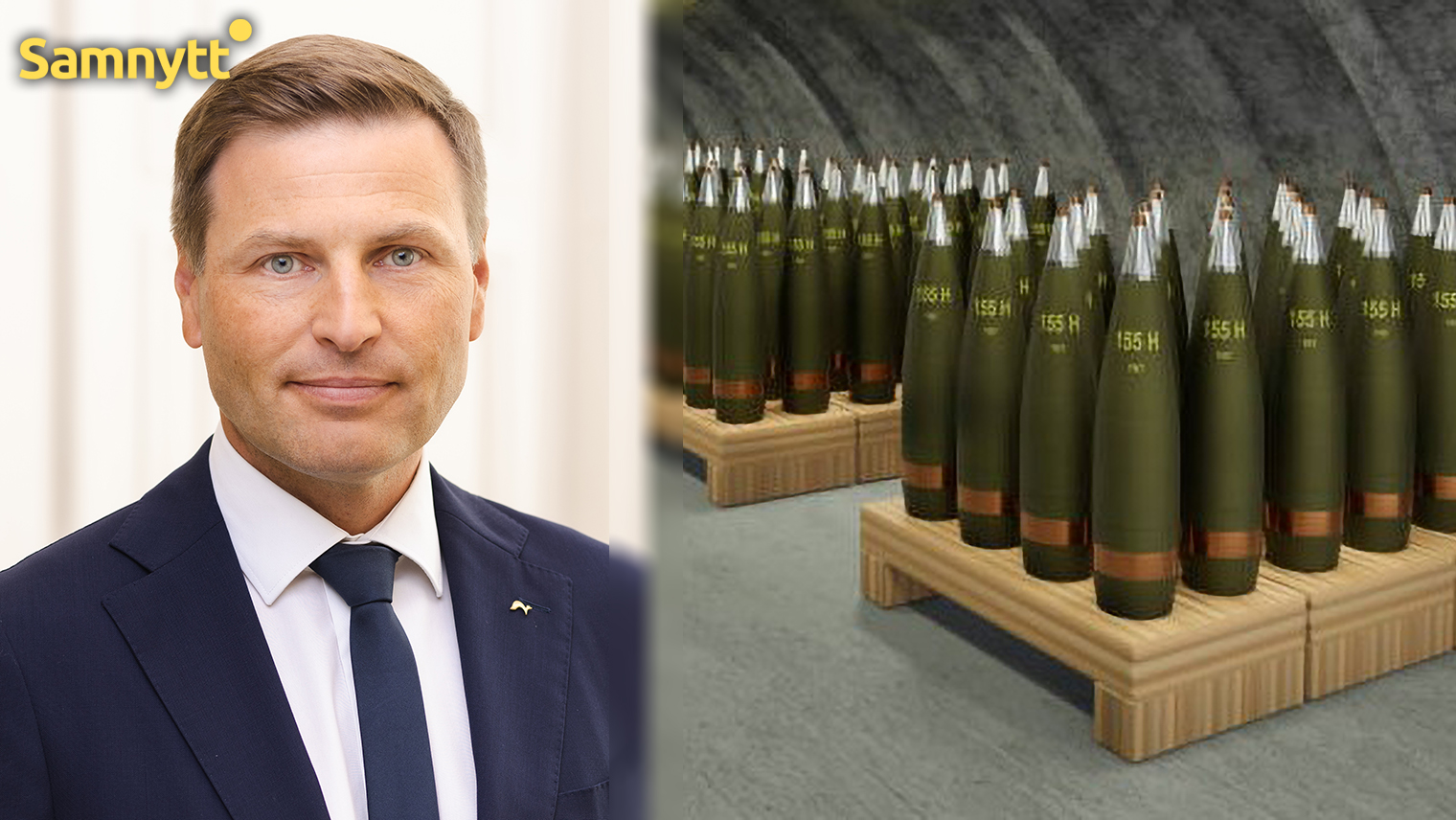
Estonia paid approximately 70 million euros in advance for artillery shells intended to be sent to Ukraine. The supplier had never previously manufactured shells – and the deliveries either never materialized or, according to reports, proved to be unusable. The deal has now turned into a major political scandal – Defense Minister Hanno Pevkur has resigned, and Estonia (read: the country’s taxpayers) risks having to cover the full cost.
The affair dates back to 2024, when Estonia’s Center for Defense Investments, RKIK, struck an agreement with the Italy-registered company Datasel S.R.L. for the delivery of artillery munitions to Ukraine.
Datasel is owned by the Indian Neco Defence Munitions. According to reports first published by the Estonian newspaper Eesti Ekspress, neither Datasel nor its parent company had any prior experience manufacturing the type of ammunition ordered.
Despite this, large amounts were paid out in advance. The money came from the EU European Peace Facility (EPF), which, contrary to its name, is used among other things to finance military support for the war in Ukraine.
Ways To Circumvent the Ban in the EU Treaty
The fund is financed with money from EU taxpayers, separate from the regular EU budget. This is to circumvent the provision in the EU Treaty that EU funds may not be used for military purposes. The funding cap has been raised several times and is now at the equivalent of about 200 billion Swedish kronor (€16 billion).
READ ALSO: Ukraine’s Ousted Defense Minister Warns: Ukraine Is Losing the War
So far, Sweden has committed to pay 6 billion kronor to the fund. If the cap is raised again, this amount will increase further. It is permitted to opt out, as three countries have done: Austria, Ireland, and Malta. Sweden, however, has not opted out.
Paid Despite Non-Delivery
The first contract was signed in August 2024, followed by an advance payment of 15 million euros. In October, another contract was signed, with an additional advance payment of 10 million euros.
The first munitions were supposed to have reached Ukraine by November that year. Instead, Datasel announced that deliveries had been delayed and faced additional problems.
Despite warning signs, RKIK signed two more contracts at the end of the year and continued to pay out advance funds. Altogether, about 70 million euros – equivalent to roughly 780 million Swedish kronor – were paid out.
The shells were not delivered as contracted. According to the Kyiv Independent, citing Eesti Ekspress, a delivery finally arrived in 2025, but the ammunition was said to be faulty and practically useless.
After meetings with company representatives in Tallinn in spring 2025, deliveries were finally halted altogether. Estonia is now trying to recover the money and has taken the dispute to the European Court of Arbitration in Strasbourg.
“We Shouldn’t Have Signed”
How the contracts could ever be approved has become a central question in the aftermath of the scandal. RKIK’s current director-general, Elmar Vaher, who only took office this year and thus was not responsible for the procurement, says he would never have approved the deal.
– In my view, we should not have signed contracts with them. If I’m going to build a house and hire a company that has never built a house before, there is reason to doubt the house’s completion, he told Eesti Ekspress.
Vaher has also stated that the decision was made within a very small circle, and that the then head of procurement at RKIK was unaware of the deal. This could mean that improper agreements were made behind closed doors without transparency.
The agency’s then director-general, Magnus-Valdemar Saar, disputes this account. He admits that buying ammunition from suppliers outside the normal circle involves risks, but says that no major decisions were made without approval from the defense ministry’s leadership.
The Defense Minister Takes Political Responsibility
The scandal has now had consequences at the highest political level. Defense Minister Hanno Pevkur, who had held office since 2022, announced his resignation on September 2.
Pevkur says he was not involved in the contract negotiations or knowledgeable about the details of the failed procurement. Nevertheless, he believes that the ultimate responsibility lies with him as minister. However, the financial burden could instead fall on Estonian taxpayers.
– Even though a minister doesn’t count socks and ammunition or participate in contract negotiations, the National Audit Office’s criticism, especially regarding the defense forces’ and the Center for Defense Investments’ operations, raises the question of political responsibility, Pevkur said upon announcing his resignation.
He also emphasized that the minister’s task was to make the fundamental political decision to support Ukraine, not to manage individual procurements.
The background is a critical report from Estonia’s National Audit Office regarding the country’s rapidly increasing defense spending and shortcomings in how investments and procurements have been managed.
Estonian Taxpayers Could Foot the Bill
The 70 million euros paid out came originally from the controversial EU European Peace Facility. This does not necessarily mean that the loss will be covered by the EU.
The European Commission is in contact with Estonian authorities to investigate whether Estonia will have to pay back the money. A spokesperson for the Commission emphasized that there are oversight and recovery mechanisms to ensure taxpayers’ money is used as intended.
READ ALSO: EU: New Billions for Ukraine – Nearly 70 Billion Kronor
Estonia’s National Audit Office has warned that approximately 70 million euros may ultimately have to come directly from Estonia’s national budget. This would come at the expense of other planned expenditures on welfare, infrastructure, and other priorities that may then have to be postponed.
The deal occurred at a time when Ukraine was in acute need of artillery ammunition. In 2024, there was a severe shortage of shells on the front, as US aid was delayed and the EU had missed its earlier goal of delivering one million shells to Ukraine by March that year.
Since Russia’s large-scale invasion, Estonia has drastically increased its defense spending. According to the records, defense spending rose from about 2 percent of GDP in 2022 to 3.4 percent in 2025, and for 2026 the government has signaled spending amounting to 5.4 percent of GDP. This is equivalent to 25 billion kronor for the war in Ukraine – a sum not far from what the country spends on its entire national military defense.
Criminal Investigation Also Launched
The scandal is not over. Prime Minister Kristen Michal called the government to a meeting on September 3 to discuss Pevkur’s resignation and the audit reports.
The Estonian prosecutor’s office has also launched a criminal investigation into issues raised in the 2025 and 2026 audit reports. However, according to available reporting, no one has yet been formally suspected of crimes specifically related to the failed ammunition deal.
Despite his resignation, Pevkur defends the overarching defense policy and support for Ukraine. He says he is leaving his post convinced that the government made the right decisions to strengthen the country’s defense.
– Estonia is better protected than ever before, he wrote in connection with his resignation, emphasizing that the country must continue to support Ukraine, as this also contributes to Estonia’s own security.