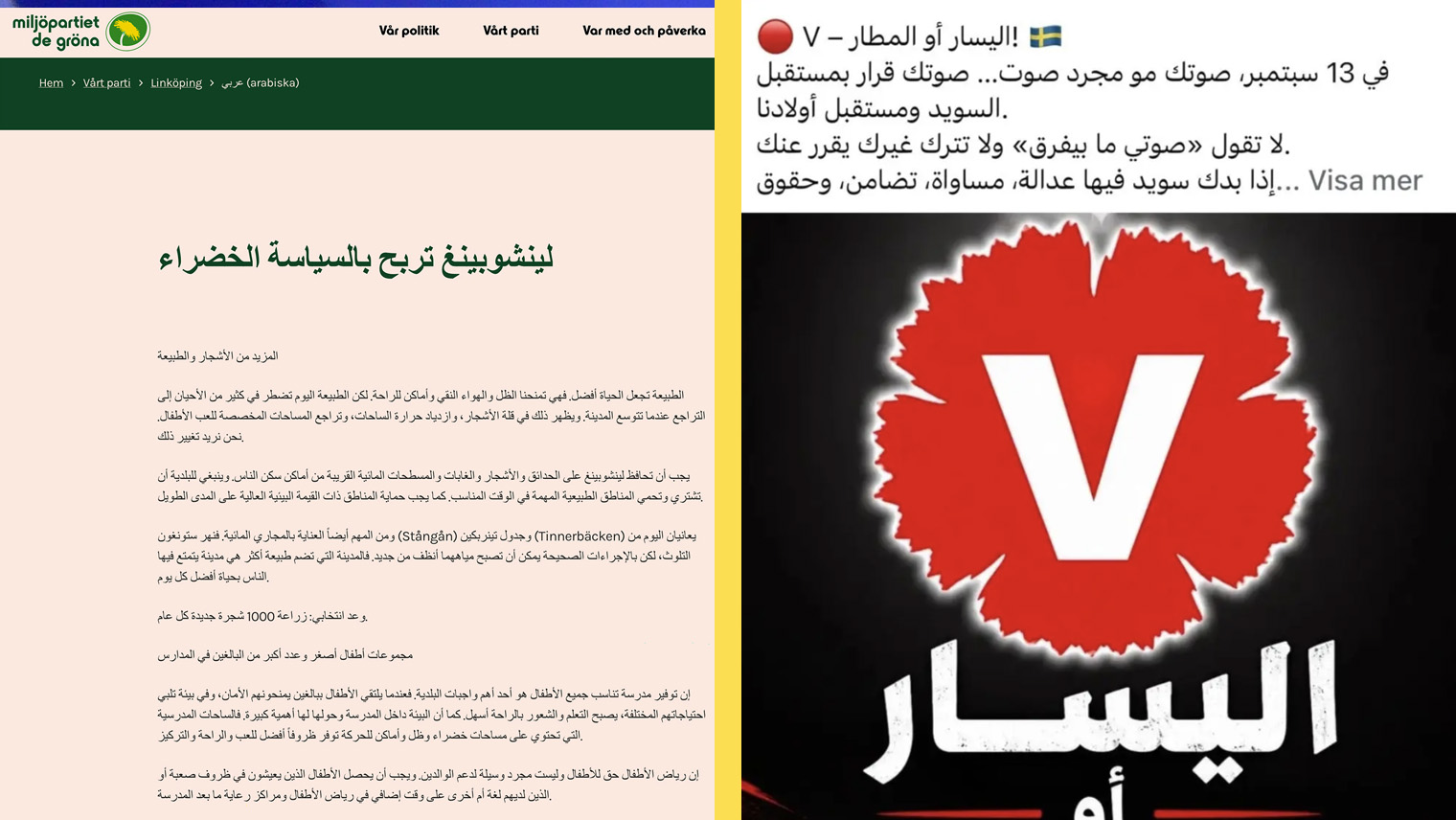
COLUMN • The Arabic-language election campaign now emerging in Sweden is about much more than just a few translated pamphlets. It shows how demographic change is beginning to alter democracy itself— which voters the parties must reach, in which languages they must be reached, and what political majorities will even be possible in the future.
Yesterday, I wrote about how Swedish political parties’ policies are now marketed in Arabic. This can, of course, be described as integration—allowing more people to participate in democracy. But I also see something entirely different.
A country needs a common language, and in Sweden, that language must be Swedish. It is through Swedish that we work together, take part in public debate, interact with authorities, and, above all, can talk to each other.
Of course, people can speak whatever language they wish in private. But the aim of integration cannot be a Sweden where large population groups, decades after arrival, still need political messages served in Arabic, Somali, or other immigrant languages just to follow a Swedish election campaign.
For if we reach that point, we have failed to integrate people into a shared Swedish public sphere. We have started building parallel publics. And there, the language issue becomes a demographic issue.
The entirety of Swedish integration policy has rested on an implicit assumption—there is a Swedish majority for newcomers to gradually become part of. One learns the language, enters society, and in time, makes Sweden home.
But what happens when the majority itself shrinks? What happens when the Swedish-speaking and culturally Swedish population is no longer the obvious majority into which integration occurs?
This is a question Sweden has long been able to postpone. But not forever. Time is running out.
READ ALSO: Parallel Election Campaign in Arabic—Voters Scared with Deportation
The larger these parallel language groups become, the easier it is to live an entire life in Sweden without ever fully entering the Swedish public sphere.
You can work here, socialize here, consume media here, and now, apparently, even follow a Swedish election campaign through another language and information channels.
Then the logic of integration also changes. As long as the Swedish majority is overwhelming, there is a strong social and practical pressure for those who come here to learn Swedish and adapt to the surrounding society.
But as the majority becomes smaller, and the parallel environments larger, that pressure risks becoming weaker. Eventually, you reach a tipping point.
And it is that tipping point that makes today’s Arabic-language election campaigns far more unsettling than just some pamphlets ahead of an election.
At that point, the very concept of integration is turned on its head. Integration has always assumed there was something to integrate into. And when the majority is no longer a majority, a question remains that few Swedish politicians have dared to pose—who is actually supposed to integrate into whom? That is the pitch-black logic of mass immigration.
Jonas Andersson
They give us a foretaste of a Sweden where political parties can no longer automatically assume that the electorate shares a common language, a public sphere, or even the same image of the country.
READ ALSO: Here’s the Left Party’s Arabic Advertisement—Warns About Racism and Discrimination
This is also where disinformation becomes particularly dangerous. When political messages circulate in languages that large parts of the rest of society do not understand, claims, half-truths, and outright lies can live lives of their own far outside the control of the Swedish-speaking debate.
So, the risk is not just that people will vote differently. The risk is that people will be voting based on completely different information worlds.
And behind all this is the much larger demographic question. If this development continues, Sweden may eventually reach a point where the historic Swedish population itself is no longer the majority in its own country.
At that point, the very concept of integration is turned on its head. Integration has always assumed there was something to integrate into.
And when the majority is no longer a majority, a question remains that few Swedish politicians have dared to pose—who is actually supposed to integrate into whom? That is the pitch-black logic of mass immigration.
READ ALSO: Police officer Maria Rosander warns of Islamization: “Society is being devoured from within”
Sweden Created This Itself
For decades we heard that mass immigration wouldn’t fundamentally change Sweden. Origins wouldn’t matter. Religion wouldn’t matter. Culture wouldn’t matter. Everyone would eventually become pretty much like us.
But when an election is at stake, it suddenly turns out that all this matters immensely. Pamphlets get translated, and particular voter groups are identified.
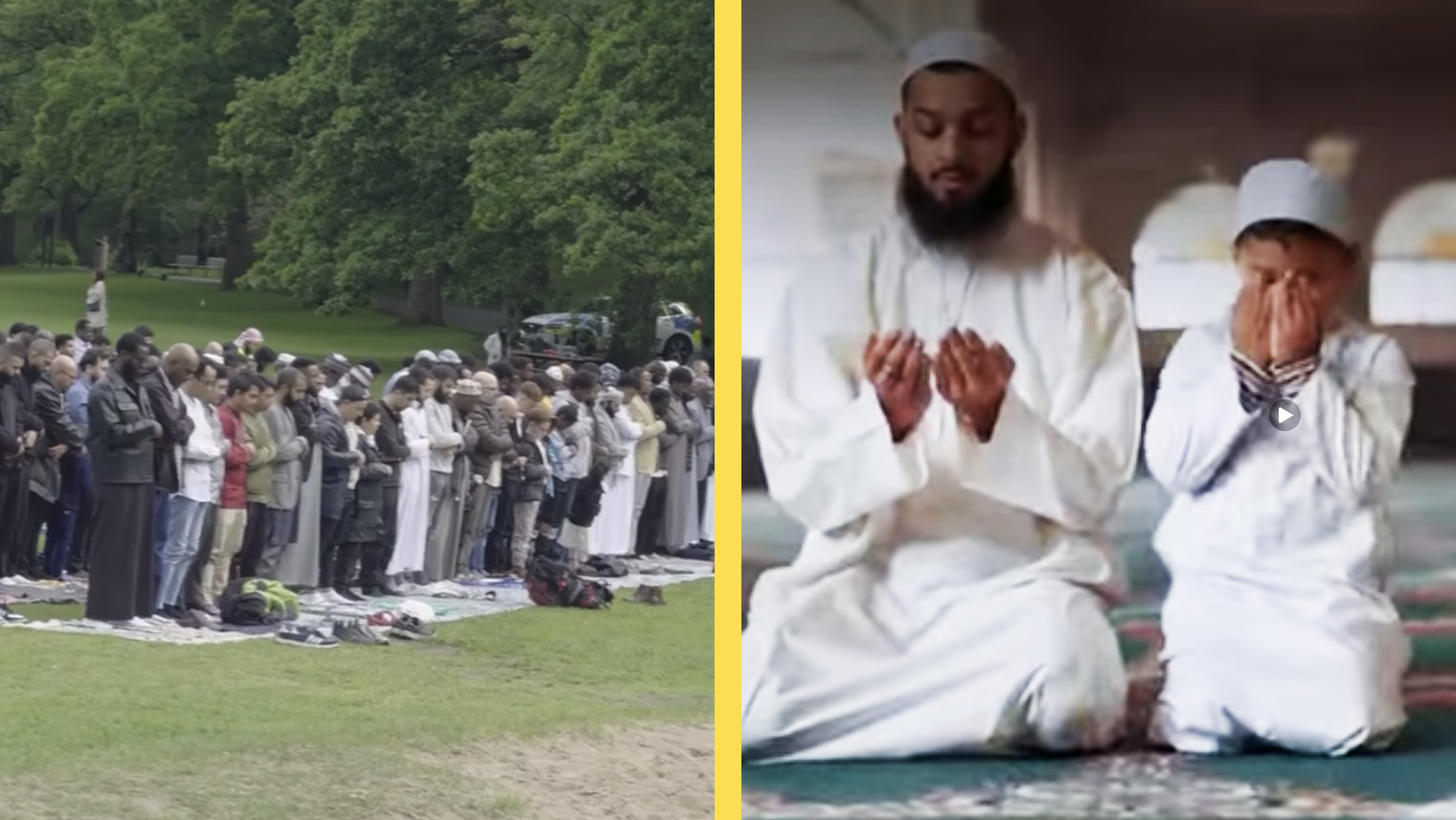
Mobilization happens through mosques and ethnic networks, and political messages are tailored for people based on language, religion, and migration background.
This is hardly a conspiracy. It’s much simpler than that. Politicians want votes.
If there are hundreds of thousands of voters who can be mobilized through messages about, for example, discrimination, Islamophobia, migration policy, or the threat from the Sweden Democrats, political actors will naturally try to reach them.
And if the Social Democrats can buy clan votes in exchange for allowing yet another shady Islamic center, they will do so. Which is exactly what has happened, even if they deny it themselves.
And here, a political feedback loop arises that Sweden has barely begun to discuss. The larger these voter groups become, the more important their votes become. And the more important their votes, the greater the incentive for parties to tailor their policies to them.
Migration thus changes not just the population. It can also change the conditions for future migration policy.
Demographics Vote Too
This is where my earlier interview with the Finnish mathematics professor and demography researcher Kyösti Tarvainen becomes uncomfortably relevant. Tarvainen has tried to calculate how population composition in the Nordic countries might evolve over the long term.
In a 2018 study, he calculated, based on the model’s assumptions about migration, birth rates, and assimilation, that the share of the native Swedish population could drop to around 49 percent by 2065. Today, many claim that may happen even faster.
Precision is important here. This is a projection, not a prophecy. If migration or other factors in the model change, so does the outcome.
In a recent Novus poll, around 85 percent of Muslim voters in Sweden stated that they support one of the three red-green parties S, V, and MP. Just the Social Democrats and the Left Party together gather over 80 percent.
Jonas Andersson
But that really is the whole point. The future is not predetermined. It depends on what we do now.
READ ALSO: The Only Thing That Can Never Be the Problem
When I interviewed Tarvainen earlier this year, his conclusion was that reduced immigration is no longer enough if the ambition is to actually reverse the trend. His conclusion was therefore repatriation. And this is where demographics meet democracy.
The Population Decides What Votes Exist
This should really be obvious. If two voter groups, on average, have significantly different political preferences, a shift in their relative sizes will also have political consequences.
Of course, this does not mean that people with immigrant backgrounds all vote the same way. They don’t. People change their minds, assimilate, move up the class ladder, and children can have completely different political values than their parents.
READ ALSO: Europe is changing its population—but politicians are still talking about integration
Still, in a recent Novus poll, around 85 percent of Muslim voters in Sweden said they support one of the three red-green parties S, V, and MP. Social Democrats and the Left Party together gather over 80 percent alone.

And already today, we see how religion, migration, ethnicity, and group identity can be used for political mobilization. This is democracy in its most brutally mathematical form.
If Europe’s demographics change fundamentally, Europe itself changes. Countries are not just administrative areas with a registration number, a flag, and a tax office. Nations are made up of people, language, history, culture, and continuity between generations.
Jonas Andersson
Those who get the most votes win. But the population decides which votes are up for grabs.
READ ALSO: Hesa Fredrik Sounds—but No One Warns About the Invasion
Vlaardingerbroek: Europe Without Europeans
The same question recurred when I interviewed the Dutch opinion maker and right-wing debater Eva Vlaardingerbroek. For her, mass immigration is no longer mainly a debate about integration budgets, labor markets, or crime. She sees the question as existential—who will make up Europe’s population in the future?
And thus—who will make up Europe’s electorate?
Vlaardingerbroek put her position truthfully and brutally:
—Europe without Europeans as the majority population will no longer be Europe.
READ ALSO: Eva Vlaardingerbroek to Samnytt: “Repatriation is Europe’s last peaceful chance”
You can agree with her or despise the conclusion—but reality can’t be wished away. Europe is not just a patch of land or a geographic area. It is the cradle of the world’s most successful and humanist civilization and culture.
If Europe’s demographics change fundamentally, Europe itself changes. Countries are not just administrative areas with a registration number, a flag, and a tax office. Nations are made up of people, language, history, culture, and continuity between generations.
That really should be the most self-evident thing in the world to understand.
Can the Right Win Back Power?
This brings us to the question the Swedish right should be losing sleep over. What happens to the possibility of enforcing a restrictive migration policy if the groups most opposed to it simultaneously grow as a proportion of the electorate?
What happens to the Sweden Democrats? What about the Moderates and Christian Democrats?
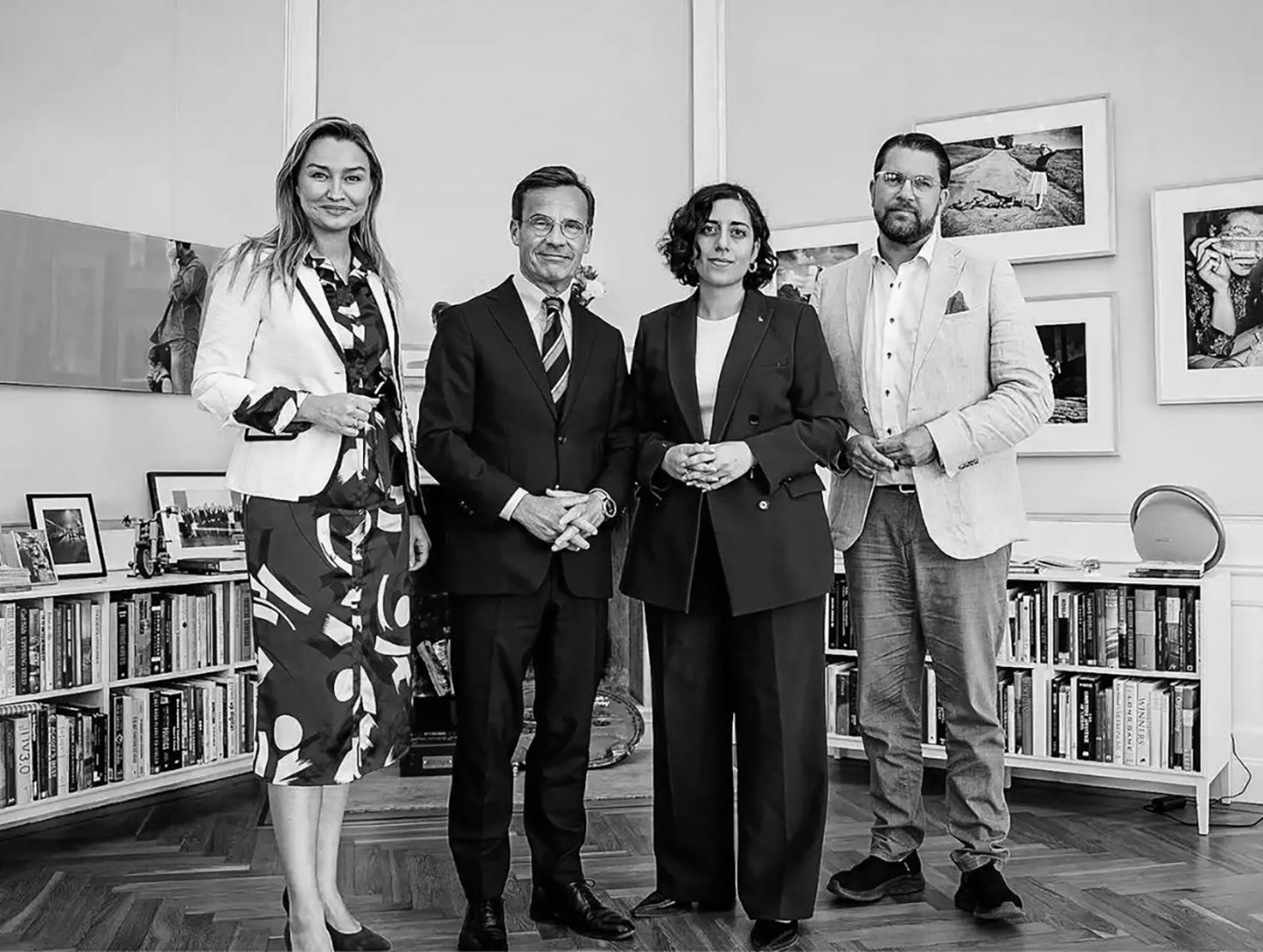
What happens to the possibility of forming a center-right government if the left succeeds in building a long-term coalition of traditional left-wing voters, public-sector urban voters, and large groups of voters with non-European backgrounds?
The right still seems to imagine politics like a football match. If we lose this time, we’ll win the next. Or the time after.
But that reasoning is based on an unspoken assumption—the playing field and basic makeup of the electorate remain about the same.
And that’s where we come to the word that still makes much of the Swedish establishment choke on their coffee. Repatriation. Vlaardingerbroek, when I interviewed her, described it as Europe’s last peaceful option. Tarvainen’s conclusion is, from a demographic perspective, similar—if the ambition is to truly reverse the trend, it’s not enough, in his view, to just reduce future immigration.
Jonas Andersson
But that’s not the case. Sweden changes with every election—and over the past decades, our country has changed drastically.
READ ALSO: Sweden faces its fateful election—and Tidö risks having thrown away its chance
Think about the mechanism. Migration creates new citizens and voters. Voters influence migration policy. And migration policy in turn influences the future population.
And the future population determines the electorate of the next generation. This creates a self-reinforcing political development. The further it goes, the harder it is to build a democratic majority for the kind of policies that could break it.
READ ALSO: Andersson: “Time to rally around the next demographic do-or-die issue”
This is why today’s Arabic-language election campaigns are far more significant than any pamphlets. They show us a chilling miniature of the future.
Repatriation
And that’s where we come to the word that still makes much of the Swedish establishment choke on their coffee. Repatriation.
Vlaardingerbroek called it Europe’s last peaceful option when I interviewed her. Tarvainen’s conclusion is similar from a demographic point of view—if the ambition is to actually reverse the course, it is not enough, in his view, to simply reduce future immigration.
I think this question must be taken seriously.
Not because people with foreign backgrounds lack human dignity or democratic rights. Of course they don’t. But because Swedes also have a right to want Sweden to remain Sweden. Europeans have a right to want Europe to remain European.
And I refuse to accept the argument that we must do the opposite just because a bunch of lost skinheads used the slogan “Keep Sweden Swedish” in the 1980s. That’s about as stupid as claiming we must eat meat because Hitler was a vegetarian.
Jonas Andersson
This is a self-evidence we accept when almost every other people in the world express it, but that suddenly becomes suspect when Europeans do it.
READ ALSO: Head of the Repatriation Institute warns Sweden: “You have a window of five to ten years”
A Swedish Sweden Even for Our Grandchildren
For me, then, repatriation is not primarily a question of anger or punishment. It is a question of the future. If Sweden, fifty or a hundred years from now, is still to be a recognizable Swedish and European country, it is not enough to simply manage demographic development a bit more effectively. It must be reversed.
And I refuse to accept the argument that we must do the opposite just because a bunch of lost skinheads used the slogan “Keep Sweden Swedish” in the 1980s. That’s about as stupid as claiming we must eat meat because Hitler was a vegetarian.
How such a policy is designed is a separate discussion. Naturally it must follow Swedish law and international obligations, and differentiate, for example, between voluntary repatriation, people without legal right to remain, and Swedish citizens whose rights do not disappear simply because their parents were born elsewhere.
But the goal itself must be open to discussion. For the alternative is also a political choice—to continue to a place where Sweden ceases to be a Swedish country.
Democracy Requires Something in Common
There is a deeper question than just who wins the election. How long will a democracy function well if citizens no longer share the same public conversation?
Democracy is more than ballots. It presupposes at least some form of demos—people who perceive themselves as participants in the same society, can communicate with each other, and essentially discuss the same political reality.
But demography is not the weather. It is the result of political decisions. And political decisions can be changed. The question is just how long that possibility will remain. For one day, the Swedish right may discover that it did not lose power for four years. It lost the possibility to regain it.
Jonas Andersson
The Sweden that built modern Swedish democracy had all this almost for free. Almost everyone spoke the same language. There was a strong shared national identity. Social Democrats and Moderates could despise each other’s politics, but at least they debated what kind of Sweden Sweden should be.
Now, the very question risks changing—not how Sweden should be governed, but what Sweden is.
READ ALSO: Demographer to the Riksdag: “Only repatriation can save Sweden”
The Irrevocable Election
This is why I think we will look back on this period with amazement. We saw the statistics. We saw segregation. We saw parallel societies. We saw language problems. We saw religious and ethnic mobilization. And we saw election campaigns in Arabic.
And still, much of political Sweden continued to talk about demography as if it were a weather forecast no one could affect.
But demography is not the weather. It is the result of political decisions. And political decisions can be changed.
The question is just how long that possibility will remain. For one day, the Swedish right may discover that it did not lose power for four years. It lost the possibility to regain it.
READ ALSO: Bali: Demographics May Make Future Right-Wing Governments Impossible
And one day, Swedes may discover that the question is no longer what kind of Sweden they want to pass on—but whether the Sweden their ancestors left to them still exists.
That’s why the trend must be reversed while it can still be reversed. For if Sweden is to remain a Swedish and European country in the future, Swedes themselves must dare to say that that is exactly what they want.