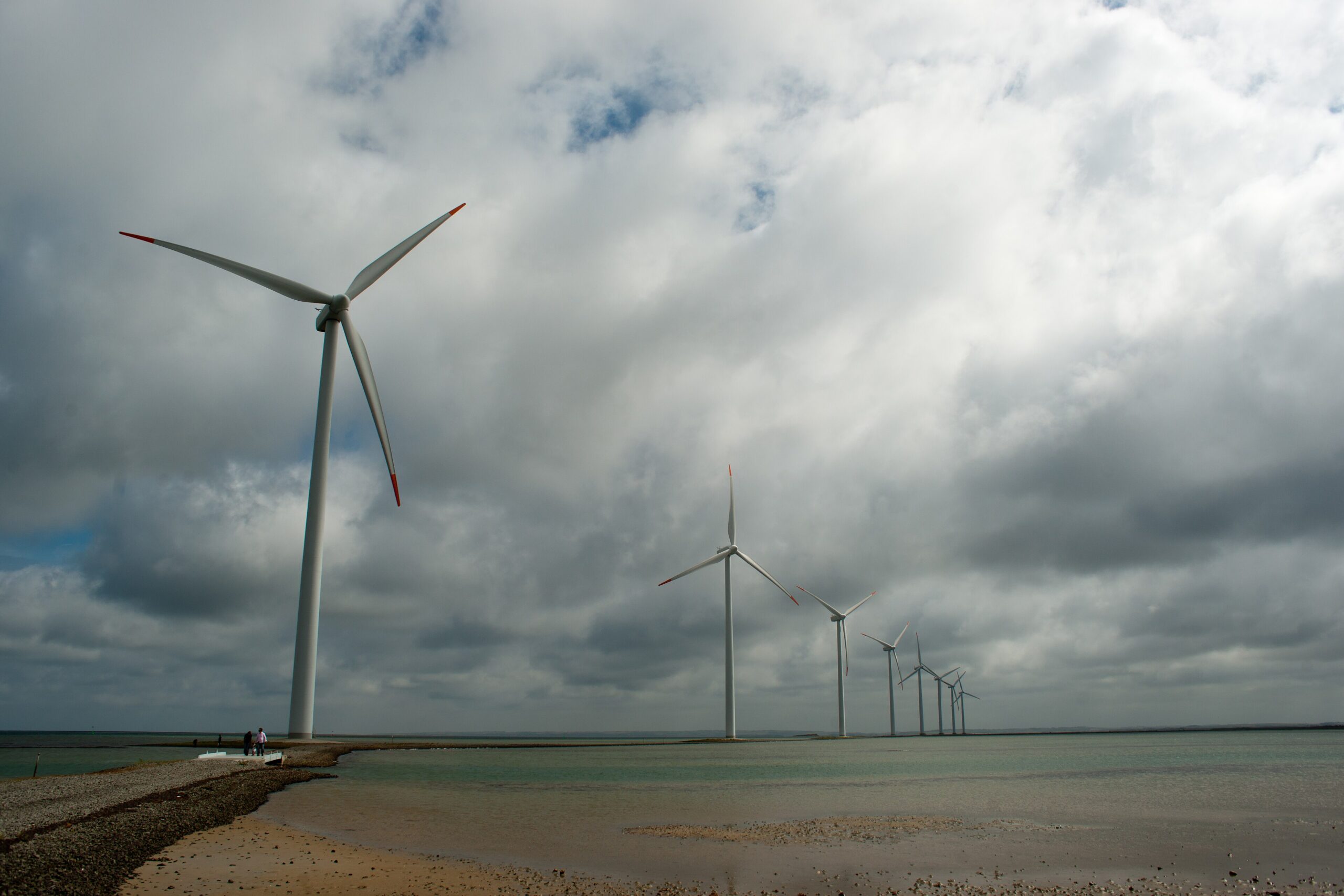
A municipal wind power initiative intended to deliver cheap electricity and strengthen the local economy instead ended up resulting in heavy losses for taxpayers. This is the claim of former Sweden Democrat MP Thoralf Alfsson, who in a video segment delivers sharp criticism against both the project’s forecasts and the political decision-making behind it.
The project in question is Emåbygdens Vind AB, which was owned by three municipalities in Småland. The wind turbine was purchased for SEK 33 million but sold in 2024 for just over SEK 2 million—a deal that meant a loss of more than SEK 30 million.
On top of that are additional costs in the form of capital contributions and outstanding loans, pushing the total burden on the municipalities to over SEK 40 million. In his post, Alfsson describes the affair as a clear example of failed municipal entrepreneurship.
– This is what happens when local politicians try to play businessmen… it’s a complete disaster.
Lower Production Than Expected
A central point of criticism concerns the fact that the wind turbine never achieved the production levels that had formed the basis for the investment decision. According to the original calculations, the turbine was supposed to generate just over 7,300 MWh per year.
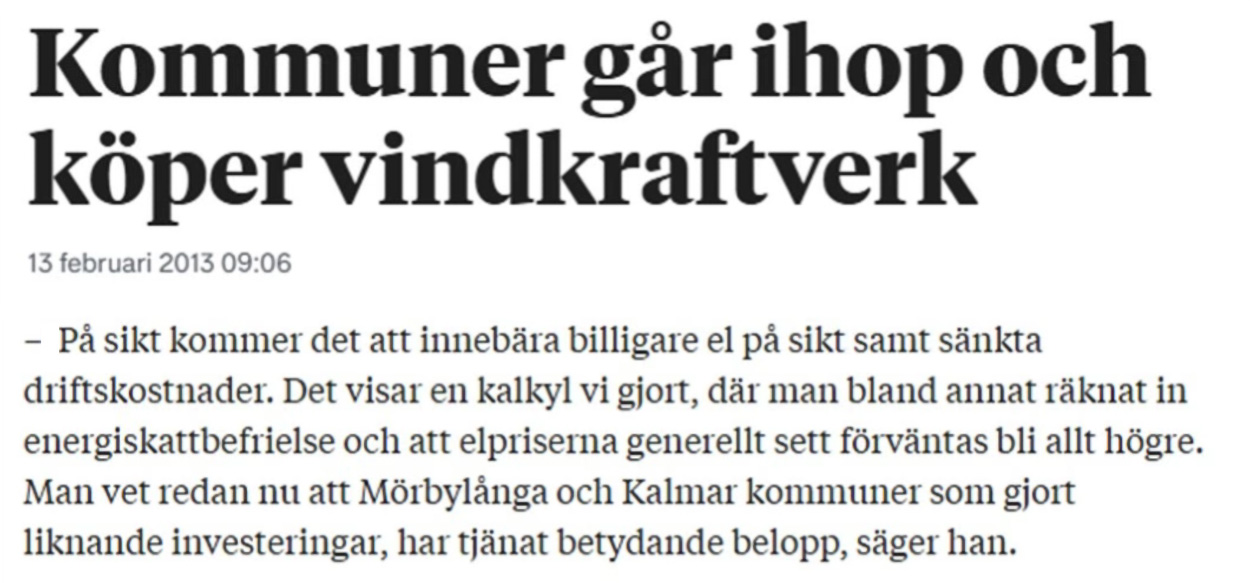
The actual outcome averaged around 5,300 MWh—about 30 percent lower. Alfsson claims this is typical for similar projects.
– These are wishful calculations… the efficiency rate is always lower than expected.
The lower production had direct financial implications by reducing revenues, which quickly led to deficits.
Repeated Capital Injections
Just a few years after the project launched, the municipalities were forced to inject new funds to keep the company afloat. Capital infusions were made on several occasions—including in 2017, 2020, and as recently as in 2024 and 2025.
In spite of this, the losses continued, and eventually the owners decided to sell the facility. Even after the sale, there remained loans that the municipalities had to settle, which increased costs further.
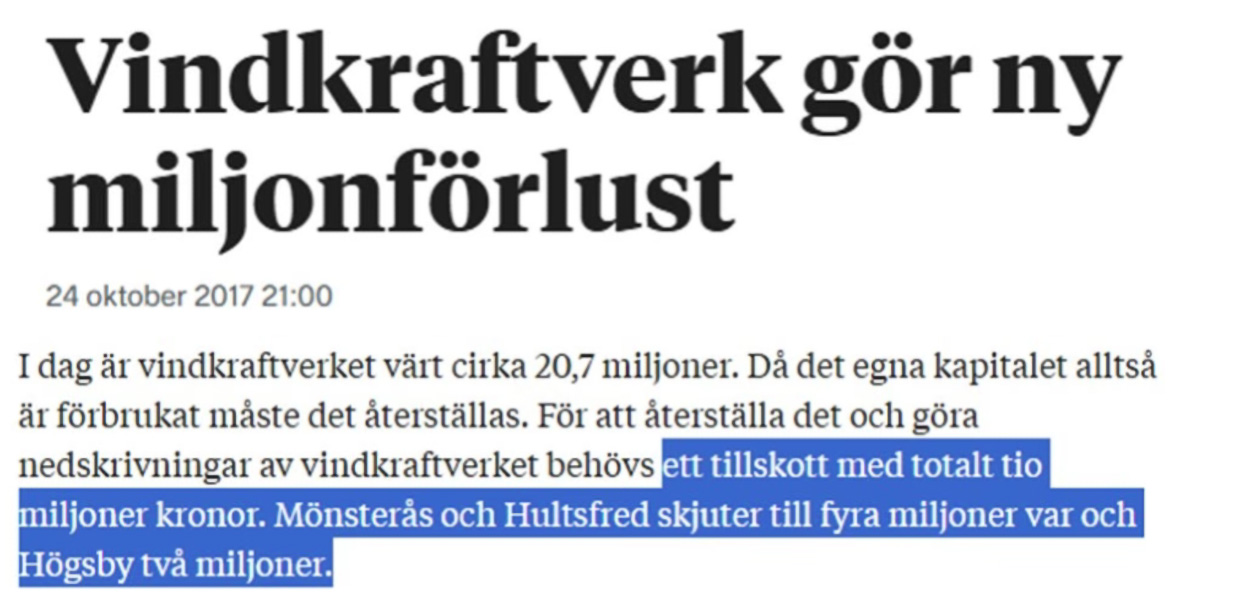
Alfsson describes the development as a protracted financial failure where the decision to wind down came too late.
Political Criticism of Decision-Making
A large part of the criticism is directed at the politicians who pushed through the investment. According to Alfsson, the decisions were based on overly optimistic forecasts and lacked connection to the municipalities’ core responsibilities.
He also points out that similar initiatives were undertaken in many municipalities during the same period, often with the ambition to become self-sufficient in electricity. At the same time, he questions the prioritization.
– Tax funds… should have gone to healthcare, schools, and social services instead.
“A Problem Project” in Retrospect
When the decision to sell was finally made, representatives of the municipality described the deal as necessary. In his post, Alfsson notes that the project was then called a “problem project”—despite the fact, he says, that the issues had been obvious much earlier.
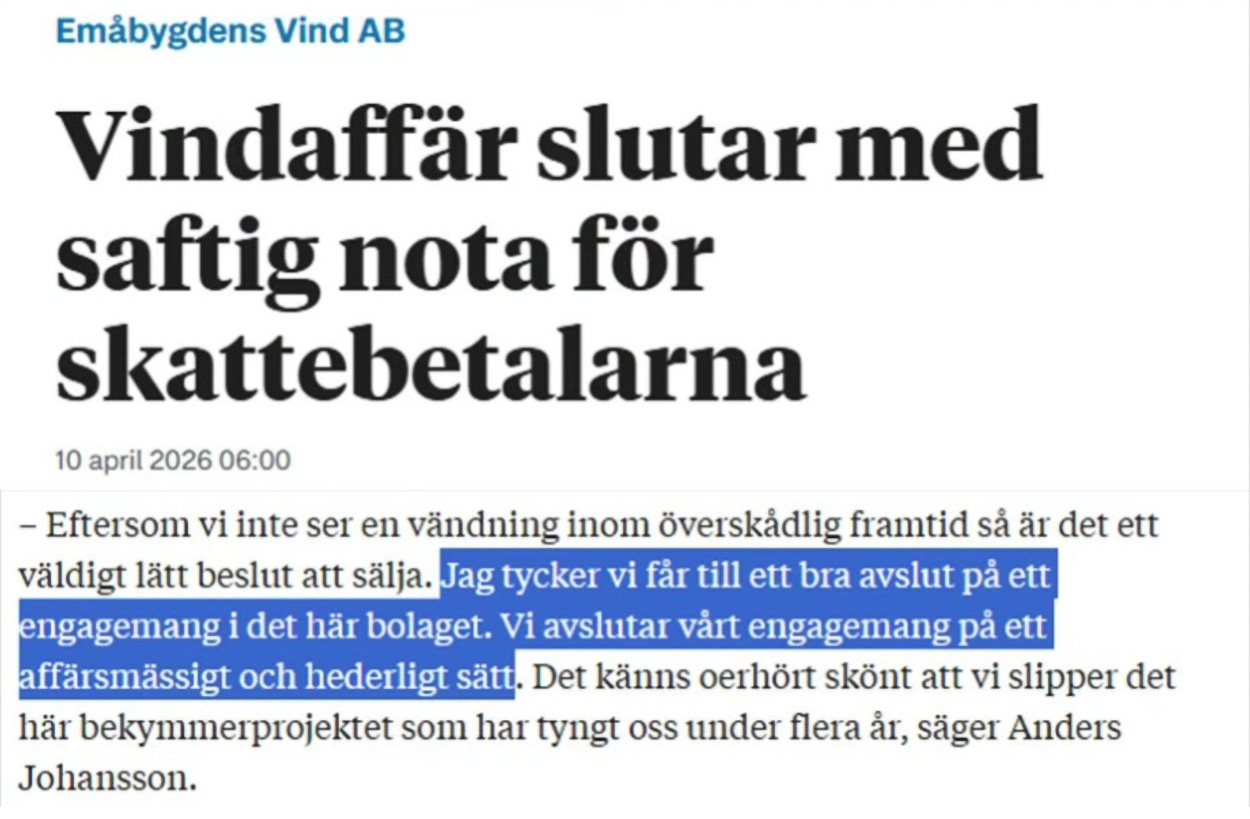
He also quotes statements calling the sale a “good conclusion,” which he himself questions in light of the major losses incurred.
Calls for Accountability and Lessons Learned
In conclusion, Alfsson uses the case as a broader example of the risks associated with municipal business projects beyond their core operations. He calls for greater accountability from politicians and encourages voters to reflect on how tax funds are used.
According to him, the case demonstrates the need for more realistic economic projections, clearer links to the municipality’s core duties, and greater transparency in decision-making processes.
The case of Emåbygdens Vind AB thus becomes, in Alfsson’s view, not just a single transaction but a symbol of broader issues in municipal investments.
Watch Thoralf Alfsson’s full post below.