LEADER • I have written a lot and often about Sweden’s demographic development. About the risks of handing out Swedish citizenship as extensively as Sweden has done – and about the absurdity of people who are not even Swedish citizens being allowed to take part in deciding municipal and regional elections. Now, only three weeks remain until election day. The question I constantly return to is therefore: why did the right choose to risk both their own election victory and Swedes’ ability to decide their own country’s future?
Demography is power. The left understands this. Many immigrant groups from the Middle East and Africa know it too, where representatives have openly spoken of growing political influence while clan- and personal voting has already affected Swedish candidate lists. Samnytt has reported on this numerous times.
The right, on the other hand, does not seem to have grasped the importance of the issue. If they had, it’s hard to understand why 217,181 Swedish citizenships have been granted since the change of government – from October 2022 through July 2026.
This could prove to be Tidö’s biggest strategic mistake of the whole term.
READ ALSO: With mass immigration comes clan voting
According to SCB’s latest party preference survey from May 2026, the party preferences among foreign-born and people with a foreign background look like this:
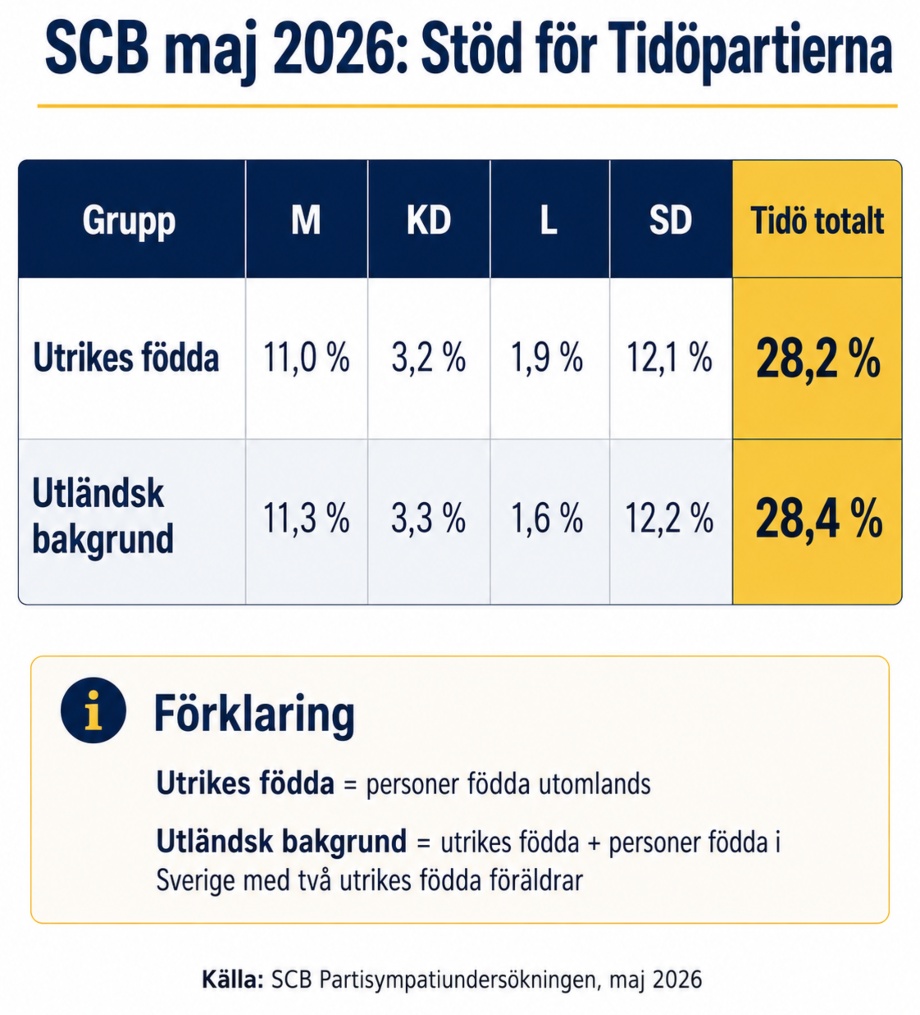
Among foreign-born, S, V, C, and MP together receive 70.4 percent.
This is an enormous political tilt.
Grim math
So what do the 217,181 new citizenships mean for the election? Not all can vote, of course. Some are children.
Statistics from the Migration Agency show that just over 154,000 were registered as adults already when they received Swedish citizenship. So this is not an estimate, but a direct figure from the authority’s statistics. In addition, nearly 63,000 people were minors when the decision was taken.
Some of them have since – or will – turn 18 before the election on September 13, 2026. Since the Migration Agency’s public statistics don’t specify exact birthdates for the group, it isn’t possible to get an exact number. But based on the year citizenship was granted, one can make a cautious estimation.
READ ALSO: Ekeroth: ”The right really wants to lose the election”
Children who received citizenship already in autumn 2022 have had nearly four years to reach legal age. For the 2023 group, it’s about three years, for 2024 about two years, and so on. With a rough age distribution, this means that around 8,000 of those registered as children can be expected to have become adults before the election.
That means we end up with about 162,000 new Swedish citizens entitled to vote in 2026.
But of course, not everyone will actually vote.
In the 2022 general election, voter turnout among foreign-born was about 67 percent. If we assume about the same turnout among this group in 2026, this means:
162,000 × 67 percent = about 109,000 votes cast.
And now comes the decisive part. SCB’s latest party preference survey thus shows that 70.4 percent of foreign-born support S, V, C, or MP, while 28.2 percent support the Tidö parties.
If the new citizens vote about the same as the foreign-born group overall, those 109,000 votes would be distributed roughly like this:
S + V + C + MP: about 76,600 votes.
M + KD + L + SD: about 30,700 votes.
The difference:
About 46,000 votes in favor of the left side.
And how big was the Tidö parties’ margin of victory in the 2022 election?
46,296 votes.