EDITORIAL • The US and Israel’s attack – Epic Fury / Roaring Lion – against Iran has been described by many as a morally and security-wise necessary intervention against a brutal regime. But when international law, nuclear weapons regulations, and principles of political violence are applied differently depending on who breaks them, it raises the question of how rule-based the world order the West claims to defend really is.
Iran is without doubt one of the world’s most repressive regimes. Opposition is crushed with violence, women are oppressed, and minorities persecuted. That the regime is weakened or obliterated therefore elicits understandable schadenfreude among many – not least among Iranian exiles.
The Iranian regime illustrates not only what happens inside, but also outside, when Islam is allowed to govern a country. Here it has manifested in an intense hatred towards distant America, the “Great Satan,” and a grossly criminal, antisemitic foreign policy towards Israel in the relative vicinity.
But that doesn’t exempt us from the requirement to be able to hold several thoughts in our heads at once. That a regime is brutal does not mean that all methods against it automatically become legitimate. If principles only apply when it’s convenient, they, by definition, cease to be principles.
The attack on Iran raises questions about why now, against a regime whose evil we have tolerated for almost 50 years, and whether the motives are only the noble ones heard in public or if there are other hidden reasons. But above all, the question once again arises: where did the rule-based world order so often championed by Western political leaders disappear to?
Selective International Law Is Not International Law
The US initiated the assault without a UN Security Council mandate. The White House also had not sought any formal approval from Congress. In an international system where the use of force is in principle forbidden – except in self-defense or with the Security Council’s mandate – this is no minor detail but a core issue.
Israel, at least, had some degree of domestic political backing for the operation. The government acted in concert with military leadership and had support from the Knesset’s Foreign Affairs and Defense Committee. The country has also long been in a warlike conflict with Iran. But internationally, this doesn’t change the fundamental problem: the attack lacks broad international legitimacy.
READ ALSO: Dagerlind: Whose Rules, Whose Order?
In recent decades, the West has repeatedly described international politics as a system of shared rules. When Russia invades Ukraine or when other states violate international law, the very foundation of this order is said to be at stake. The condemnations rain down, with one viewpoint wholly prevailing.
But when Western powers themselves violate the same principles, it is instead described, at best, as a regrettable but necessary exception, and at worst, not considered a violation of the rules at all. The result is a world order where the rules do not apply equally to all, but often function as a language to criticize opponents.
I devoted another editorial recently to examining this concept with a historical perspective. The image was disheartening. Now we have a fresh example of the application of rules—or, rather, their absence. The picture darkens further.
Nuclear Weapons and Double Standards
Iran has long developed its nuclear technology and today enriches uranium to levels far above what civilian programs normally require. This is a legitimate cause for concern. At the same time, the International Atomic Energy Agency, IAEA, has not been able to determine that Iran currently runs an active program to actually build a nuclear bomb.
Israel, on the other hand, is considered by most international observers to have possessed a significant nuclear arsenal for a long time. However, the country has never officially acknowledged this and has not signed the Non-Proliferation Treaty, NPT. This “strategic ambiguity” makes it possible to both deter opponents and avoid international inspections.
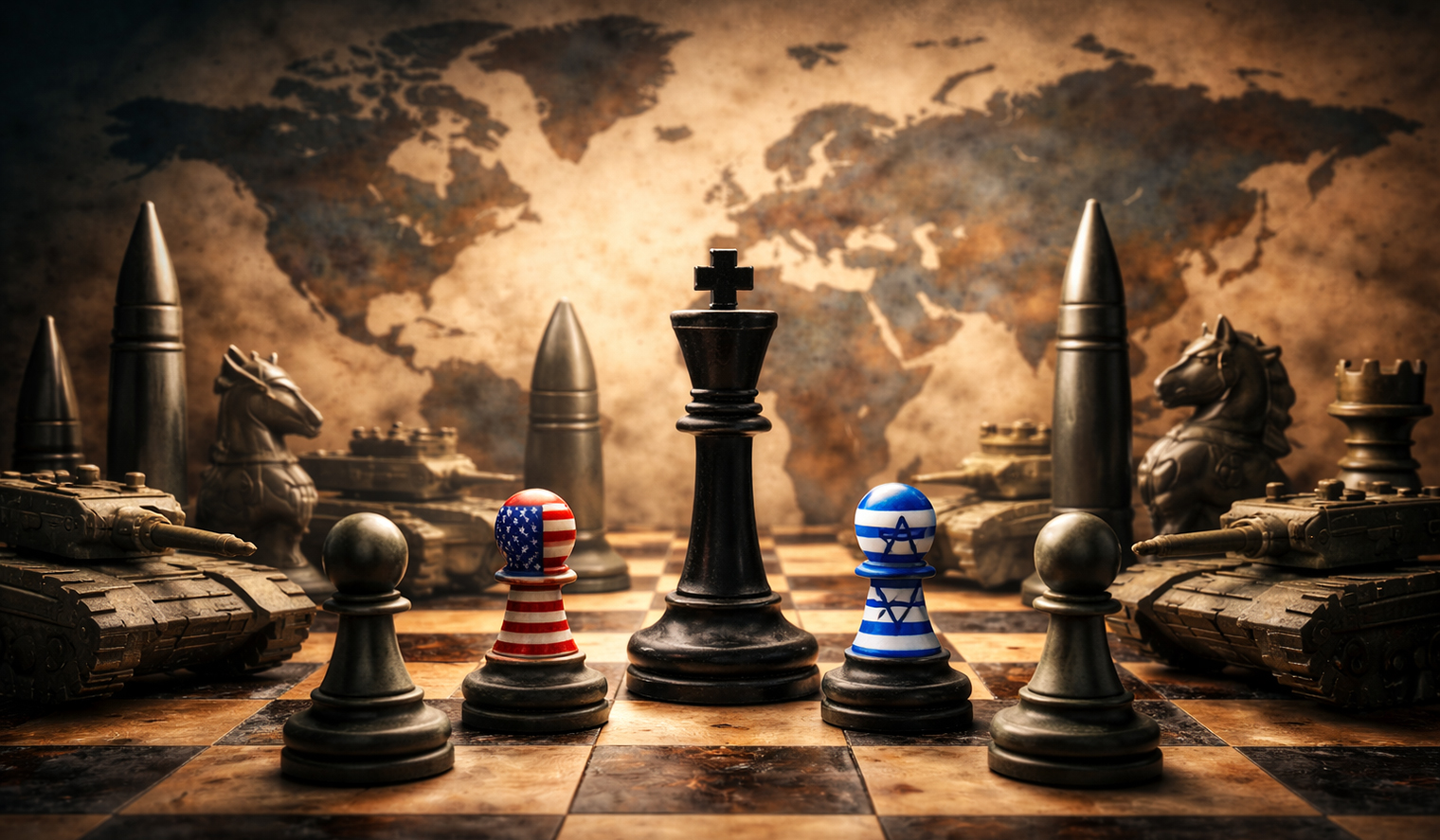
It is something of a paradox that a country outside the nuclear regulatory regime attacks another country suspected of violating that very regime. The defense is that the Israelis are good and the Iranians evil – so we ignore the rules in one case and bomb a country to pieces in the other.
The prospect of a Muslim-ruled Iran with nuclear weapons is indeed more problematic than a Jewish-ruled Israel with nuclear weapons. In the West, we see this as an objective truth. But the West is not the whole world, and elsewhere – no matter how strange we find it – the opposite opinion prevails. A Jew with nukes is evil defined.
That opinion has, in fact, recently found its way into the Swedish commentariat. The questioning of the attack on Iran from the standpoint of a rule-based world order, as one could interpret this text’s stance to be, is insignificant compared to the unconditional support for Iran against Israel’s Jews that much of the Swedish left has now added to the equally unconditional support for Hamas in recent years.
But when the rule-based world order is applied selectively based on who is viewed as good or evil, it is no order at all. That’s subjective values, and these can vary greatly depending on whether one adheres to liberal democracy or a Muslim death cult as a worldview.
The Experience of Military Interventions
History also gives reasons for caution when military interventions are presented as shortcuts to democracy. The Iraq War in 2003 was supposed to liberate a people from dictatorship but resulted in state collapse and sectarian violence. The intervention in Libya in 2011 followed a similar pattern. In Afghanistan, it took two decades before the Taliban reclaimed power from a corrupt puppet regime with little reach beyond Kabul, which was the only alternative the West managed to establish.
READ ALSO: Dagerlind: A New Middle East War – and Europe as the Final Destination
Experience shows that bombs and invasions rarely serve as precursors to democracy in the way their advocates hope or at least claim to believe. It also weakens criticism against actors who do the same but in ways and for reasons we dislike, such as Russia.
Shifting Attitudes in Swedish Debate
After the attack on Iran, Iranian exiles in Europe took to the streets to celebrate the regime’s weakening and the fall of its leadership. At the same time, other groups have demonstrated and expressed sorrow over what happened, not without having valid grounds to criticize the attack. The reactions have been strong and contradictory.
Every week for years, we have seen Palestinian exiles and other Hamas supporters take to the streets in Sweden with unashamed Jew-hatred. Diasporas from other countries have done the same. Are we now to add mass demonstrations by Iranian exiles? And what happens when these groups confront each other? Do we want our cities to be the stage for this? Should we apply a general principle for these phenomena or just go with our gut feeling?
In some cases, it is seen as perfectly legitimate to rejoice when a political leader is liquidated, citing that the person represents a brutal regime threatening the world. In other situations, the same type of reactions—where people celebrate violence against opponents and their untimely death—are condemned.
Palme and Khamenei – Different, but Also Not
That people feel and react differently is something we are forced to live with. Many mourned when Sweden’s Prime Minister Olof Palme was assassinated. But there were also those who cheered. Problems arise when principles yield to opinions, and celebrations in our streets over a liquidated ayatollah Ali Khamenei are seen as entirely uncontroversial and without consequences.
Publicly cheering the death of political enemies should be problematic, regardless of who the victim is, unless it occurs in wartime and according to the rules of war. The liquidation of Khamenei does not meet those criteria, however abhorrent we may think he is. Over there, there are also many who view Western leaders with similar disgust, and we will have a hard time making our arguments if and when they are assassinated.
Even less legitimate are the assassinations of Iranian nuclear scientists who are more to be regarded as impartial civil servants than evil leaders. The threshold for the elimination of key competence in our society is accordingly lowered. Right now, there is much talk of Swedish nuclear weapons. How would we view Swedish nuclear scientists being found murdered by Novichok in the future—as just part of the game we chose to play and have to tolerate? Doubtful.
If we accept such actions when they target our opponents but condemn them when they target our allies, it is no longer principles that guide us, but loyalties. Having loyalty and holding to principles may then seem mutually exclusive, but it becomes a bit easier if your loyalty lies with those who remain principled. Blind clan loyalty is not something to emulate.
This is not the same as relativizing ideologies. We do not have to see Iran’s brutal Muslim dictatorship with its antisemitism, misogyny, executions of homosexuals, and more as equally valuable as our liberal democracy. But there’s a limit to how narrow the margin can be in actions before it’s hard to see the difference.
When Rules Only Apply to Others
International politics will always be shaped by power and interests. It would be naive to think it can be abolished entirely through legal formulations. But precisely for this reason, principles and rules are important. They serve as a brake on pure power politics. Problems arise when the rules are only considered binding for some, or are even constructed to be so.
If the rule-based world order is to be more than a rhetorical slogan, it must also apply when it is politically inconvenient. Otherwise, it risks becoming what many already suspect it is—a language to legitimize one’s own actions and condemn others’.
And in such a world, it is ultimately not the rules that decide what is right or wrong—but who has the power to break them.
READ ALSO: So Many Millions Have Fled Their Homes Due to US Wars Since September 11, 2001