
EDITORIAL • Recently, I wrote about how one of the locks in the Swedish constitution – the total ban on revoking citizenship – is on the verge of being opened. It is an important normalization of the political scope of action in a Sweden where many should never have become Swedish citizens and others have forfeited the right to continue being so. But concurrently, a process is underway regarding the mechanics of the constitutional locks, which, if completed first, could make it impossible to open the former constitutional lock with the current key. Uncertainties surrounding this raise questions – one of them being whether the government is undermining its own policy.
At the same time as the parliament is preparing for the first of two votes on the possibility of revoking citizenship, it is also working on a proposal to change the decision-making rules for future constitutional amendments and introduce a requirement for a qualified majority for the second decision. Both proposals follow the same procedure: two identical decisions with a parliamentary election in between. But because they run in parallel, they have the ability to influence each other.
The purpose of the 2/3 rule is to strengthen the protection of the constitution and increase the inertia in changes to it. The reasons for why this is deemed necessary will be the subject of a future editorial by me on the topic of constitutional amendments. Here, we will suffice to note that such a constitutional amendment, when it comes into force, affects all future constitutional amendments. If the 2/3 rule undergoes its final parliamentary process before the citizenship issue and comes into force immediately, the conditions for the latter process change radically – from a simple majority to a qualified one.
Possible can become impossible
Even the former, given the current state of public opinion, is not a given that the Tidö parties will gather support after the election. The latter is a practical impossibility, knowing that all opposition parties, S, MP, V, and C, have made it clear that they intend to vote against. Constitutional work should be characterized by particular thoroughness and thoughtfulness, but now it becomes a bit like a high-speed riot between two competitors about who will reach the finish line first.
Those who want to carry out the citizenship amendment have an interest in having its second decision come before the entry into force of the 2/3 rule. Those who, for opposite reasons, wish to see the proposal voted down want the opposite. At the same time, no one publicly communicates this to the voters. They only argue for and against the two constitutional amendments in two separate discussions. But the showdown is in the air – there must reasonably be a political battle about the order of events. Anything else would be odd.
A timetable where two are desired
The government and the Sweden Democrats have announced a timetable for the constitutional amendment regarding citizenship, but neither they nor the opposition parties have done the same for the other constitutional amendment on a qualified majority for constitutional amendments. Here, there are only declarations of intent from the parties, where all parties except the Sweden Democrats have announced that they intend to vote for such a constitutional amendment. Why there is such a bias between yes and no is, as mentioned, material for a future editorial.
It is primarily up to the government to soon explain how it intends to proceed with a proposal to change the rules for a constitutional amendment to a qualified majority, so that the opposition parties are forced to show their true colors. Should they push to get the sequence of the two constitutional-related votes that benefits them or rely on winning the election and being able to defeat the citizenship constitutional amendment with the current rules where a simple majority suffices? But they also have an additional card to play.
Can play the motion card
A constitutional amendment does not have to come through a government proposition but can also be initiated through a motion by members of parliament. Formally, the right of initiative is thus open to the opposition as well. The crucial thing is not who proposes the amendment, but that the parliament makes two identical decisions with an election in between.
However, it is not the opposition that determines when such a motion is considered. The timetable is practically determined by the committees – in this case, the Constitutional Committee – where the government parties together with the Sweden Democrats have a majority. Even if all parties except the Sweden Democrats claim to support the 2/3 rule in principle, the government side can block or postpone the consideration, citing that the issue should be decided through the government’s own proposition.
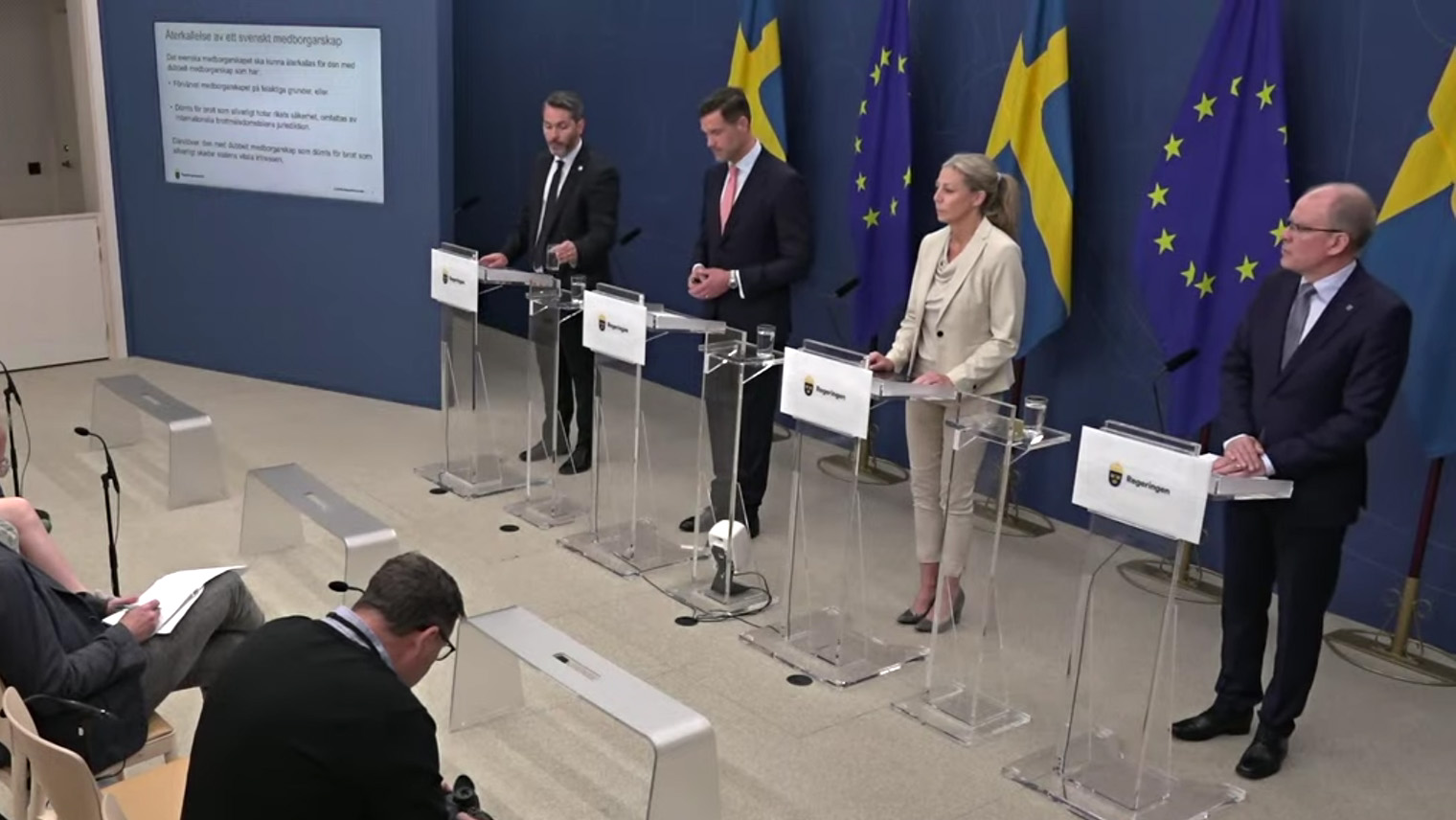
Politically, it would be difficult for the government parties to openly vote against a reform they have claimed to support, but it is possible to say yes to the idea and no to the timing. In this way, the opposition can make it difficult for the government to explain why it wants to delay the process of a constitutional amendment that it has emphasized as so important and can accuse the government of doing so for selfish reasons – to secure a victory in the other constitutional amendment on citizenship – and jeopardizing the “liberal democracy” by not prioritizing a strengthened protection against constitutional amendments. But, as mentioned, more on this argumentation will be covered in a future editorial.
However, the opposition cannot on its own force a quick first constitutional decision. In practice, it requires at least one of the government parties to break the bloc order for the opposition’s timetable to become a reality. It is not beyond the realm of possibility that the opposition could persuade, for example, the Liberals to switch sides, if Mohamsson assesses that it would benefit their dismal poll numbers. Desperation is high within the Liberals; it is about the party’s continued existence as a parliamentary party. But the scenario of bypassing a government proposition with a parliamentary motion may still be seen as unlikely and possibly something that can be conveyed as a threat in the debate.
Clear answers before the election campaign
The idea of constitutions is that they should be society’s most stable and predictable structures and a foundation for the democratic rule of law. The fact that two weighty constitutional issues are running in parallel does not in itself have to be a major problem, even if it is not ideal to let such central legislative proposals compete for space in the public debate and the attention of the media and voters.
What is unfortunate here is that one legislative amendment potentially can change the conditions for the other and that no one knows how it will turn out. This is because the government has not communicated how it intends to change the rules for constitutional amendments and let that announcement be the starting point for any countermeasures from the opposition so that the discussion can be concluded before the election campaign starts in earnest, where there are enough other burning issues to focus on.
The focus should also be on the substance of the two proposed constitutional amendments, not on a meta-debate on how the decisions should be made to benefit one side or the other. For one of the constitutional reforms, the timetable is set – the one to open the lock that keeps politics from revoking incorrect and abused citizenships. Now we need to know if the key to that lock will become unusable before it has a chance to be turned, because the entire lock mechanism has been replaced.