Swedish State Agency Puts Hijab on Its Gender Equality Strategy
A Swedish government agency chose a woman in a hijab for the cover of its gender equality strategy. Critic Josefin Utas of the women's network Kvinnokraft 4.0 says the authorities are normalising women's subordination - the agency says it does not judge religious symbols.

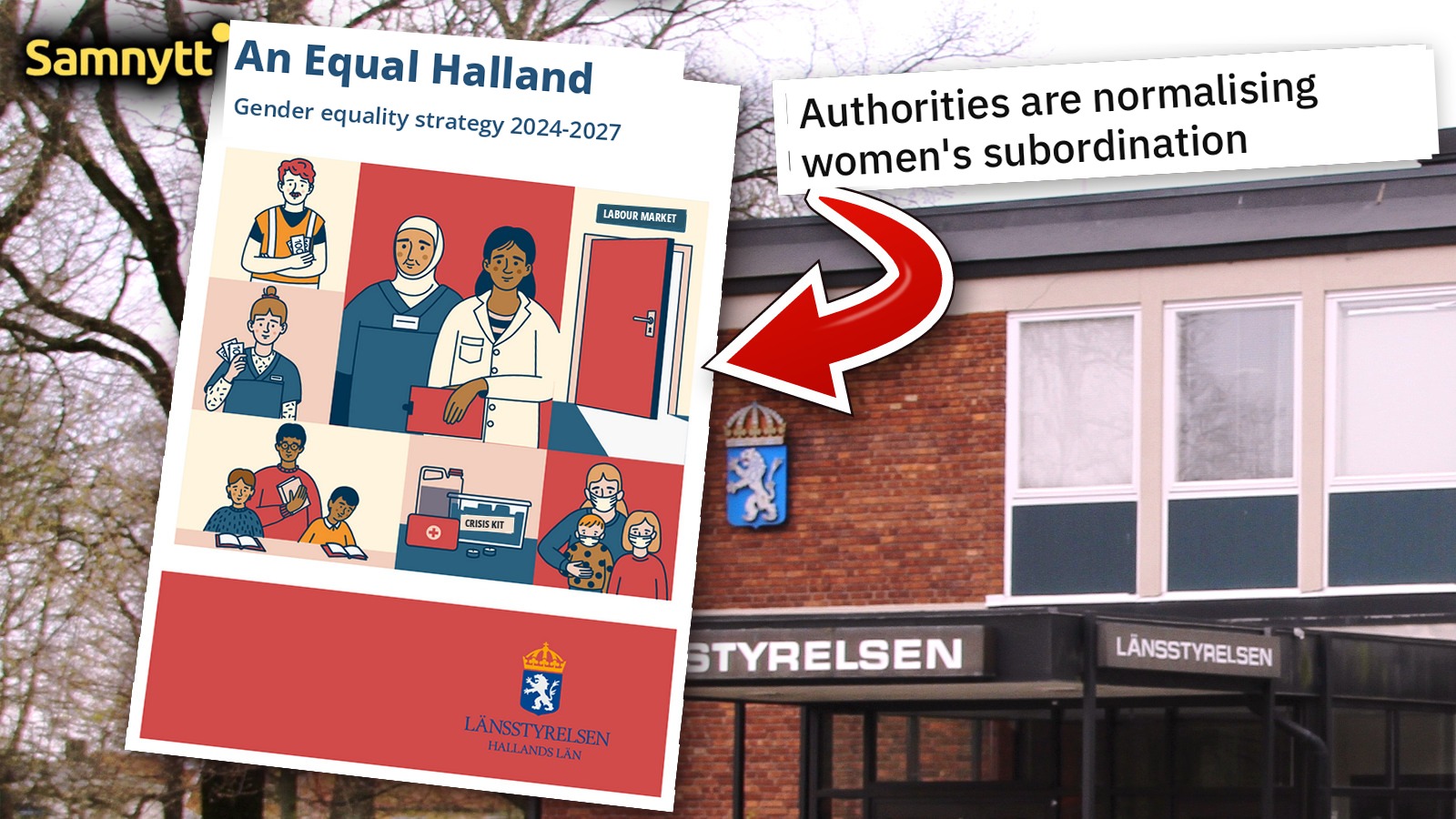
HALMSTAD - The County Administrative Board of Halland, a regional arm of the Swedish state, has put a woman in a hijab on the cover of its gender equality strategy.
Writing in the newspaper Nya Wermlands-Tidningen, commentator Josefin Utas of the women's network Kvinnokraft 4.0 says the authorities are normalising the subordination of women. The agency's answer: it does not judge what religious symbols mean.
The strategy, called "An Equal Halland", runs from 2024 to 2027. It was drawn up after a government assignment in 2023 in which the county boards were told to focus, among other things, on getting foreign-born women into work.
The assignment also covered economic equality and gender equality in civil preparedness. The strategy builds on Sweden's six national gender equality goals, one of which is that men's violence against women must end.
The cover is an illustration. A woman in a hijab stands beside a colleague in front of a door marked "labour market". The strategy text itself mentions neither the veil nor the hijab.
"We do not assess religious symbols"
In January, Kvinnokraft 4.0 asked why a state agency had picked the hijab for a document about gender equality. In a reply dated 19 January, the county board wrote that the image was meant to make visible a target group covered by the strategy, tied to the section on foreign-born women entering the labour market.
"The County Administrative Board does not assess or value the meaning of religious symbols, theological interpretations or their relationship to different systems of norms," the agency wrote.
Utas calls the answer absurd. The whole point of gender mainstreaming, she writes, is that equality must be weighed in everything an agency does.
"Girls are raised into obedience"
To Utas, the hijab is part of a gendered power system in which a woman is expected to submit to her husband, her family or the imam, and in which girls are raised into obedience.
When authorities keep showing the garment uncritically, she argues, the pressure on girls and women to wear it grows.
She adds that women and girls who fled oppression in which the hijab played a central role now have to watch Swedish authorities treat it like any neutral piece of clothing.
According to Utas, the authorities justify such images with talk of inclusion and diversity, without ever addressing the gender roles the hijab is tied to. The garment is treated as a marker of identity rather than a symbol with a message.
The power structure behind the hijab, she writes, runs against both Swedish law and the UN women's convention CEDAW, which obliges states to counter norms and customs that limit the rights of girls and women.
"Sweden is one of the countries in the world that has come furthest on gender equality. We cannot let our shared public authorities normalise a symbol that at its core is about the subordination of women," she writes.
The strategy does name honour-related violence and oppression as an obstacle to foreign-born women finding work. The veil, however, is not mentioned once.
Simon Kristoffersson · Responsible Publisher & Senior Editor (Ansvarig utgivare)
Simon Kristoffersson is the Legally Responsible Publisher (Ansvarig utgivare) and Senior Investigative Editor of Samnytt and Samnytt News under Sweden's Constitutional Freedom of the Press Act, specializing in courts, organized crime, municipal governance, and public-sector investigations.
Follow @SamnyttNews on 𝕏 ↗