Swedish State TV Veteran: 'SVT Is Clearly Right-Wing'
Retiring after 36 years, former Moscow correspondent Bert Sundström dismisses claims that Swedish public broadcaster SVT leans left - and names the Sweden Democrats as a threat to its finances. He also reveals that SVT never ran his early article on Ukrainian involvement in the Nord Stream sabotage.

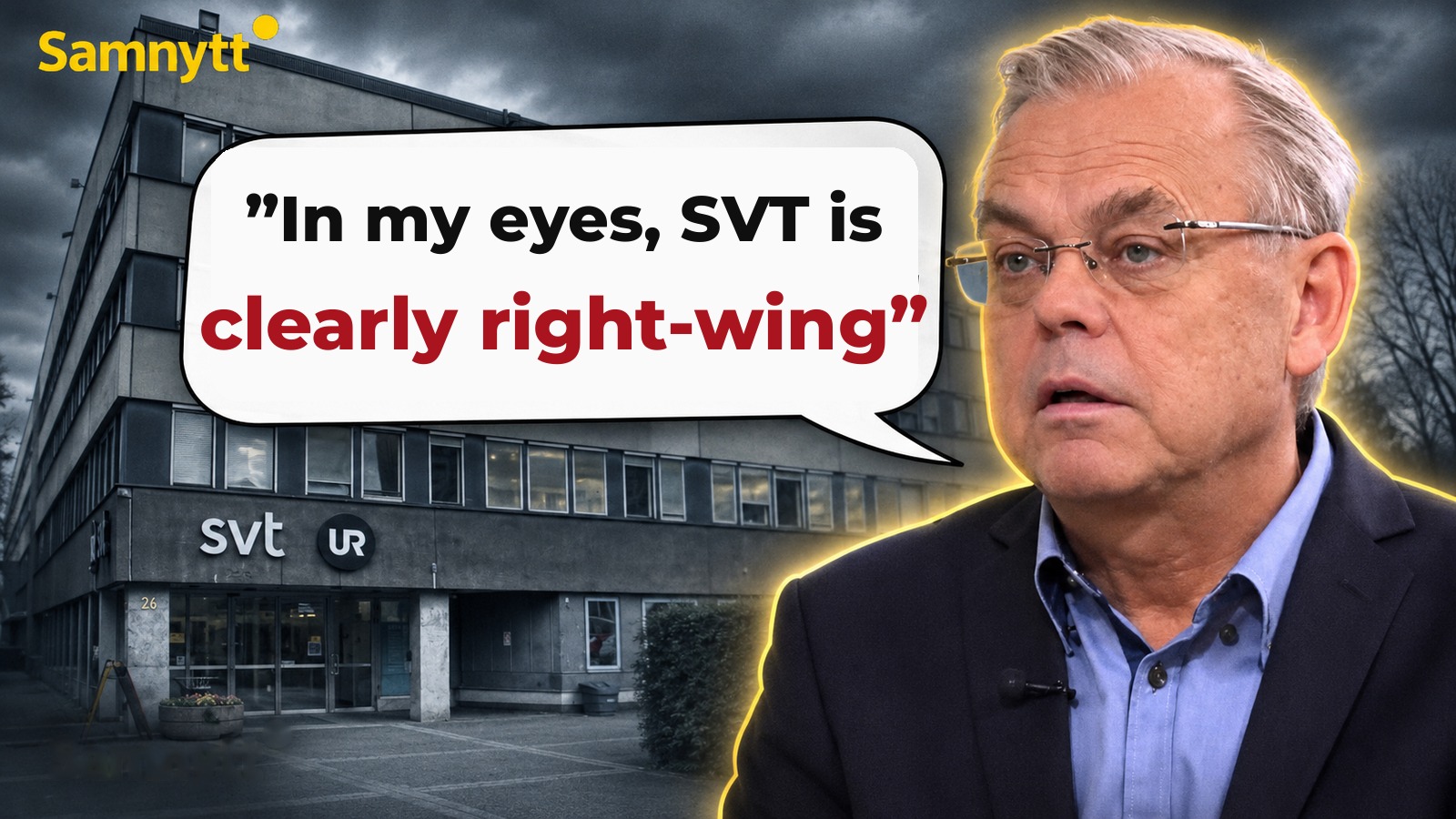
STOCKHOLM - After 36 years at Sweden's state broadcaster, veteran reporter Bert Sundström is retiring - and he is using his farewell to brush off one of the most persistent charges against public service television.
SVT is not left-leaning, he says. Quite the opposite: it is "clearly right-wing".
The former Russia correspondent, 67, announced on Tuesday that he is leaving SVT. Afterwards he answered questions from viewers and readers in a live chat.
When one of them asked whether SVT had drifted to the left over the years, Sundström dismissed the idea.
"In my eyes SVT is clearly right-wing. Maybe it was left in the 60s. But absolutely not today," he wrote.
Points the finger at the Sweden Democrats
Another reader asked whether his decision to quit was linked to SVT's strained finances, more expensive terrestrial broadcasting and "the right-wing parties' wish" to cut its budget.
"Yes. The Sweden Democrats and some others want to restrict us heavily. Our finances are getting worse. That's true in the rest of Europe too. But stopping when you're about to turn 68 is a personal decision," Sundström replied.
Behind the remark lies a heated fight over SVT's budget. In February the broadcaster said it had to save 355 million kronor this year, mainly because the terrestrial network became more expensive after commercial channel TV4 left it.
When the government proposed an extra 383 million kronor for SVT and Swedish Radio this summer to cover the network, the Sweden Democrats said no.
"Our starting point is that public service should not get more money," the party's culture spokesman Alexander Christiansson told the magazine Kvartal.
Nord Stream article never ran
On SVT's own website, Sundström also reveals that just days after the Nord Stream pipelines were blown up in 2022, he wrote an article pointing to Ukraine as the likely culprit. SVT never published it.
Viewers thus missed early reporting that pointed in a completely different direction from the one that dominated much of the Swedish media at the time, where suspicion was aimed at Russia.
The detail is all the more striking since the German criminal investigation later focused on Ukrainian citizens, and prosecutors claim the sabotage was carried out on behalf of Ukrainian authorities.
Journalists vote green
Sundström's view that the broadcaster is "right-wing" runs directly against the research on journalists' own sympathies.
The last time the University of Gothenburg's journalism department surveyed reporters' party preferences, in 2012, 41 percent named the Greens as their favourite party. The Left Party came second with 15 percent.
At SVT the figure was even higher: 52 percent of its journalists backed the Greens, according to the tabloid Aftonbladet. Altogether, the red-green parties drew 70 percent of the entire press corps.
Professor Kent Asp, who led the study, said the Greens had been given a "fast lane" in the media.
Criticism has come from inside too. Veteran SVT investigative reporter Janne Josefsson said in 2023 that most of his colleagues sympathise with the Greens or the Left Party.
"I know most have been Greens or Left Party voters. Has that affected what we have covered or not? Yes, it has affected it and it still does," he said.
Josefsson also recalled once proposing an investigation into welfare fraud. His colleagues said no, because it would only help the Sweden Democrats.
Trust collapses on the right
The gap shows clearly among voters. In this year's trust barometer from the Swedish Media Academy, 62 percent had high confidence in SVT. Among Centre Party and Green voters the figure was 87 percent - among Sweden Democrat voters just 25 percent.
The SOM Institute's trust figures for SVT have also faced criticism over their method. In April, Kvartal showed that Sweden Democrat voters and other groups with low trust in public service are under-represented in the survey, and that the results are published unweighted.
When the 2024 figures were properly weighted, trust in SVT fell from 73 to 68 percent.
"It's very likely that this is a problem for the survey and that it doesn't reflect reality correctly," said Johan Martinsson, former head of the SOM Institute.
Kvartal also revealed that SVT and Swedish Radio themselves fund the survey. The SOM Institute says the differences are small and within the margin of error.
Simon Kristoffersson · Responsible Publisher & Senior Editor (Ansvarig utgivare)
Simon Kristoffersson is the Legally Responsible Publisher (Ansvarig utgivare) and Senior Investigative Editor of Samnytt and Samnytt News under Sweden's Constitutional Freedom of the Press Act, specializing in courts, organized crime, municipal governance, and public-sector investigations.
Follow @SamnyttNews on 𝕏 ↗