Poland's President Vetoes EU Censorship Law - Sweden Voted Yes
Polish President Karol Nawrocki has blocked a law that would let state officials order online content taken down, calling it censorship. The law implements the EU's Digital Services Act, which Sweden backed - every Swedish party voted for it except the Sweden Democrats.
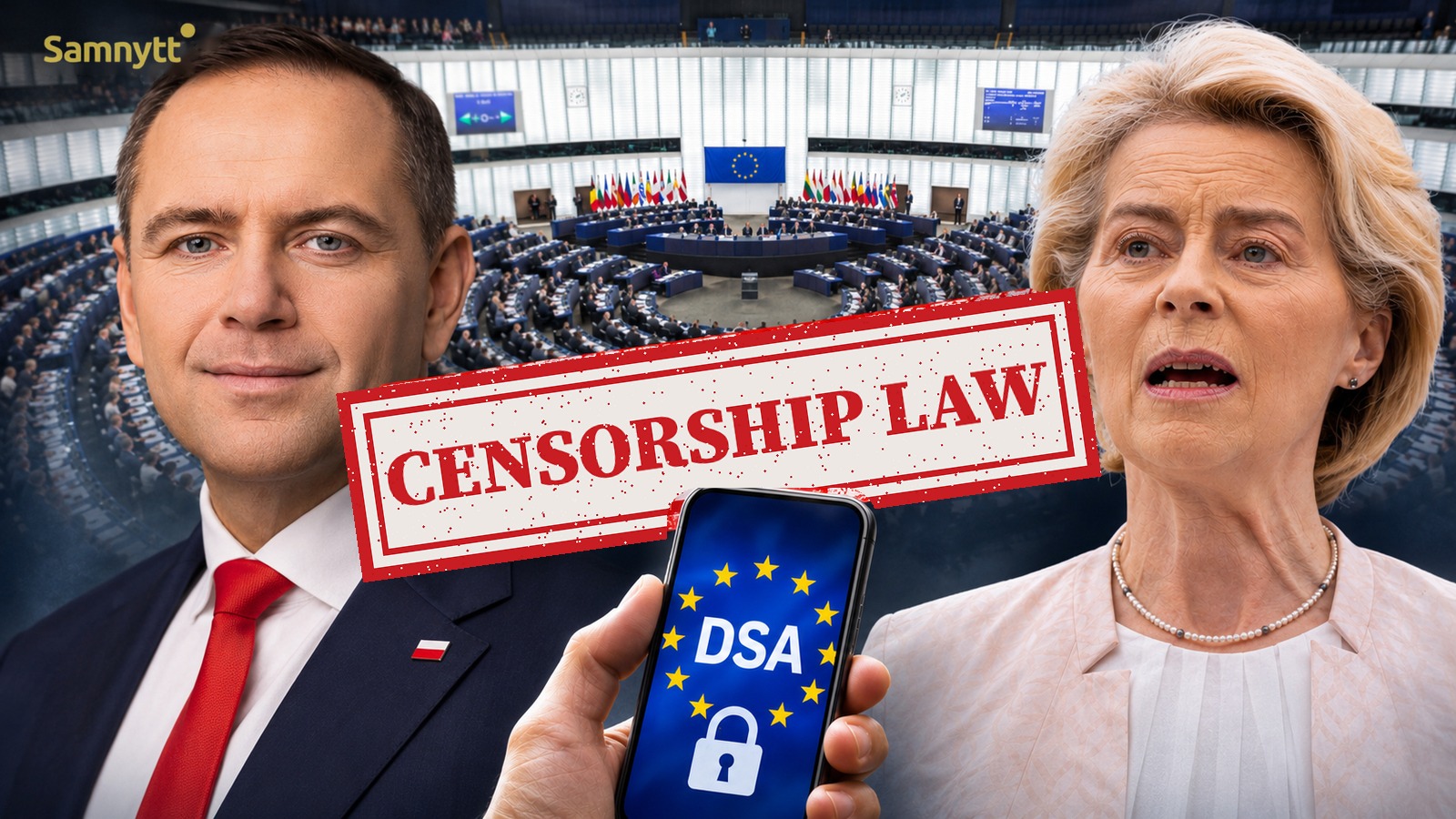
WARSAW - Polish President Karol Nawrocki has vetoed a law that would have given state officials the power to block content online. He calls it censorship and says government agencies should not decide what people may say, write or publish.
The law would have put into effect the part of the EU's Digital Services Act, the DSA, that deals with removing and blocking content.
The regulation already forces platforms such as Facebook, X and TikTok to take down illegal content across the whole union, Sweden included. But each country decides which authorities get the power to order removals.
In Poland, that would mainly have been the head of the telecoms regulator UKE. For video platforms like YouTube, it would have been the chair of the broadcasting council KRRiT.
Nawrocki announced his decision on Friday 13 November, the last day of the deadline, refusing to sign the law passed on 22 October.
"The ghost of a censorship official"
In a statement published by the presidential office, Nawrocki accused the government of mixing a European obligation with its own political interests.
"The ghost of a censorship official has returned, one who would decide what is and is not allowed on the internet. It is not an official's role to rule on whether a given piece of content was a crime. That is solely the task of the courts and independent judges," he said.
In his view, the law would in practice hand the government arbitrary control over what people can say, write or publish. He also objected that an entire domain could be put on a blocking register because of a single illegal comment, which could shut down a whole news or education site.
"Citizens' safety must not be a pretext for weakening their freedoms. You cannot build a false choice between security and freedom. A responsible state must secure and balance both," Nawrocki said.
Prime Minister Donald Tusk, a committed EU liberal, was furious. He wrote that protecting children from criminals online should unite people across political divides, yet the president had used his veto anyway. Digital Affairs Minister Krzysztof Gawkowski called it a black day for internet safety.
The government insists the blocked rules covered illegal content, not opinions, and that decisions could have been appealed in court. Deputy digital minister Dariusz Standerski said the president was not defending free speech but siding with the big platforms.
What the law would have done
Officials would have been able to order content blocked. In the most serious cases, a decision could take effect immediately if a prosecutor or the police backed the request - for example over incitement to suicide, contract killings, and violence or threats based on origin, religion or political affiliation.
The Senate widened officials' powers to block exactly that kind of content. When the lower house, the Sejm, approved the change, it passed 238 to 194, with the conservative PiS and Konfederacja voting against. Nawrocki says it was in the Senate that the censorship official came back.
The government has tied the law to a series of knife attacks in Polish schools. Nawrocki calls that emotional blackmail and says the authorities could already act under existing rules, including the EU regulation on terrorist content online.
Second veto this year
Nawrocki stopped a first version of the law in January. He called it administrative censorship back then, comparing a government-controlled official deciding what is allowed online to the Ministry of Truth in George Orwell's "1984".
"If those in power decide what is 'truth', what is 'disinformation', who may speak and who may not, freedom disappears step by step," he said at the time.
The government then split the law in two. Nawrocki signed the first part, naming UKE as coordinator, in September; it took effect on 6 November. The second part, with the blocking powers, is the one he has now stopped.
The European Commission took Poland to the EU Court of Justice on 5 February for failing to appoint a digital services coordinator, give it sufficient powers and introduce penalties.
Sweden said yes - except the Sweden Democrats
The European Parliament adopted the regulation on 5 July 2022 by 539 votes to 54. Every Swedish MEP who voted backed it, except the three Sweden Democrats: Charlie Weimers, Jessica Stegrud and Peter Lundgren.
In the Council, where member-state governments sit, the law was approved unanimously on 4 October 2022. Sweden voted yes, with Magdalena Andersson's Social Democrat government still in office as a caretaker before Ulf Kristersson took over.
The right-wing Kristersson government then brought in Sweden's implementing law, which took effect on 1 December 2024. The Swedish Post and Telecom Authority is Sweden's DSA coordinator, with the Swedish Consumer Agency and the Swedish Agency for the Media also acting as supervisors.
Weimers has kept up his criticism. In December 2025 he co-wrote a question to the European Commission describing the EU's 120 million euro fine against X as a way of pushing "the EU's censorship agenda".
"Orwell's dystopia was a warning, not an instruction manual," he has said in the European Parliament.
The law now goes back to the Sejm, where overriding the veto requires a three-fifths majority. Judging by October's vote, the government side does not have the numbers.
Simon Kristoffersson · Responsible Publisher & Senior Editor (Ansvarig utgivare)
Simon Kristoffersson is the Legally Responsible Publisher (Ansvarig utgivare) and Senior Investigative Editor of Samnytt and Samnytt News under Sweden's Constitutional Freedom of the Press Act, specializing in courts, organized crime, municipal governance, and public-sector investigations.
Follow @SamnyttNews on 𝕏 ↗