Paludan Blasts Akesson - Deport Two Million to Save Sweden
In a Samnytt interview, Danish-Swedish Quran burner Rasmus Paludan slams Jimmie Akesson and says the only way to save Sweden is to forcibly deport two million people. He lived ten months under PET protection after death threats.
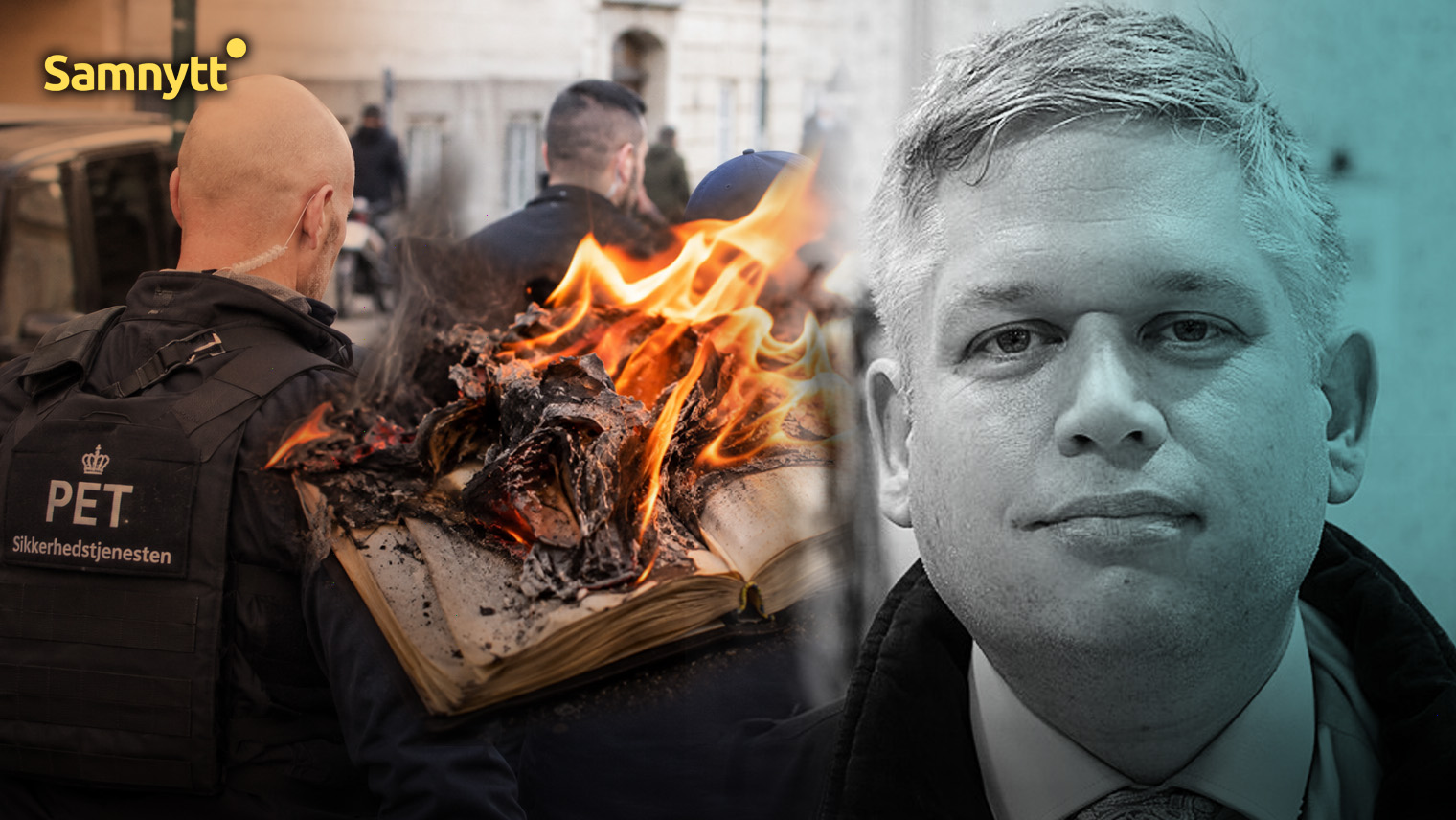
INTERVIEW - He is a Swedish citizen, once lived on Strandvägen in Stockholm, and spent much of his childhood with relatives in Skåne. At the same time, Rasmus Paludan has become one of Sweden's most controversial political figures - known worldwide for Quran burnings and the riots that followed.
In a wide-ranging Samnytt interview, the Danish-Swedish lawyer talks about his Swedish roots, years under death threats, the murder of Salwan Momika, and his view of Sweden's future. He also aims hard criticism at Jimmie Åkesson and the Tidö government, which he says lacks the will to make the changes he thinks are required.
Paludan was born in Denmark in 1982 to a Danish mother and a Swedish father from Helsingborg. He is a trained lawyer and founded the anti-immigration, Islam-critical party Stram Kurs in 2017. The party ran in Denmark's 2019 parliamentary election but won no seats.
In Sweden he became widely known at Easter 2022, when planned Quran burnings were followed by riots in several cities. Hundreds of officers were deployed, police vehicles were attacked, and many people were later convicted over the unrest.
Swedish citizen - but says he cannot live in Sweden
Critics call his protests deliberate provocations against Muslims. Paludan says the point is to show how people react when Islam and its symbols are criticised in public.
When Samnytt reaches him he is in Denmark, just after a digital seminar on the crucifixion of Jesus. In recent years he has spent more time on academic study, including theology and Islamic studies. His political conclusions, he insists, remain as far-reaching as before.
READ MORE: Man Who Threatened Quran Burner Rasmus Paludan Stripped of British Citizenship
His link to Sweden long predates the burnings. His father is from Helsingborg; as a child he regularly visited relatives in Skåne - Råå, Södra Sandby and Helsingborg - with goose dinners and Swedish Midsummer.
"I was probably the sibling who was most in Sweden with my dad," he says.
In autumn 2000 he also worked a few months in Stockholm and lived on Strandvägen in Östermalm. He describes that Sweden as a country that differed sharply from today's society.
The family link later mattered in an unexpected way. When Swedish authorities barred him from entering in August 2020 on national-security grounds, it emerged that he also held Swedish citizenship. According to Paludan, the Swedish Migration Agency established that he had been a Swedish citizen since 1989, when his parents married. The entry ban could not then be enforced as against a foreign national.
But citizenship, he says, is not the same as being able to live in Sweden. He argues Swedish authorities do not offer the protection he would need to stay.
"It is a bit strange that I am a citizen of a country where I cannot really be," he says. "I would gladly have Swedish friends too. But it becomes difficult when the media have presented me as the new Adolf Hitler."
He feels more Danish than Swedish and prefers to keep living in Denmark - while regretting that Swedish citizenship does not give him the freedom of movement he wants.
On al-Qaeda's hit list - and wanted by Turkey
The threat against him is not new. Already in 2020 he was named as a target in al-Qaeda propaganda, alongside figures such as Lars Vilks and Geert Wilders. Groups linked to Islamic State have also urged violence after his Quran burnings.
For years he has lived under personal protection from Denmark's security service PET, which has repeatedly stepped up measures around him.
After the Quran burning outside Turkey's embassy in Stockholm in January 2023 - mid-way through Sweden's NATO bid - the threat hardened further. Turkey's President Recep Tayyip Erdoğan reacted with fury while Ankara could still block Sweden's accession. In July that year an Ankara court issued an arrest warrant accusing Paludan of publicly insulting religious values. He dismissed it as a political PR move.
The personal cost was high. He tells Samnytt that for ten months in 2023 he lived isolated at protected addresses in Denmark, surrounded by up to seven PET bodyguards. Security, he says, judged the threat at the highest level: not only people who wanted him dead, but concrete preparations for a murder.
"From February through November. It was a challenge, you could say," he says of that period. Outside the security staff he could barely meet anyone. He calls the isolation one of the highest personal prices he has paid for public activity.
The murder of Iraqi-Swedish Quran burner Salwan Momika in January 2025 was another reminder. Paludan had some written contact with Momika but did not know him closely. Early the next morning Danish security police rang to inform him and discuss consequences for his own safety.
"I thought it was fairly expected, really. Momika had made himself very known for not respecting Islam. And in a democratic society that is completely legal," he says. He is surprised Momika - an obvious terror target - did not have better personal protection.
He also blames Swedish media for turning him into a symbol rather than a person.
"Yes, I absolutely believe that [media portrayals] have contributed to the threats. You cannot say the media have all the blame, because there are many more Muslims in Sweden. That matters a great deal too. But dehumanising me with no nuance at all makes it easier for people to kill someone."
In Denmark, he says, he has had hours and days of conversation with Muslims at his protests - and is not dehumanised there the way Swedish media have done.
"If Jomshof can be in SD, I should be able to be there too"
Paludan's politics began long before Stram Kurs. As a young man he was active in Denmark's social-liberal Radikale Venstre - surprising given his later profile. He denies a sharp ideological U-turn: his view of Islam and immigration simply became clearer, and incompatible with that party.
"It is not that I have changed political direction. It is just that I have become clearer about what I thought."
Today he sits far from mainstream Swedish party politics. When Jimmie Åkesson commented on Paludan's Quran burnings in 2022, the Sweden Democrat leader called him an idiot while defending his right to hold the protests.
Asked what he thinks of Åkesson as a person and politician, Paludan is cool: "I do not know particularly much about Åkesson, so I cannot say that much about him. I know a bit more about Jomshof, who is a bit closer to me politically, I would think."
He places Richard Jomshof far closer to his own views than SD's official line. "You can really say that if he can be in SD, I should also be able to be there."
Would the Sweden Democrats want him as a member? "Now they do not want me, because they are afraid there are people who would not vote for them. It could be the opposite - more people might want to vote for them."
Åkesson, he argues, has shifted from a more ideology-driven leader to someone who adapts his message to what he thinks voters want to hear. "I would wish he still said what needs to be said."
He would gladly be in touch with Jomshof. "I actually sent him a postcard, but he has not answered."
READ MORE: Sweden Democrat Veteran Defies Party - Files Seven Motions on Islam
"Swedes do not get that it is over"
His main charge against the Sweden Democrats is not the personalities but what he calls inadequate ambition. He grants that the Tidö cooperation has delivered several election promises - including a drop in shootings - but says the underlying direction has not changed.
Has Sweden become less Islamised under Tidö? "No, I do not think so. I think the development continues in the same direction. But on what they themselves said they wanted to do, it has been successful. They said various things they wanted to do, and they did them."
Harder sentences, more police and tighter migration rules are not enough, he argues. Sweden's problems run deeper than any Riksdag party will admit.
"The only way to save Sweden is to forcibly deport two million people with force."
Such mass forced removals would, depending on who was covered and how, conflict with basic legal protections against collective expulsion and discrimination. Paludan says that is exactly the kind of proposal the Sweden Democrats dare not put to voters.
Asked about demographic projections that ethnic Swedes could become a minority around 2046, he answers: "I think it happens before 2046. And then I would say you have to do it - throw out two million people by force. Because voluntary will not be enough."
Those projections rest on particular definitions of Swedish background and assumptions about future migration and birth rates, as Samnytt has previously reported.
READ MORE: Åkesson Drops Cabinet Demand - Will Tolerate Kristersson Then Oppose
He does not believe Swedish voters will accept the politics he advocates. When Stram Kurs ran in Sweden's 2022 election the party won only 156 votes - a result he finds almost incomprehensible.
"Swedes do not get that it is over. Because what would be required to save Sweden, Swedes will never vote for."
Media focus on burnings and riots, he says, left his political programme barely covered. "You cannot say I got 156 votes because that was what people thought. That is impossible to say."
He returns to the 2022 Quran riots as a demonstration of the problems he had long warned about: "I tried to show them in 2022. Do you get what it is you have let into your country? Do you get it?"
Could Sweden's lack of modern war and occupation - unlike Denmark and Norway - explain why Swedes take the country's continued existence for granted? "I am not an expert on political science or psychology. But from my political experience, if you have not experienced other people who wish you ill, it can perhaps be hard to imagine that they exist. So that could be an original explanation."
He also calls Swedish political culture more conformist than Denmark's: "It seems to matter more in Sweden that you are a bit conformist with how you think you are supposed to be. It is less so in Denmark."
No regret - pity for Swedish teenagers
Looking decades ahead, he rejects the idea that Sweden must become a Muslim caliphate. He instead expects a society marked by deep ethnic and cultural conflict - and compares it with South Africa. Asked about Canadian evolutionary psychologist Gad Saad's book Suicidal Empathy, he says many Swedes care enormously about being seen as good people.
"I think it means an enormous amount to many Swedes that they are good people. But I would think it is enough to be a good person. You do not need to do things so that others will think so, do you? For them it is important that other people think they are good people. And that means much more to them than whether they actually do good things. That is a very big problem."
Despite death threats, long isolation and little political support, he expresses no regret. He remains convinced his analysis of Sweden is right - even if Swedes never accept his conclusions.
"I am not frustrated for my own sake. Because I have done the right thing."
What worries him, he says, are young Swedes who will live with today's political decisions: "I feel very sorry for 15-year-old girls and boys in Sweden. They have not chosen to grow up in a country that is going to disappear."
Jonas Andersson · Political Columnist
Jonas Andersson is a political columnist at Samnytt, writing on Swedish politics, the media, and the post-election crisis in Stockholm.
Follow @SamnyttNews on 𝕏 ↗