EU Rule: Your New Car Won't Start Until Emissions Are Fixed
From November 29, new car models in the EU must police their own exhaust. Ignore a serious emissions fault for 2,400 kilometres and the car can refuse to start. From 2027 the rule covers every new car sold in Sweden.

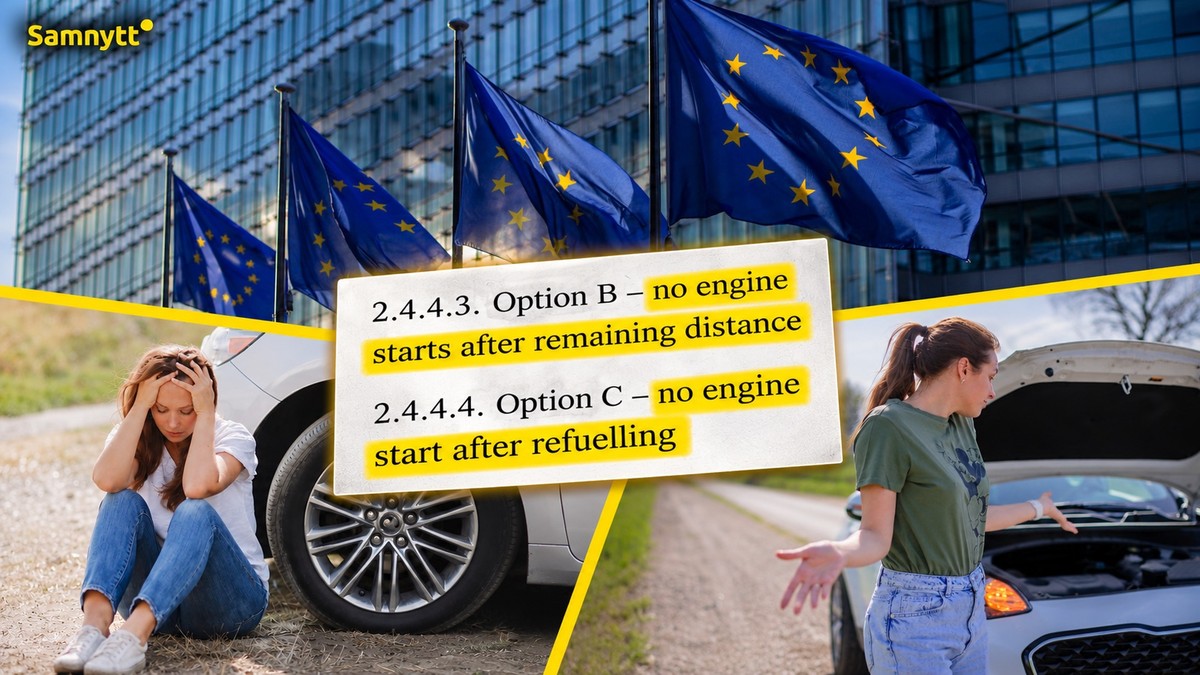
BRUSSELS - An emissions fault you don't fix could soon leave your car dead in the driveway. From November 29, the EU requires new car models to monitor their own exhaust emissions. If the system detects a serious fault or tampering that is not repaired, the car is locked down after 2,400 kilometres, for example by refusing to start.
Cars already on the road are not affected. But from November 2027 the requirement covers every new car sold, in Sweden and across the EU.
The rules are part of Euro 7, the bloc's new emissions standard. The system is meant to catch faults or cheating that stop the exhaust cleaning from working.
A countdown on the dashboard
Once the system raises the alarm, a counter starts ticking, but only while the combustion engine is running. In a plug-in hybrid, distance driven purely on electricity does not count.
The driver must be warned on the dashboard. For some faults, the manufacturer may delay the first warning by up to 400 kilometres. From 1,400 kilometres the warning has to be shown all the time, telling the driver how far is left before the lock kicks in. If the fault is still there after 2,400 kilometres, the block is triggered the next time the car is started.
An engine that is already running will not be switched off mid-journey. A hybrid can also keep going on electric power as long as the battery lasts, the German magazine Auto Motor und Sport reports.
Many diesel drivers already know the principle. Run the AdBlue tank dry and the engine eventually refuses to start. Now the same kind of block is being extended to more emissions faults, and to petrol cars.
That means an ordinary owner who puts off an expensive new particulate filter or catalytic converter once the warranty has run out could be left stranded until a workshop fixes the problem.
Four ways to stop the car
Manufacturers have to pick one of four methods. In the first, the driver gets at most 20 more engine starts, after which the engine will not start for the next trip. Automatic restarts from start-stop systems, or restarting after a stall, do not count.
In the second, the driver can keep going at most as far as a full tank typically lasts before the next start is blocked.
In the third, the engine will not start after the next refuelling. In the fourth, refuelling itself is locked, so you cannot fill up any more.
Which method your car uses should be stated in the owner's manual. Once the block is active, the dashboard must show how many starts or kilometres remain.
Not a remote kill switch
The implementing regulation adopted by the European Commission in July 2025 says use of the vehicle shall be restricted until an appropriate repair has been made. A workshop can unlock the car with a standard diagnostic tool, and it does not have to be a brand dealer. Simply deleting the fault code will not buy the driver another 2,400 kilometres.
Car models that are already approved may, as a rule, be sold without the block until November 29, 2027. After that, the rule covers essentially all new passenger cars and light vans.
Cars already registered will not have to be modified. The block is triggered by the car's own system, and no rule gives the EU the power to shut down vehicles remotely. Emergency vehicles are exempt.
It is the latest in a series of Brussels rules aimed at Swedish motorists. Earlier this month the Commission was pushing to force large Swedish companies to buy electric cars.
Simon Kristoffersson · Responsible Publisher & Senior Editor (Ansvarig utgivare)
Simon Kristoffersson is the Legally Responsible Publisher (Ansvarig utgivare) and Senior Investigative Editor of Samnytt and Samnytt News under Sweden's Constitutional Freedom of the Press Act, specializing in courts, organized crime, municipal governance, and public-sector investigations.
Follow @SamnyttNews on 𝕏 ↗