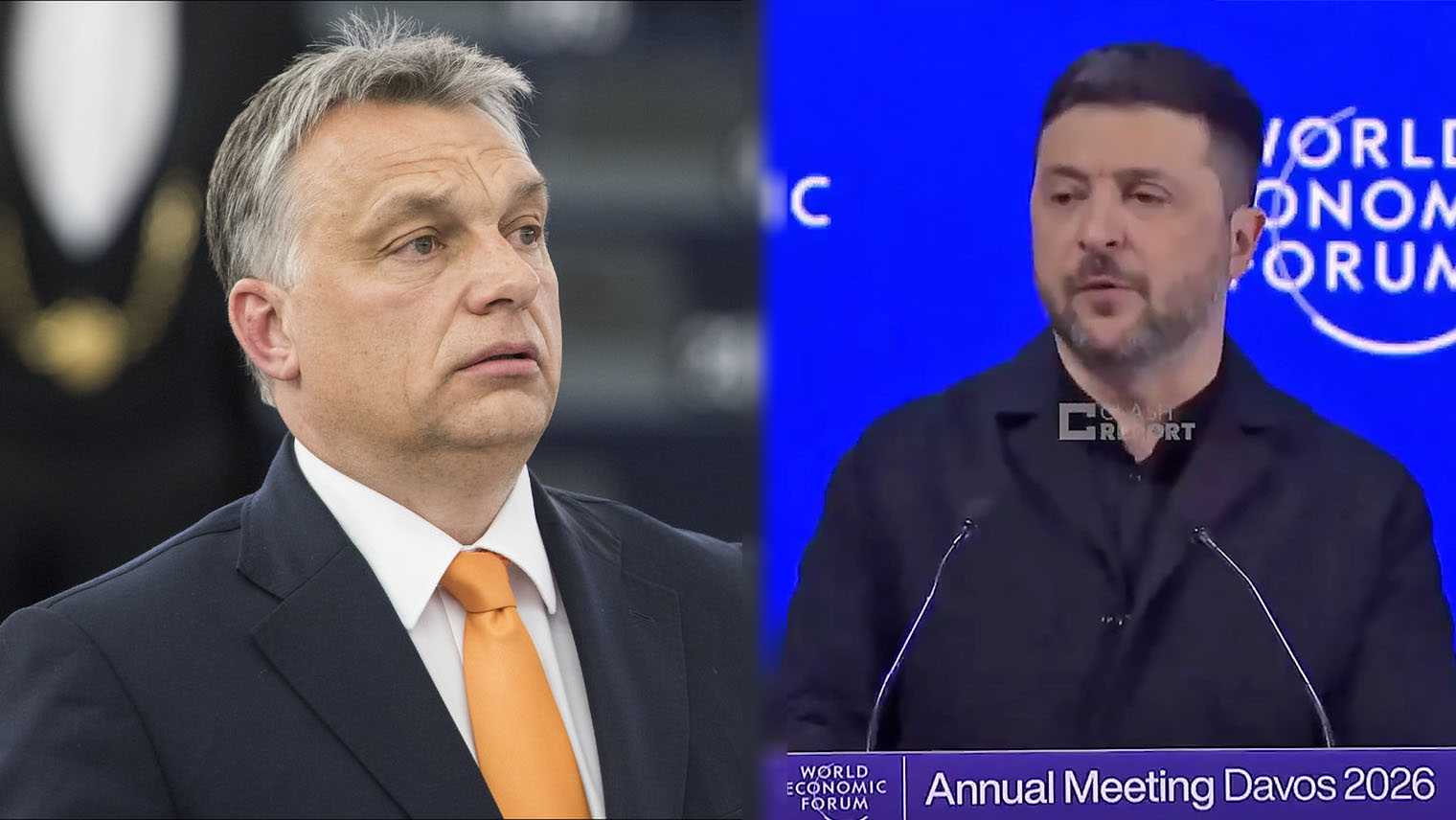
Ukrainian President Volodymyr Zelensky launched an unusually harsh attack against Hungarian Prime Minister Viktor Orbán in Davos. In a speech, he implied that Orbán “deserves a slap in the face” and described Hungary as a force trying to destroy Europe from within. Orbán later responded on X, arguing that Zelensky’s remarks about physical violence had “crossed a line.” The heated exchange reflects the long-strained relationship between the two countries.
It was during his speech at the World Economic Forum in Davos that Zelensky accused what he described as “internal EU forces” of trying to undermine Europe. With a clear, though implicit, reference to Hungary, he targeted Prime Minister Viktor Orbán.
“Every ‘Viktor’ who lives off European money while trying to sell out European interests deserves a slap in the face,” said Zelensky.
Zelensky harshly criticised Hungary’s Prime Minister Viktor Orbán:
“Every ‘Viktor’ who lives off European money while trying to sell out European interests deserves a slap in the face.” pic.twitter.com/gEQHnGy7M0
— NEXTA (@nexta_tv) January 22, 2026
At the same time, Ukraine survives thanks to the equivalent of about 4,500 billion SEK in military, financial, and humanitarian aid from the Western world.
READ ALSO: Mysterious Russian Connections During Raid Against Zelensky’s Inner Circle
The president continued by warning against tolerating Moscow’s influence within the EU, stating that just because someone feels comfortable in Russia doesn’t mean European capitals should be allowed to be turned into “little Moscows.”
Orbán’s Response: “Zelensky Crossed a Line”
Orbán’s reaction was not long in coming. In a post on X, he asserted that Zelensky had gone too far.
“Yesterday in Davos, President Zelensky crossed a line,” Orbán wrote, claiming that the Ukrainian president targeted not only Hungary but also criticized other European leaders for insufficient support to Ukraine.
Yesterday in Davos, President @ZelenskyyUa crossed a line.
There is nothing new in the fact that, as elections approach in Hungary, he once again placed the Hungarian government, and me personally, in his sights. What was surprising, however, was that in his speech he also…
— Orbán Viktor (@PM_ViktorOrban) January 23, 2026
Orbán also linked Zelensky’s statements to the European Commission’s roadmap for Ukraine, which according to him entails extensive financial commitments from the EU, faster EU membership, and long-term support.
“Zelensky has it all backwards, but Brussels is eager to pay,” he wrote, announcing a national petition in Hungary to reject the plans.
Dear President @ZelenskyyUa,
It seems to me that we will not be able to come to an understanding. I am a free man who serves the Hungarian people. You are a man in a desperate position who, for the fourth year now, has been unable or unwilling to bring a war to an end—despite…
— Orbán Viktor (@PM_ViktorOrban) January 22, 2026
In a later post, Orbán addressed Zelensky directly and made it clear that Hungary will not support Ukraine’s war effort. At the same time, he promised continued humanitarian assistance, including electricity, fuel, and help for Ukrainian refugees.
“Life itself will determine the rest, and everyone will get what they deserve,” he concluded.
Long-standing Conflict in the Background
The harsh tone is the culmination of a longer period of tension between Ukraine and Hungary. Orbán’s government has consistently opposed rapid Ukrainian EU membership and has criticized the extent of economic and military support to Kyiv.
READ ALSO: Orbán Warns: EU Support to Ukraine Could Hit Pensions and Family Benefits
According to Orbán, Ukraine is seeking up to $800 billion in EU support over ten years, along with further large-scale military investments. He has also claimed that the EU leadership has accepted the demands and is aiming for Ukrainian membership as early as 2027—a move Hungary strongly opposes.
Meanwhile, the Hungarian government has accused Ukraine of trying to influence Hungarian domestic politics ahead of elections, while Kyiv, in turn, sees Orbán’s approach as an obstacle to both EU cohesion and support for Ukraine in the war against Russia.