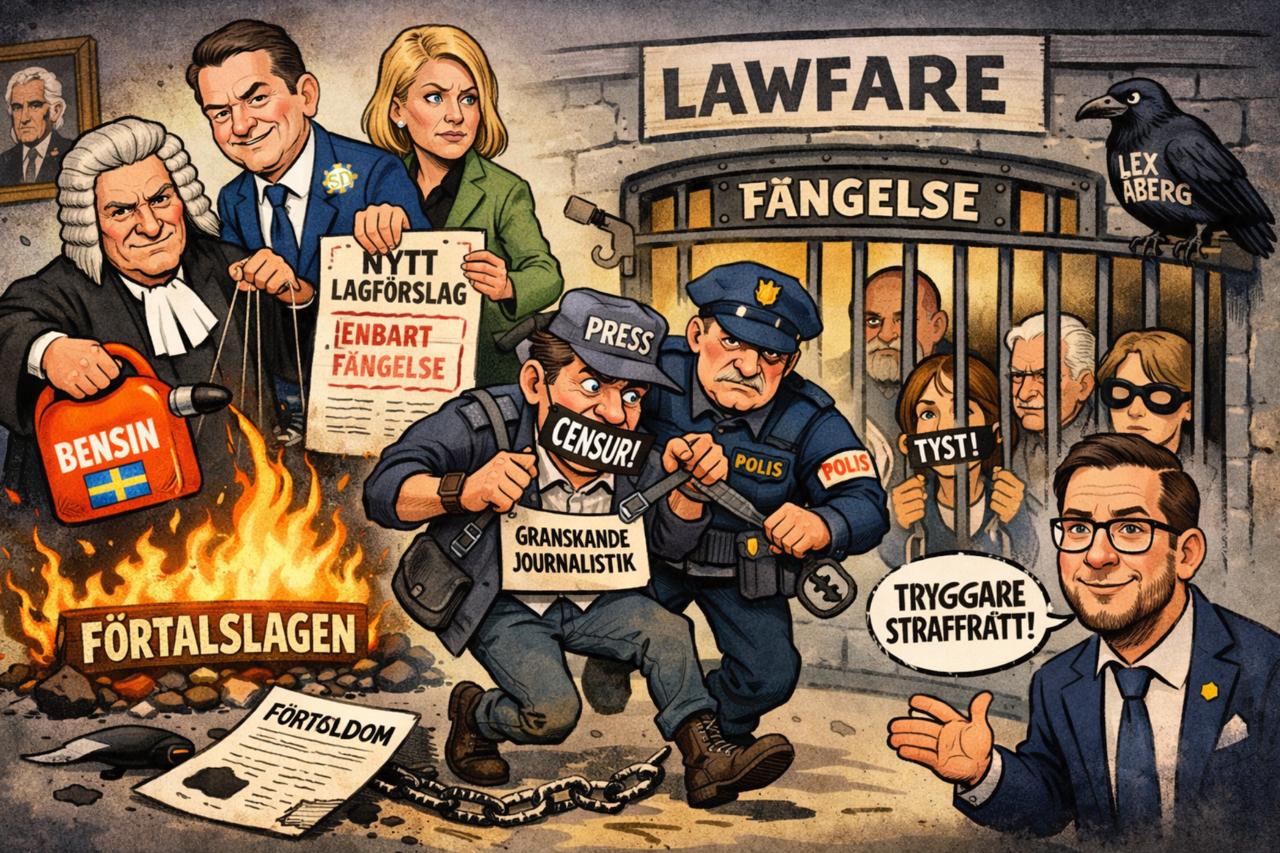
OPINION • When the Tidö coalition government recently presented the proposal to make aggravated defamation a crime punishable only by prison, it was nothing short of astonishing. Not because defamation cannot cause harm, but because the Swedish defamation legislation is already today legally uncertain, unpredictable, and politicized.
To then increase the penalties, without first addressing the systemic flaws, would have been like pouring gasoline on an already burning legal scandal.
I wrote my first opinion piece about this recently, and Samnytt interviewed an SD member of the Justice Committee, Pontus Andersson Garpenvall, who at that time claimed, “The raising of penalties for aggravated defamation is being done to make criminal law more consistent,” and thus seemed to defend the whole thing, referring to the law being reformed at some later date.
READ MORE: Ekeroth: SD must back down from prison sentences for defamation
That is obviously untenable. You cannot worsen the punishment for a law you have realized isn’t functioning.
I contacted SD on the issue, and after my editorial was published, I received the response that the Sweden Democrats intend to try and stop this particular penalty increase. Signals from the negotiations are said to be tentatively positive. This is a wise announcement. And yes: it suggests that SD has actually listened and that their initial position may not end up being their final stance.
And yesterday, Ulf Kristersson also went on Facebook and suddenly began talking about the need to revise the defamation law. They do, admittedly, only refer to ‘pedophiles and murderers,’ which doesn’t cover the whole issue with the current defamation law. It’s good that it’s being corrected so that one can warn about murderers and pedophiles, but the problems with the law are not primarily about those cases, but above all about cases where left-wing extremists try to silence newspapers, or private individuals, who write about and scrutinize leftist representatives.
Hopefully, all my objections will be taken into account when the law is finally presented to parliament.
Lawfare
So the problem with Swedish defamation law is not primarily penalty levels, but its construction.
Today, a statement judged as ordinary defamation—without a single word being changed—can become aggravated defamation merely because it has spread. And ‘sufficient spread’ according to legal precedent does not need to be very many at all. In some contexts, 10–20 people is enough. In digital environments, a few hundred readers can suffice. The result is absurd. The more journalism reaches out, the greater the risk of penalty. The greater the reach, the more dangerous the truth becomes.
This is the direct opposite of how a free society should work.
In my motion to the Sweden Democrats’ national congress last autumn—which the party leadership also backed—I described how the defamation law is used today as a tool of power. Not to defend someone’s honor, but to punish and silence criticism. This phenomenon is called lawfare.
It’s not a conspiracy theory but has become everyday practice in the Swedish legal system.
Opinion-makers, independent journalists and public commentators are drawn into lengthy legal processes where the punishment is often the process itself. Costs, stress, self-censorship—and ultimately sometimes convictions, even though the information was true, well-founded, and presented in a clear societal context.
Who is a public figure?
One of the most obvious systemic flaws concerns the concept of public person.
People who are visible in the media, run lawsuits, obtain large public grants, and actively influence societal debate are still repeatedly classified as private individuals in court. The result is that legitimate scrutiny becomes criminalized.
The cases involving the state-funded so-called Hate Speech Investigator (Näthatsgranskaren) Tomas Åberg are a textbook example. Despite his clearly public role, he enjoys almost absolute protection, while investigative journalism is punished—not because it was false, but because it was uncomfortable.
READ ALSO: Now Mats Is to Serve a Prison Sentence for Illegal Journalism
At the same time, we see the opposite in other cases. Harsh political insults can be acquitted as ‘value judgments’ in a political context, while far more substantiated claims about abuse of power or Islamist ties lead to convictions.
When similar statements are judged completely differently depending on who made them and in what ideological context, then the law has lost its legitimacy.
Arbitrariness combined with prison sentences belongs in authoritarian states—not in a democracy that claims to protect free speech.
Good by SD
That the Sweden Democrats now signal their desire to halt increased penalties for defamation is the right thing to do. But I hope the party will follow up on what they promised at their national congress, when in their reply to me they said that the parliamentary group is now tasked to rewrite the defamation law.
It needs to be fundamentally redone and have a clear and objective definition of ‘public person,’ include a presumption of justification for true or well-founded information in social debate, clarify the constitutional requirement for an overall assessment, stop private lawsuits that aim to punish journalism or similar, and establish a principle of proportionality where prison is an absolute last resort.
There is still a chance to do the right thing and ensure Sweden gets defamation legislation that strengthens—not stifles—freedom of expression.
SD’s work to stop this would in that case be a blow for free speech and a victory for the voters who supported us in SD—where we genuinely fight abuse of power and politicized justice.
READ ALSO: SD wants defamation law reformed before toughening penalties