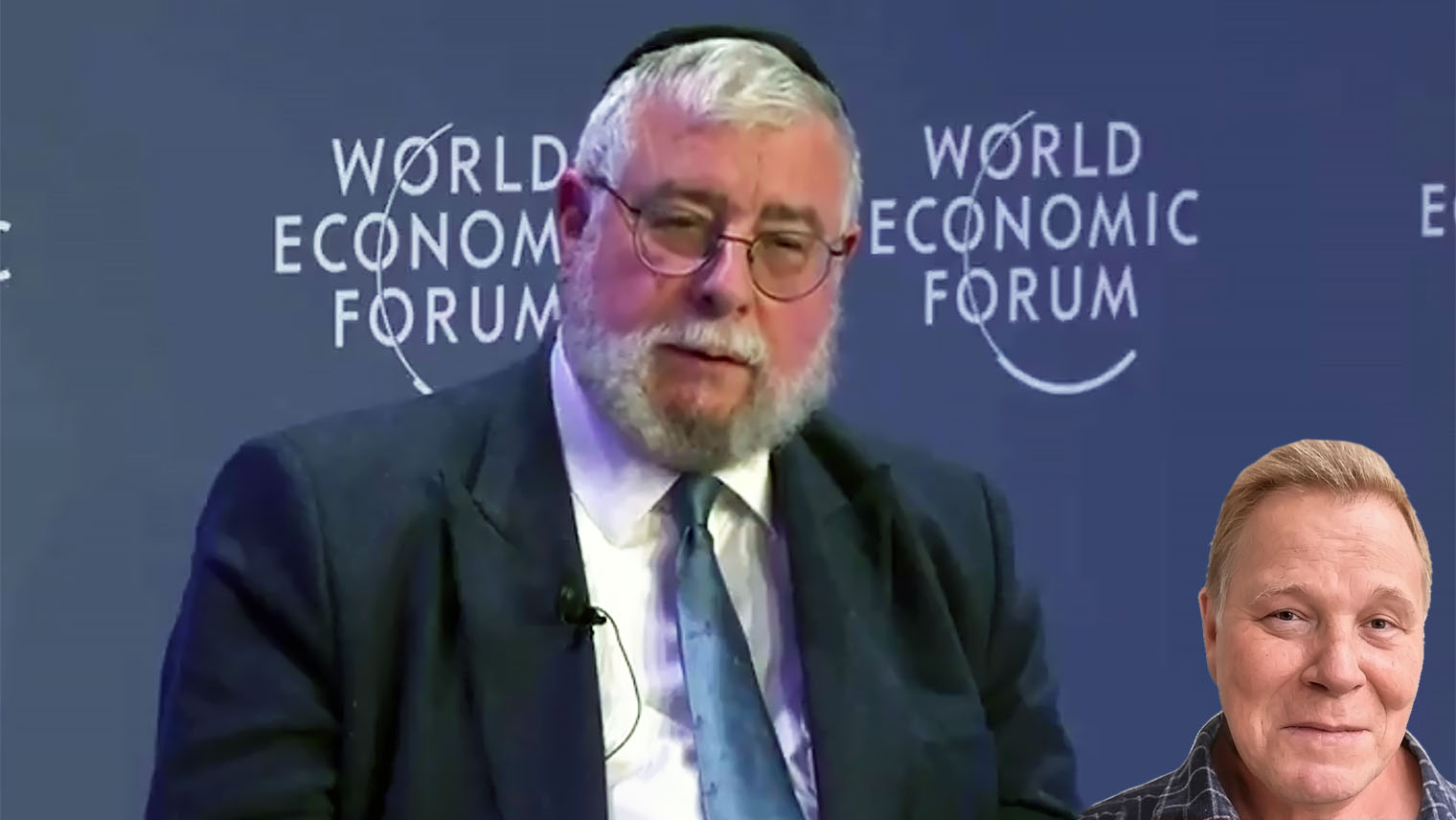
EDITORIAL • In a discussion during the World Economic Forum in Davos, the well-known Swiss-born rabbi Pinchas Goldschmidt painted a picture of the causes of antisemitism in Europe that raises more questions than it answers. His analysis risks misleading the debate as well as complicating the fight against the real Jew-hatred that is currently growing on Europe’s streets.
When Goldschmidt begins by speaking about October 7, 2023, he omits that the violence consisted of an Islamist terrorist attack carried out by Hamas, the regime that controls the Gaza Strip. This isn’t a minor semantic issue, but rather an erasure of decisive context.
Leaving out the perpetrator skews our understanding of subsequent events—including the wave of aggressive Israel-hatred that has swept across Europe since then, targeted at Jews in general and the Middle East’s only democracy, Israel, in particular. This was no oversight from Goldschmidt, but deliberate, since the purpose of the conversation was to talk about Jewish-Muslim fraternity by pointing fingers at right-wing extremists.
An Obsolete Explanatory Model
Goldschmidt speaks of a 500 to 1,000 percent increase in antisemitic acts in Europe since the October 7 attack, insinuating that right-wing extremism is the primary underlying and driving force. That diagnosis doesn’t fit the picture that emerges from court cases, police reports, and public demonstrations that anyone with eyes to see could have witnessed first-hand—not least in Sweden in recent years.
READ ALSO: SKMA Attacks SD – Dislikes Party’s Good Relations with Israel
The overwhelming majority of antisemitic incidents after October 7 have taken place in connection with mass demonstrations against Israel and in support of the Hamas regime in Gaza—carried out by perpetrators from migrant backgrounds rooted in the Muslim Middle East, often in alliance with segments of the political left at universities and in activist circles.
Antisemitism is truly flourishing—even mainstream media excels in it—but right-wing extremism has nothing to do with it; everything has been sparked by Israel’s defensive war against Hamas. Doggedly insisting on right-wing extremism as the main explanation is, in light of this and decades of mass immigration from the antisemitic Muslim world, an obsolete and incorrect explanatory model. It leads to resources and attention being diverted away from the environments where the problem is actually escalating today.
READ ALSO: Sharp Criticism from Åkesson against SKMA’s Nazi Accusations
The reason left-liberal circles won’t let go of this is that they want the mud they sling about right-wing extremism to splash also on conservative democratic nationalism. After all, it would strengthen this popular movement if it were admitted that Islam really is the major threat—to Jews and many others.
“Old Europeans” and a Reversed Blame Game
Particularly notable are Goldschmidt’s speculations that “so-called old Europeans” are pushed into right-wing extremism by “insecurity” toward Muslim migration from the Middle East. Here, two shifts occur: first, the existence of a native European population is questioned; second, the blame for the growth of antisemitism is condescendingly laid on those who react to societal changes—not on the ideologies truly bearing Jew-hatred.
NOW – President of the Conference of European Rabbis: "The rise of the extreme right in many European countries is a response to the insecurity felt by the old Europeans, 'so-called old Europeans,' regarding the new immigrants… fighting Islamophobia and antisemitism is in… pic.twitter.com/mUtg7v1a1c
— Disclose.tv (@disclosetv) January 21, 2026
This is especially problematic coming from a representative of a tradition where national self-determination—Zionism—has been central and led to a Jewish state. To then deny or relativize other peoples’ historical continuity or right to territory appears deeply dishonest.
Antisemitism and “Islamophobia”—A False Equivalence
Goldschmidt equates antisemitism with Islamophobia. Antisemitism is racist hatred against Jews as people. Criticism of Islam in Europe is mainly about ideas and practices—for example, views on democracy and freedom of speech, the position of women, sexual minorities, and violence as a political method—all of which are in direct conflict with liberal democracies. To label such criticism as a “phobia” is to depoliticize and pathologize a necessary debate about ideas.

Jewish minorities in Europe are highly integrated and contribute at every level of society. There is no equivalent Jewish organized crime or religiously motivated terrorism in Europe. To blur and fail to address these differences does not make society safer—as Goldschmidt claims is his goal—but rather degrades the analysis and leaves society ever more unsafe.
Interfaith Dialogue with Demands
Goldschmidt highlights interreligious cooperation under the Muslim Jewish Leadership Council as a way forward. Dialogue can be valuable, but only if it is grounded in reality and clear demands. Antisemitism is deeply rooted in many Muslim environments and is transmitted culturally and religiously from generation to generation. To turn a blind eye to this and replace demands for adjustment with symbolic handshakes is counterproductive and misleading.
READ ALSO: The Muslim Massacre of Jews Must Have Real Consequences
What is needed is not for Jewish representatives to reach out unconditionally, but for Europe’s Muslim organizations to take clear responsibility for reforming and countering Jew-hatred within their own ranks—in the same way that Jewish migrants historically adapted to Western norms.
Antisemitism previously existed within the Christian church and, through its influence, also institutionally and in the consciousness of the European populace, even though—with the exception of Nazism—it was never at the same level as in the Muslim world. Today, that antisemitism is virtually gone. It is reasonable to demand the same from Islam and Muslims.
A Small Clique Does Not Speak for All
It is crucial to distinguish between Jews as a group and a small clique of Jewish opinion-makers who exploit their background to push a left-liberal, migration-positive, and Islam-apologetic agenda. These individuals often claim to speak collectively in the name of “the Jews,” which they do not. The result is that the entire Jewish group gets drawn into political projects it has neither initiated nor uniformly supports—and that criticism, in turn, can dishonestly be dismissed as antisemitism.
READ ALSO: SD is Not the Party Jews in Sweden Should Worry About, Willy Silberstein
In Swedish debate, this pattern has appeared notably among the media-familiar siblings Willy and Margit Silberstein, to whom I have previously dedicated separate editorials. They are eager to sound as if they speak for all Jews and to frame criticism against them as attacks on their and others’ Jewish identity. This makes it difficult to criticize their political positions; one always risks being labeled an antisemite.

Misdirected Efforts Make Jews Less Safe
When leading Jewish representatives consistently point out a marginal threat from right-wing extremist milieus while simultaneously downplaying or concealing antisemitism in Islamist and left-radical contexts, the fight against the real threat is weakened. It makes Jews in Europe less—not more—secure.
READ ALSO: It Was Other Parties That Killed Your Family, Margit Silberstein
To speak plainly, as a conservative nationalist, about where antisemitism today has its strongest roots and why it has become so, is the opposite of right-wing extremism—it is to reject right-wing extremists’ conspiracy theories that “everything is the Jews’ fault” and to point the accusatory finger in the right direction. This is a prerequisite for effectively combating Jew-hatred and for restoring an honest, fact-based debate about Europe’s future.
READ ALSO: Ekeroth: “The Jewish Community Did Not Listen to the Warnings”