Sweden Pays 129 Million Into EU Migrant Pool - Six Countries Pay Nothing
Sweden will pay 129 million kronor into the EU's new asylum 'solidarity pool' - while Poland, Austria, Czechia and Croatia had their share cut to zero and Hungary and Slovakia simply refused to pay.
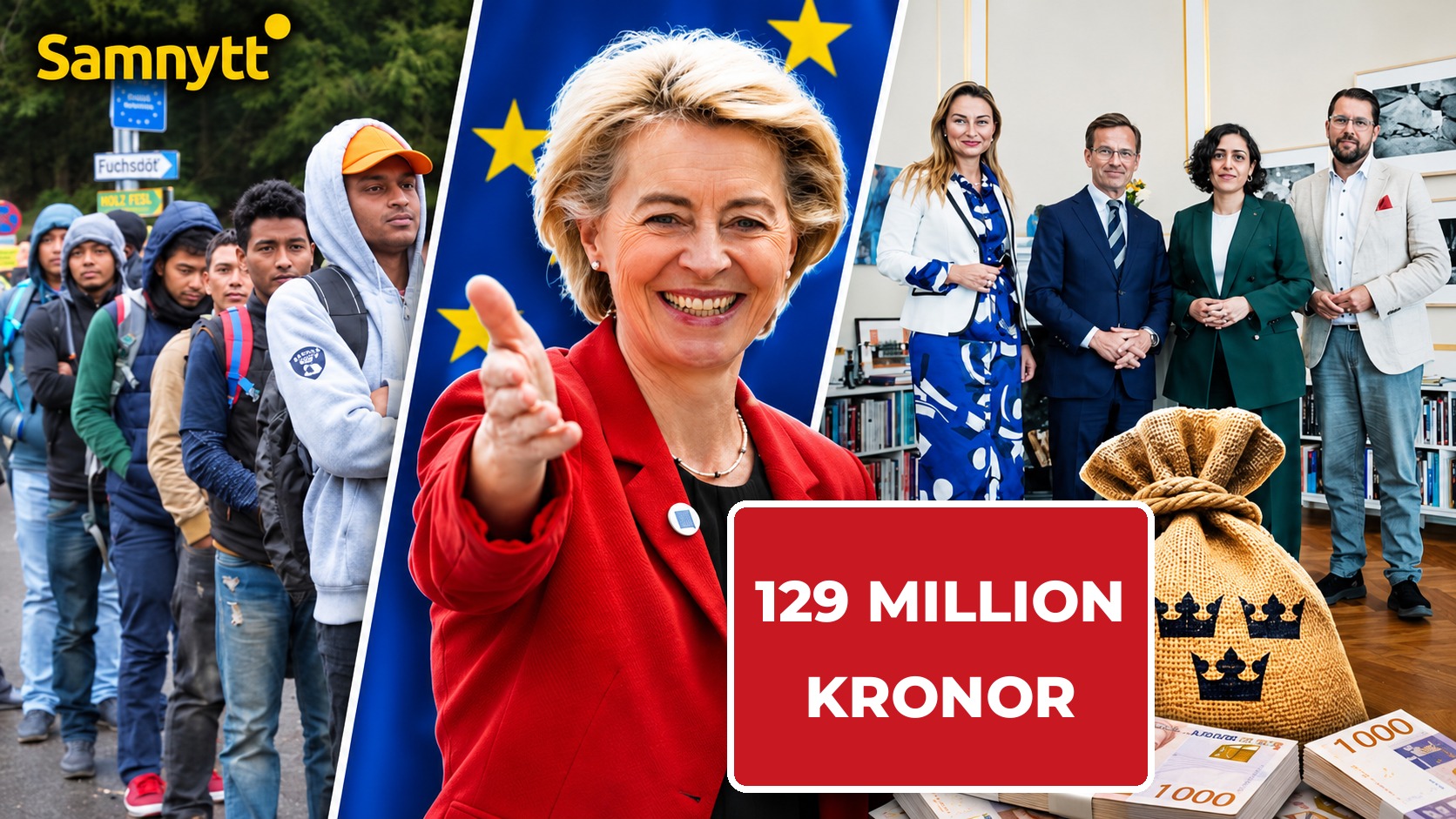
STOCKHOLM - Sweden is to pay 129 million kronor into the EU's so-called solidarity pool, which is meant to relieve Mediterranean countries receiving large numbers of asylum seekers.
The money is in the caretaker government's budget for 2027. At the same time, Poland, Austria, Czechia and Croatia have had their contributions cut to zero - and Hungary and Slovakia have not pledged anything at all.
It is Sweden's first bill under the EU's Pact on Migration and Asylum, the new common asylum rules that took effect across the bloc on 12 June this year.
In the 2027 budget bill, the government raises the appropriation for migration policy measures by 129 million kronor so that Sweden can contribute its "fair share" to the pool.
READ ALSO: Poland Gets EU Migrant Pact Exemption Again - Sweden Gets Nothing
Only the first half-year
The money comes out of the 2027 budget, but it only covers just over six months: 12 June to 31 December 2026. What 2027 and 2028 will cost is not stated.
Instead, the government is asking parliament for the right to commit money from future budgets - up to 578 million kronor for 2028-2030.
That ceiling applies to the whole appropriation, which also includes the voluntary return grant, not just the pool. But the government writes explicitly that Sweden must be able to make pledges to the EU solidarity system two years ahead.
How the migrant pool works
The basic idea of the pact is that the country where an asylum seeker first enters the EU is responsible for the case. In return, other member states are supposed to help the frontline countries that receive the most. Brussels calls this solidarity.
Every year the European Commission calculates how much help is needed. Each country's share is based half on population and half on the size of its economy.
Countries can choose between three ways of paying: taking in asylum seekers relocated from a country under pressure, paying money, or sending staff and equipment. Combinations are allowed.
Under the EU regulation, the pool must cover at least 30,000 relocated asylum seekers and 600 million euros a year - 20,000 euros for every asylum seeker a country chooses not to take.
The first pool, for the second half of 2026, was agreed by EU ministers in December. It covers 21,000 asylum seekers or 420 million euros, going to Greece, Spain, Italy and Cyprus. Sweden's share is 2.78 percent, and the government pledged the full 11.68 million euros without any deduction.
READ ALSO: Sweden's EU Bill Soars - Up 16 Billion Kronor in Two Years
Spain's mass amnesty
Meanwhile, Spain is carrying out a sweeping regularisation of illegal migrants that has so far drawn more than 1.1 million applications. Spanish police representatives have warned it could end up at up to three million people once family reunification is counted.
Spain's socialist government is also flying boat migrants who reached the Canary Islands illegally on to the mainland, where they are spread across the regions.
Because Spain is classed as a country under migratory pressure, Sweden and the rest of the EU may also have to pay or contribute in other ways to relieve it under the new pact.
Sweden voted yes - and chose to pay
The pact is not a treaty that countries sign one by one. It consists of ten EU laws passed by majority vote, first in the European Parliament on 10 April 2024 and finally in the Council of Ministers on 14 May 2024.
The government of Prime Minister Ulf Kristersson voted yes to all ten, and parliament has since changed Swedish law to fit the pact.
When the pool was negotiated in December 2025, Sweden made clear it would not take any relocated asylum seekers.
"We will not take in asylum seekers. The government's decision is instead that we will make a financial contribution next year," Migration Minister Johan Forssell told public broadcaster SVT.
Ahead of the talks, the government told parliament's social insurance committee that Sweden's large asylum intake over the years should be taken into account. It was not. Sweden is not considered a country with a "significant migratory situation" and therefore has no right to ask for a deduction.
The Sweden Democrats warned against the pact from the start. "Opening up for a law that gives the European Commission the power to dictate Sweden's migrant quota is completely the wrong way to go," the party's MEP Charlie Weimers told SVT back in 2023.
Those who refused - and those let off
Denmark is entirely outside. It has an opt-out from EU justice and home affairs cooperation, did not take part in the vote and is not in the pool.
In the 2024 vote, Hungary and Poland voted against all ten laws. Slovakia voted against the two laws on solidarity and crisis situations, Czechia abstained throughout, and Austria and Malta also voted against parts of the package.
When the bill for 2026 was split up, six countries were allowed to ask for deductions because the Commission judged they already carry a heavy migration burden. For Poland, Austria, Czechia and Croatia the commitment became zero. Estonia got a reduced share, while Bulgaria still pledged to take 214 asylum seekers.
Hungary and Slovakia pledged neither places nor money. In its annual report on 6 November, the Commission said the two countries were breaking the rules, but no legal action is being taken for now.
Slovakia's interior minister Matúš Šutaj Eštok replied the same day, according to news agency TASR, that Slovakia does not pay and will not pay for migrants relocated from other countries.
Next bill already on the table
Few countries have been willing to take people. Only eight pledged to accept relocated asylum seekers for 2026 - 8,921 in total against the target of 21,000, most of them in Germany and France.
Negotiations on the 2027 bill are now under way. The Commission proposed a new pool in November, but the proposal is secret until ministers have decided.
The same six countries have again been given the right to ask for deductions. Sweden, which has taken in large-scale immigration for decades and still struggles with the consequences, is not among them.
Simon Kristoffersson · Responsible Publisher & Senior Editor (Ansvarig utgivare)
Simon Kristoffersson is the Legally Responsible Publisher (Ansvarig utgivare) and Senior Investigative Editor of Samnytt and Samnytt News under Sweden's Constitutional Freedom of the Press Act, specializing in courts, organized crime, municipal governance, and public-sector investigations.
Follow @SamnyttNews on 𝕏 ↗