Kristersson Cut Petrol Prices - Now He Pushes Costlier Fuel
Sweden's caretaker government has joined seven EU countries in demanding that the bloc's new carbon price on petrol, diesel and heating starts on time. Only months ago, the same government was cutting fuel taxes.

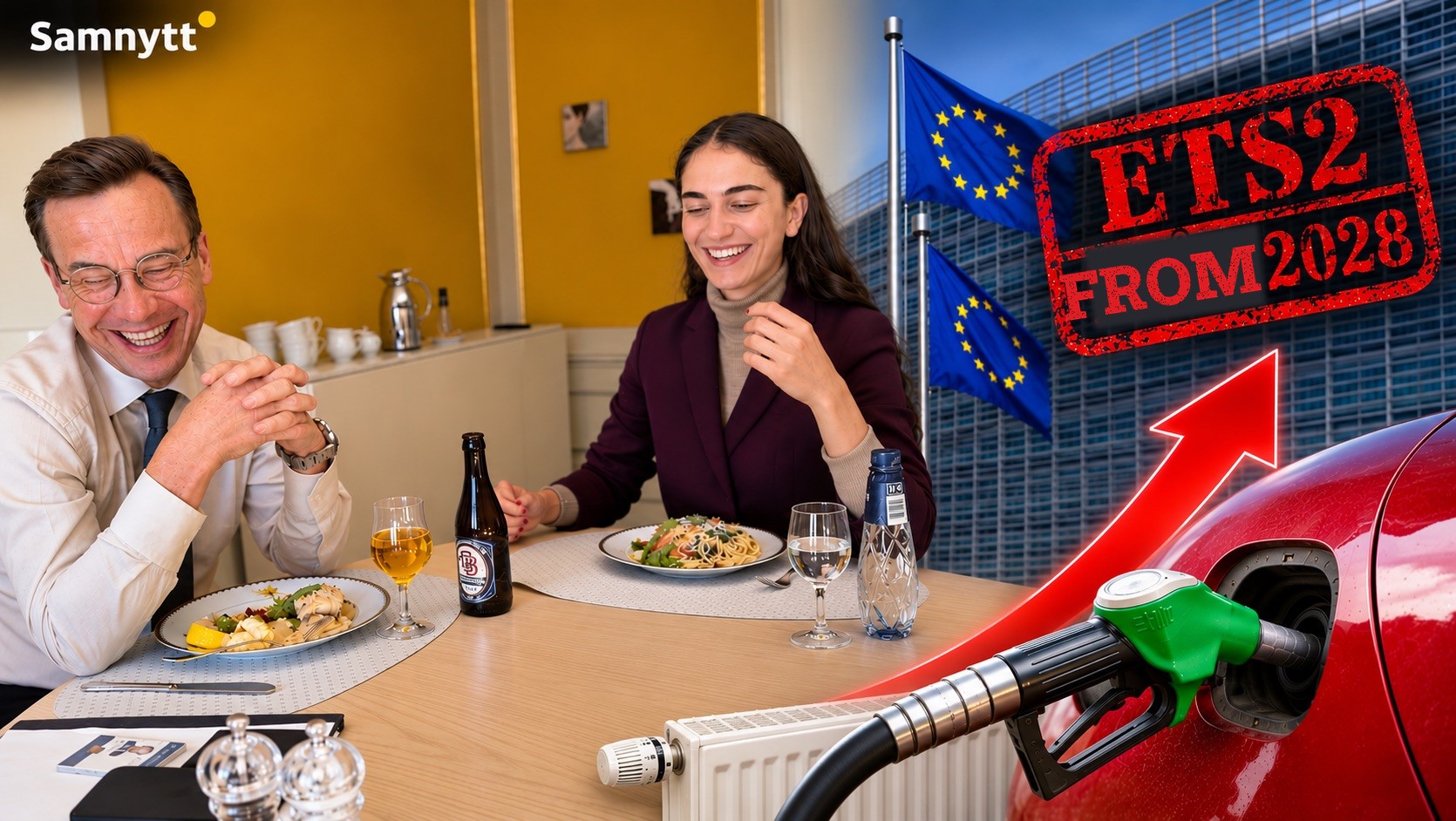
STOCKHOLM - Sweden's caretaker government under Ulf Kristersson has joined seven other EU countries in warning against any further delay to the bloc's new carbon price on petrol, diesel and heating. As recently as this summer, the same government was cutting fuel taxes to bring down prices at the pump.
The letter, dated 23 November, is addressed to EU climate commissioner Wopke Hoekstra. It is signed by the climate ministers of Denmark, Finland, Germany, Luxembourg, the Netherlands, Portugal, Spain and Sweden, where Romina Pourmokhtari of the Liberals holds the post.
The letter has not been published on the government's website. Its contents are known because Euronews has seen it.
A new charge at the pump
The new system, known as ETS2, was agreed in 2023 and was originally meant to start in 2027, before being pushed back a year. Unlike the existing EU emissions trading scheme, which mainly covers industry and power generation, ETS2 targets fuel used in cars, lorries and for heating buildings.
Fuel suppliers have to buy the emission allowances, but the bill is expected to land on households and businesses. In practice the carbon price works as a new charge at the pump and on the heating bill, even though it is formally a trading system and not a tax.
Several member states want the scheme watered down or postponed again. At the EU summit on 15-16 October, Poland, Hungary, the Czech Republic, Slovakia, Italy and Greece were among those demanding relief. The leaders refused to scrap ETS2, and Kristersson was one of those who held the line.
Reporting back to parliament on 20 October, he said several countries had wanted to dilute the existing trading scheme and postpone ETS2, and that Sweden, together with Germany, Denmark, Finland and the Netherlands, had "met force with force" to stop them.
The leaders did agree that the European Commission will assess the consequences before the planned start in January 2028. The eight countries now warn that this review could be used to reopen and weaken the legislation.
The ministers describe Europe's dependence on imported oil and gas as an economic and security weakness. According to the letter, the EU imported fossil fuels worth 340 billion euros in 2025, and the price surge after the closure of the Strait of Hormuz earlier this year has added another 127 billion euros in import costs.
"By offering a cost-effective way to speed up emission cuts in road transport and buildings, ETS2 strengthens Europe's energy security by reducing dependence on imported fossil fuels and promoting electrification," the letter says.
"It must be cheaper to be Swedish"
During the years of the Tidö agreement, under which the Sweden Democrats backed the government in parliament, the line at the pump was very different. In October 2023 the government cut the biofuel blending mandate to 6 percent for both petrol and diesel for 2024-2026, as agreed by the four Tidö parties.
Without the cut, the mandate would have been 12.5 percent for petrol and 40 percent for diesel in 2024. Energy and Business Minister Ebba Busch of the Christian Democrats defended the move with a slogan.
"It must be cheaper to be Swedish. We are now using every tool to make life easier for households. We are lowering the mandate so that all of Sweden works," she said, adding that it would also cut costs for businesses and farmers and make food cheaper to produce and transport.
The government estimated at the time that diesel could be up to 5.50 kronor a litre cheaper in 2024, including VAT, than under the higher mandate.
Taxes on petrol and diesel were then cut in several steps in 2025, partly to offset a rise in the blending mandate to 10 percent on 1 July, and the lower tax levels were frozen for 2026.
This spring and summer, while the cooperation with the Sweden Democrats was still in place, fuel taxes were cut again temporarily to soften the price shock after the war in Iran and the turmoil in the Strait of Hormuz. Energy tax was lowered to the EU minimum from 1 May to 30 September, and carbon tax was cut by a further 2.40 kronor a litre from 1 July to 30 November, according to the Swedish Tax Agency.
Now the same government, a caretaker government without the Sweden Democrats, is guarding a timetable that will push prices back up. The Tidö government and the Sweden Democrats did write ETS2 into Swedish law in 2024 and promised that consumers and businesses would be fully compensated, pointing to a future inquiry. The new letter, however, is not about compensation but about keeping the carbon price on schedule.
The Sweden Democrats were the clearest brake on fully following EU climate policy during the Tidö years. In parliament, the party's climate spokesman Martin Kinnunen has called ETS2 "deeply problematic" and said low fuel prices must be a Swedish priority.
Pourmokhtari, for her part, has repeatedly defended a strong European trading system. At the EU environment council in October she said that "the way forward is not to slow down the energy transition".
Calls for more delay
Czech Deputy Prime Minister Karel Havlíček told Euronews that the energy crisis, the war in Ukraine and the geopolitical situation have driven energy costs for households and businesses to unusually high levels.
"Introducing ETS2 in these circumstances, when the system was designed and decided under completely different geopolitical and economic conditions, simply does not seem reasonable to us," he said. "It will also become increasingly difficult to explain to citizens across the EU why additional costs should be imposed when many households are already struggling with high energy prices and the cost of living."
Ahead of the October summit, the four Visegrad countries were among those demanding that the start be delayed until at least 2030. That demand was rejected, but the issue is not settled. The next step is the Commission's assessment before the planned launch.
The bill
The Swedish fuel industry body Drivkraft Sverige has estimated that the system could raise pump prices by 1-2 kronor a litre if the carbon price ends up at the scheme's soft price cap, or by 2-3 kronor at the prices seen in futures trading in 2025.
The eight countries point to the EU's Social Climate Fund, which is meant to cushion the impact on vulnerable households and firms. They also argue that a start without more delay gives companies the predictability they need to invest, and that the system brings revenue to national budgets.
Danish Climate and Energy Minister Samira Nawa defended the push for the green transition. "We must speed up the clean transition so that the EU can reduce its dependence on expensive and unreliable imports of fossil energy," she said.
Simon Kristoffersson · Responsible Publisher & Senior Editor (Ansvarig utgivare)
Simon Kristoffersson is the Legally Responsible Publisher (Ansvarig utgivare) and Senior Investigative Editor of Samnytt and Samnytt News under Sweden's Constitutional Freedom of the Press Act, specializing in courts, organized crime, municipal governance, and public-sector investigations.
Follow @SamnyttNews on 𝕏 ↗