EU Wants to Decide Which News You See First
Brussels is weighing rules that would force platforms to push "trusted" media to the top of people's feeds. In Sweden that would mean state broadcasters SVT and Swedish Radio, while independent YouTubers and alternative media risk being buried.
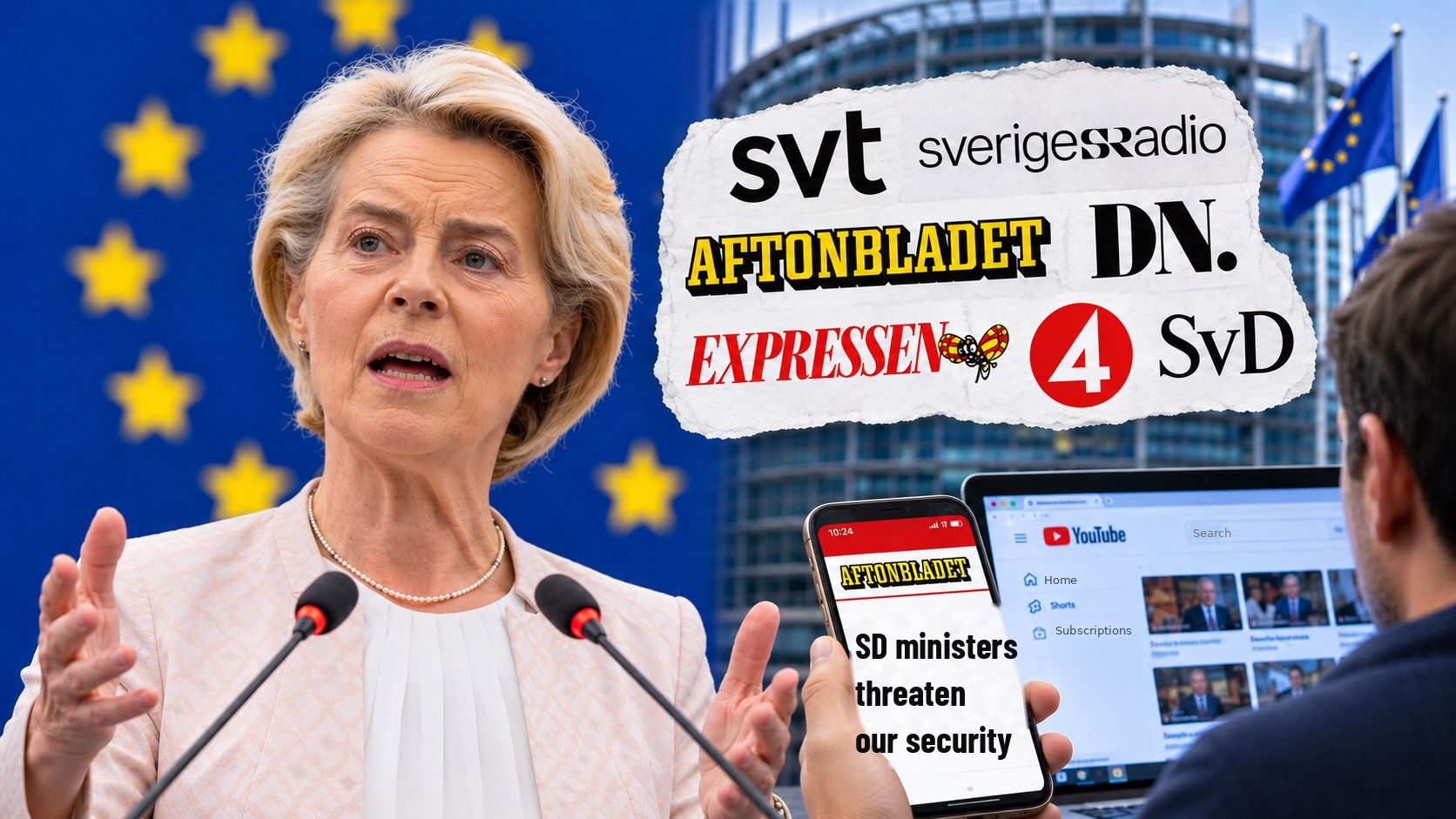
BRUSSELS - The European Union is weighing rules that would force online platforms to push "trusted" media to the top of people's news feeds. In Sweden, that would most likely mean the state broadcasters SVT and Swedish Radio. Independent YouTube channels and alternative media risk being pushed further down.
On Monday the European Parliament debates a review of the EU's media rules, sold as a way to make democracy more "resilient" against disinformation. There is no bill yet. But the EU's own documents already discuss making platforms give prominence to selected media and tightening the rules for new players online.
The European Commission unveiled its so-called European Democracy Shield on 12 November 2025. According to Brussels, it is meant to protect democracies from disinformation and foreign interference, not least from Russia.
"A confident, open and resilient democracy is the best response to those who seek to divide or weaken us," Commission Vice-President Henna Virkkunen said in a press release at the time.
Later that autumn, when the Commission asked for views on the Audiovisual Media Services Directive, the EU's rulebook for TV, streaming and video platforms, it said the review was part of the Democracy Shield.
The stated goal is "a stronger and more prominent EU media sector". The review is also meant to secure "appropriate visibility and prominence for European media".
The package includes a new EU centre for "democratic resilience", a network of fact-checkers and more money for selected media. The Commission also wants the tech giants to make it less profitable to spread what the EU classifies as disinformation.
READ MORE: Poland's President Vetoes EU Censorship Law - Sweden Voted Yes
Who gets seen first
One of the most sensitive questions is whose content shows up first. Under the approach being discussed, certain media "of general interest" would get a more prominent place. In practice, that usually means public service broadcasters.
In the Democracy Shield, the Commission writes that the review will look at how to strengthen the prominence of such media and modernise the advertising rules. Member states can already introduce prominence rules today, but they are not mandatory across the union.
EU governments have signed up to the same language. In Council conclusions from 2025, disinformation and foreign information manipulation are described as "one of the greatest challenges European democracies need to tackle".
According to the Council, making content produced under journalistic standards more visible can be "an effective tool in the fight against disinformation and foreign information manipulation". Member states are also urged to "structurally support" media that follow "professional journalistic standards".
That is exactly where it turns political. Who decides which news is "trustworthy", and which outlets meet the standard?
Presidency conclusions from 28 November 2025, backed by 26 countries, state that "access to trustworthy news is a fundamental prerequisite for our democracies to function". Media of general interest should be given prominence on platforms and screens so that users get "easier access to diverse, high-quality and trustworthy information".
The role of public service media "must be protected", the presidency writes, calling them "a civic safeguard and a pillar of society".
Public broadcasters want it mandatory
In May this year, eleven member states, including Germany, France, the Netherlands and Poland but not Sweden, asked the Commission to propose binding and ambitious rules on how media and content are displayed across the digital public sphere. That would cover the big platforms, search engines and possibly AI services too.
The European Broadcasting Union, which represents Europe's public broadcasters, wants to go further. In its submission to the review, it says it is "necessary to introduce mandatory requirements" on member states so that media of general interest are given prominence.
Such a rule should "explicitly recognise public service media" as belonging to that group, the organisation argues. In a later position paper it demands that they appear on home screens and high up in search results. In Sweden, the main winners would almost certainly be SVT and Swedish Radio.
READ MORE: Swedish State TV Veteran: 'SVT Is Clearly Right-Wing'
"Megaphones for official narratives"
The tech lobby group CCIA Europe, which represents large technology and platform companies, warns that if governments pick out which media are of general interest and then force video platforms to promote them, the platforms could become megaphones for official narratives.
Smaller, independent and digital-native voices that do not get that status risk sliding further down the feed. That, the group argues, could damage media diversity rather than strengthen it.
It also points out that the EU's Digital Services Act already regulates platforms' responsibility for disinformation, and that the European Media Freedom Act protects users' right to control their own media feeds.
Influencers named as a problem
The presidency conclusions make clear how the EU views the new voices online. The "emergence of actors" who spread news-related content online, such as content creators and influencers, is listed among the challenges to trustworthy news.
The worry is that they "are not consistently subject to the same rules as traditional media, despite often having the same or greater reach and impact".
In practice, this means alternative media and commentators who reach large audiences outside the established newsrooms. In the same list, directly afterwards, the document mentions "malicious actors" seeking to undermine democratic debate.
The proposed fix is to extend editorial responsibility to "new actors disseminating news or news-like content" and to encourage them to exercise it in a "trustworthy" way.
In Sweden, the YouTube channel Riks is one of the new outlets that has quickly won viewers away from the legacy media. It is exactly the kind of player the EU documents describe.
Today's EU rules for TV, streaming and video, last tightened in 2018, already cover video platforms such as YouTube when it comes to hate speech, the protection of minors and some advertising.
In July, the body that brings together Europe's national media regulators went further still. It recommended that influencers and other social media creators should be explicitly covered by the EU's media rules. Podcasts could follow once the consequences have been studied.
For Swedish YouTube channels, that could mean more of them being treated as traditional media, with tougher demands on advertising, content and accountability.
But the biggest risk for alternative media may lie elsewhere. With democracy as the justification, platforms could be forced to promote the outlets the EU labels "of general interest", such as public broadcasters. Independent voices would then be seen less and less.
No bill yet
Monday's debate in Strasbourg concerns a statement from the Commission, not a vote on new legislation. In its 2026 work programme, the Commission promised to "update the rules for fair competition in the media market". The bill was supposed to arrive this autumn, but it has not been presented and no new date has been set.
The direction is clear all the same. In the name of democracy, Brussels wants tighter media regulation, with "resilience", "trustworthy news" and the fight against disinformation as its arguments. Outlets with dissenting views risk getting less and less room in people's news feeds.
Simon Kristoffersson · Responsible Publisher & Senior Editor (Ansvarig utgivare)
Simon Kristoffersson is the Legally Responsible Publisher (Ansvarig utgivare) and Senior Investigative Editor of Samnytt and Samnytt News under Sweden's Constitutional Freedom of the Press Act, specializing in courts, organized crime, municipal governance, and public-sector investigations.
Follow @SamnyttNews on 𝕏 ↗