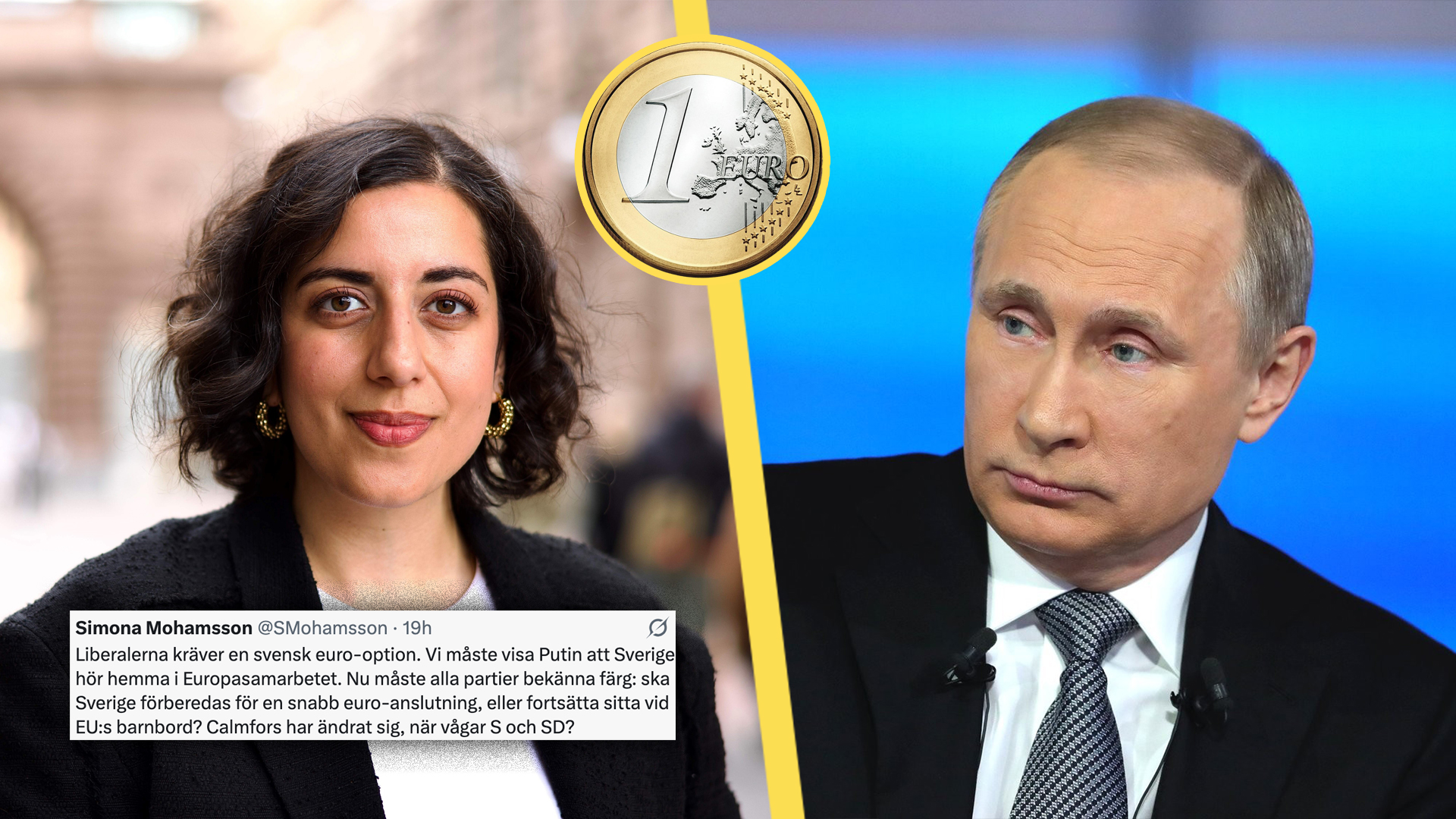
The party has long advocated for Sweden to join the euro. Now, the party leader is launching a new argument for introducing the currency – we must show Russian President Vladimir Putin that Sweden belongs in EU cooperation.
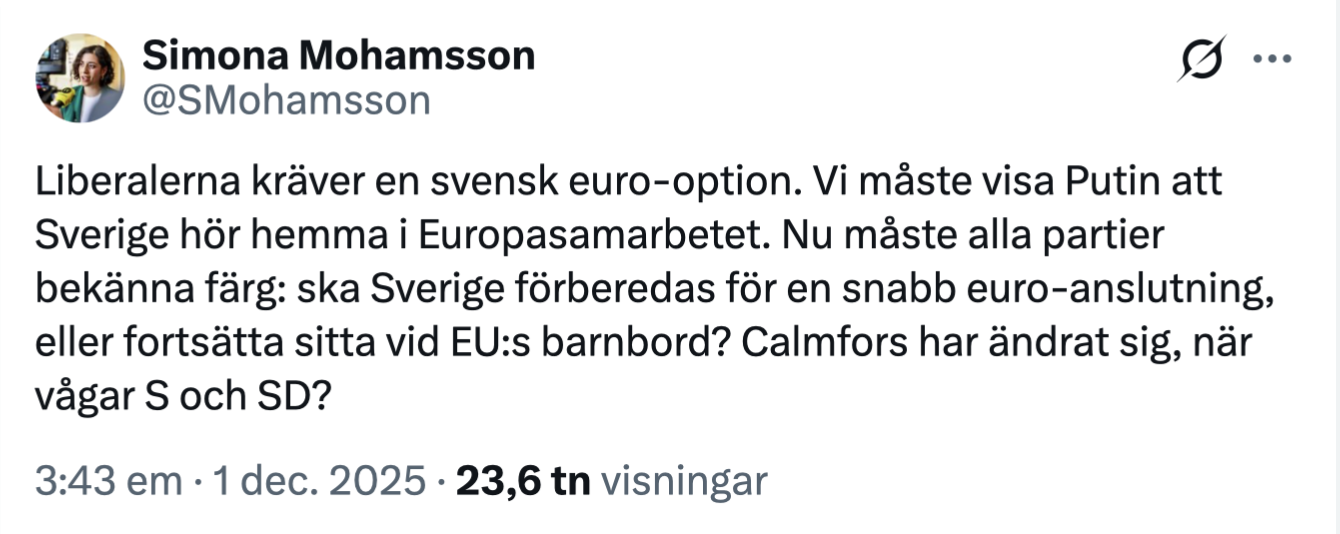
The euro issue gained new momentum after a statement from Liberal Party leader Simona Mohamsson. In a post on X, she demanded a swift Swedish euro accession and argued that currency exchange would be a way to signal against Russia.
READ ALSO: The 2 percent party Liberalerna’s new Tidö demand: The euro should be introduced
She wrote, among other things: “We must show Putin that Sweden belongs in European cooperation” and urged other parties to take a stand on the issue.
The statement stands out because Putin and the security political situation have not previously been a main argument in the euro debate. The connection between the currency union and Russia’s invasion in Ukraine has not previously been part of the economic discussion on the value of the krona, economic policy, or the banking union.
The euro issue is revived
It has been more than two decades since the 2003 referendum when almost 56 percent voted against the euro. Since then, the issue has been politically low-priority. However, the krona’s weakening at times, EU’s stricter financial regulations, and a new research review led by economist Lars Calmfors have brought the subject back onto the agenda.
Calmfors, who argued in 2003 that Sweden should wait, now emphasizes that the conditions have changed according to him. This is a line that Liberalerna leans on.
Division within the government – and in the parliament
The Moderate Party wants to re-examine the issue, but emphasizes that actual entry is far off and that a referendum is not currently relevant. The Center Party and the Christian Democrats have indicated openness to reviewing the issue. The Social Democrats believe that the referendum’s result still applies.
The Sweden Democrats say no to the euro, citing that Sweden would otherwise relinquish a central part of its economic independence.
Objections to euro entry have not diminished. A central criticism is the risk that Sweden would lose the ability to act independently in economic crises. Max Jerneck, an economist at the trade union-owned think tank Katalys, emphasizes that “As long as we have Swedish kronor, we can always pay our loans” and that the ability to create its own currency is an important factor for lower borrowing costs and greater crisis preparedness.
Another recurring counterargument is that crucial parts of fiscal policy would shift from the parliament to the European Central Bank.
Warning about Hungary
Many of Mohamsson’s previous statements have been about Sweden “being a full member in the EU’s economic decision-making” and that the euro would strengthen trade conditions. Her latest argumentation introduces a new dimension, where currency policy is linked to security policy and defense willingness.
In the same way, she hinted at geopolitics instead of economic arguments when she in SvD “warned” about otherwise standing with Hungary.
– Do you want to stand outside together with Hungary or sit at the table and make decisions about our economy together with Finland, Germany, and the Netherlands, Mohamsson asked.
Public opinion still opposed
Resistance to the euro is lower than before, but support is still weaker than opposition. According to this year’s SOM survey, 41 percent say no to the euro, while the yes side is around 25–30 percent. A larger political conflict on the issue would therefore likely occur against the backdrop of a still skeptical electorate.
Mohamsson’s statement not only means a renewed euro debate but also a changed line of argument. Instead of emphasizing economic stability or practical trade advantages, the euro is now highlighted as a signaling political tool against Russia. Whether this marks a temporary shift in position or the beginning of a new geopolitically framed euro campaign remains to be seen – but the debate has once again left the freezer.