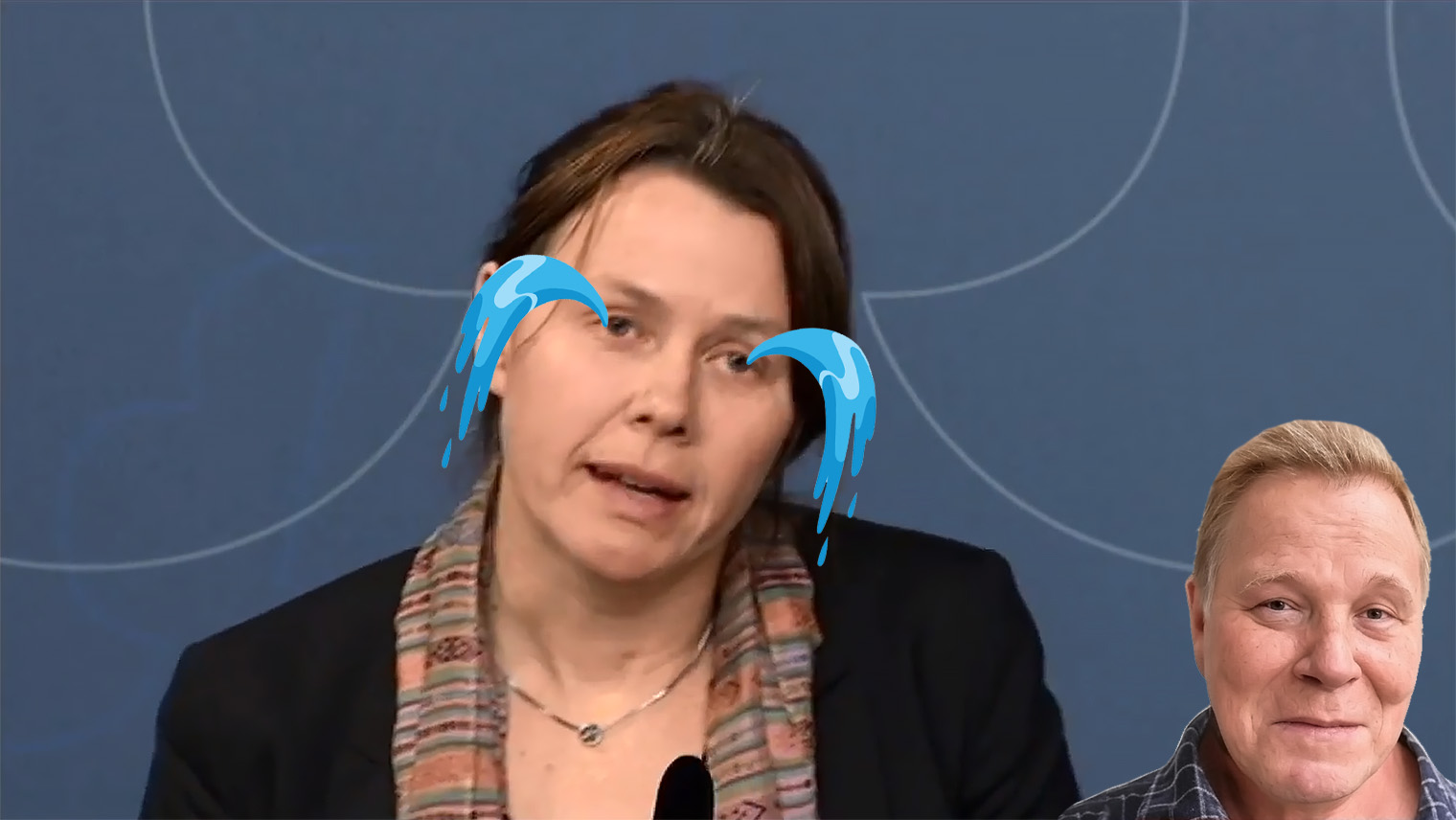
EDITORIAL • It’s time to ask why emotional outbursts have become an increasingly common feature in Swedish politics. The phenomenon is no coincidence, but rather part of the – in the worst sense – ongoing feminization of society and public debate. This shift, which has been ongoing for some time, undermines rational argumentation and leads to poor decisions in a range of policy areas where entirely different personal qualities are needed.
In recent times, we have seen a growing number of high-ranking politicians and government officials who break down in tears when protesting, presenting, or defending political decisions. Often, it concerns immigration policy, and several examples have etched themselves into the political memory.
READ ALSO: New national police chief member of Expo-affiliated network
Åsa Romson cried during the press conference when the government was forced to tighten immigration in 2015. Left Party member Christina Höj Larsen cried in the parliament’s speaker’s chair in 2021, also regarding an immigration policy issue. National Police Chief Petra Lundh drew attention for her quivering voice and tears in her throat when speaking about her area of responsibility, serious crime.
We should also not forget the kneeling, crying police officer during the Black Lives Matter hysteria in 2020.
The latest example, when Camilla Waltersson Grönvall held a press conference about children taken into custody, shows that the phenomenon continues to spread. The common denominator is hard to miss: all these public emotional outbursts come from women.
Having the cake and eating it too
It may be convenient to dismiss this as a coincidence or even portray it as something good – that a warmer, more empathetic female perspective takes place in politics in contrast to the emotionally cold or toxic male. There is a difference between men and women, and surely this should also be reflected in political life, one might argue.
But when the tears reappear in crucial political moments, and when they consistently arise in connection with controversial decisions, they begin to show a different pattern. Female politicians on the left who claim to be strong feminists in their everyday lives but suddenly break down in a performance for the galleries are exploiting an outdated gender role about the fragile woman.
READ ALSO: Here are the members of the Expo-affiliated power network Hilda
They want to have their cake and eat it too. They want all the advantages of being equal when they want, but an emotional appeal when it can win sympathies and they lack factual arguments. And to criticize this tactic as a male politician can backfire, as it only confirms how tough and insensitive one is.
But it is reasonable to demand that women who claim to be equal to men in political life must also be able to handle decisions going against them in a democratic manner without resorting to tears. The behavior also plays into misogynistic forces’ hands where all women are tarred with the same brush:
“Can’t we see now how wrong it was to give women the right to vote? Don’t we understand that women have no place in politics, but belong in the kitchen and nursery?” And the paradox is that it is the feminist women of the left who give the most nourishment to such opinions.
It is also strikingly often misplaced tears, where the crying is for the wrong people. There are tears shed because criminals and age-cheating migrants have to leave Sweden, but not for the victims of migrants: Swedish children who are humiliated and robbed, Swedish girls who are assaulted and gang-raped, Swedish elderly who are deceived of their money and belongings, the even older who are mistreated and subjected to sexual abuse in home care and nursing homes.
Thatcher and Meir
The point is not that emotions in themselves should be forbidden in politics. They have their rightful place but are exceeded by women who are splashing the public space with their tears and contributing to a feminization of political leadership where a teary-eyed view replaces a clear-sighted one, and the quality of decisions suffers as a result.
The question is also why today’s female politicians so often use crying as a tool, when yesterday’s female leaders had a different and more resilient attitude. The development should reasonably have gone in the other direction in an increasingly equal society where boys and girls are raised equally.
READ ALSO: The Mannaminne network leads the protests against the breakdown of the rule of law
History has many examples that female leadership does not equate to crying one’s way to accomplishments. Margaret Thatcher governed Britain through crises with a determination that many male politicians could only envy, and other women, regardless of their political opinions, should take as an example. The same goes for Golda Meir, Israel’s former prime minister. She carried an entire country on her shoulders in times of war and terror instead of breaking down in tears and needing to be comforted by her male colleagues.
They and their contemporaries understood that strength, rigor, and responsibility required leadership that prioritized rationality and firmness. Today’s feminized politics instead build on the dangerous notion that a soft, caring, and emotionally-driven approach is not only acceptable but even superior.
Perhaps it can be on certain policy areas, but it has had catastrophic consequences when it has taken over in areas such as criminal and immigration policy. Soft pants are also replacing uniform pants in the defense. Ethnic and sexual diversity are prioritized over combat capability – conservative men with military experience are excluded while trans individuals and immigrants lacking loyalty to Sweden are invited.
Feminized politics
The result of this feminized approach is directly dangerous for our country’s security and safety. It also leads to tolerance for the intolerant. It manifests a female nurturing instinct in a political context where it does not belong, creating societal problems rather than solving them.
This misplaced instinct enables decisions about open borders and lenient criminal policies, that we get police officers who see themselves more as social workers and buddies with criminals. Leaders molded in this form are easily manipulated when the media propaganda tries to convince them that adult men from Afghanistan are innocent little boys.
Sweden deserves leadership – from women and men – that can weather the storm without being swayed by irrational emotional outbursts when decisions become difficult. It’s not about demanding inhumanity, but about safeguarding a political culture where clarity, rational arguments, and taking responsibility weigh heavier than an ideological belief that the soft hand is superior in all situations.
When the feminized emotional politics dominates in areas where the opposite is needed, societal problems become harder to solve instead of easier – the situation worsened instead of improved.
READ ALSO: More female police chiefs take place – professor explains how the legal system is changing