EDITORIAL • Women should be protected from violence, threats, persecution, and sexual abuse. But when the state also wants to protect them from “contempt,” equality starts to shift into protectionism. Women and men are equal citizens – not fragile groups who need different amounts of help to handle public discourse.
It is hard to object to much of what the government aims to achieve with the new legislation against online abuse. Those who stalk women should be punishable. Those who threaten them, too. Spreading nude photos or AI-manipulated intimate material without consent is a serious violation that the rule of law has good reason to intervene against.
But in the official inquiry “New Online Crimes and Other Measures for the Implementation of the Directive on Combating Violence Against Women and Violence in Close Relationships,” another step is proposed, one that is not as obvious.
A new offense is proposed: gender-based online hate. This would target those who, with technical tools, “incite violence against, threaten, or express contempt for a group of people or an individual with reference to gender.”
The standard punishment could be up to two years in prison. For severe cases of gender-based online hate, the proposal is imprisonment from six months to four years.
In practice, this is a gendered, online version of incitement against an ethnic group. The inquiry itself admits this – the crime of incitement (HMF-law) has served as a model, and the legal construct largely mirrors its first paragraph.
But the HMF law’s design and application have been arbitrary and skewed. Many believe it should be scrapped or fundamentally rewritten. It should not serve as a model for a new law on gender-based online hate.
Sweden Goes – As Usual – Further Than the EU Demands
The background is an EU directive on combating violence against women and violence in close relationships, which member states must implement by June 14, 2027. It may be tempting for Swedish politicians to hide behind Brussels. But it’s not that simple.
The EU directive requires member countries to criminalize public incitement to violence or hate against a group or a member of a group, with reference to gender.
READ ALSO: New Hate Crime Laws Criticized for Threatening Freedom of Speech
The Swedish inquiry chooses the much broader HMF-formulation – “incite violence against, threaten, or express contempt for.”
The investigator themself admits that the Swedish wording goes further than the EU directive requires. Even regarding dissemination, the proposed Swedish scope of punishment is broader than the EU’s minimum level.
The EU also requires that the maximum punishment for this type of offense be at least one year in prison. Sweden is proposed to introduce two years for the standard level and up to four years for aggravated offenses.
This is therefore not just a situation where Sweden reluctantly implements a detailed regulation from Brussels. Sweden must complement its legislation to meet the directive, but the chosen Swedish solution is, in key respects, more far-reaching.
Politicians must take responsibility for this themselves. Nor is it the first time that the Tidö government has chosen an investigator whose final report sounds as if the assignment originated from the red-green parties.
When the State Begins to Punish Contempt
The principled difficulty lies in the word “contempt.” Threatening a woman with violence is an act with an identifiable victim and a concrete meaning. Expressing contempt toward women is something else, not just milder but also notably vague—it can include almost any statement disliked by the recipient.
The inquiry draws the meaning from legislation about incitement against groups. There, contempt can include derogatory remarks and ridicule. Not everything like this is criminal, of course. A statement should be assessed in its context and it must be clear that the line for a factual and reasoned discussion has been crossed. The European Convention’s protection of freedom of expression can also necessitate a restrictive application.
These are important legal safeguards. But they do not solve the basic problem. Now police, prosecutors, and courts must decide when a citizen’s bad opinion about men or women has become so derogatory that it is not just stupid, distasteful, sexist, or vulgar—but criminal.
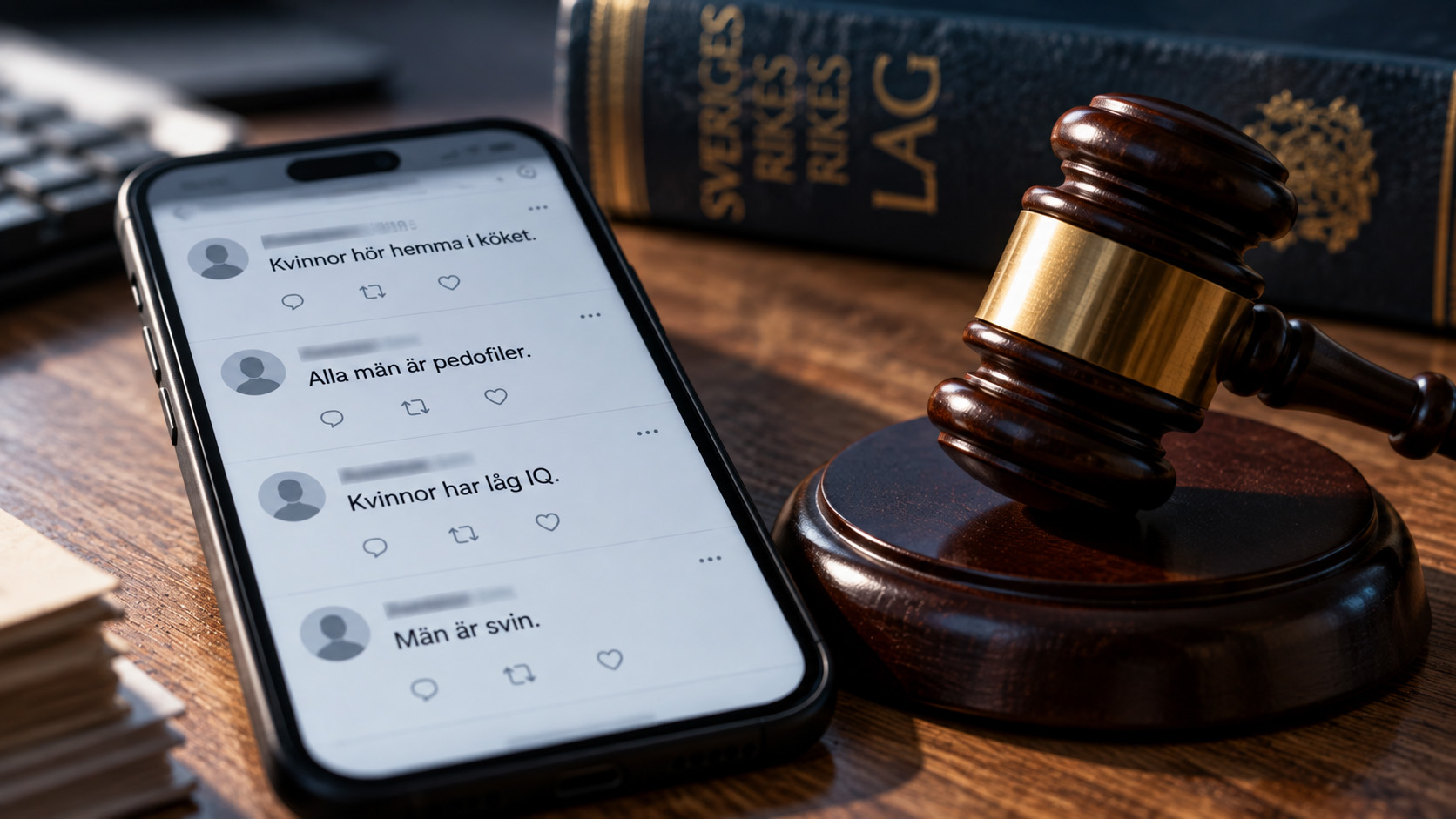
Civil law professor Mårten Schultz has asked whether, for example, it could become a crime to claim all women have low IQs, call all men pedophiles, or spread the SCUM manifesto.
You can add more. Women belong in the kitchen. Men are pigs. Women can’t drive. All men are potential rapists.
READ ALSO: Ekeroth: “Why is the HMF Law Still Here?”
It’s not hard to judge that such generalizations are stupid. It’s harder to explain why the state should decide which of them are so stupid that the speaker should be punished.
Freedom of speech is, after all, not mainly needed for well-articulated, friendly, and widely accepted opinions. It is the repugnant, dumb, and provocative statements that test whether freedom actually exists.
Another law, with the HMF law as the yardstick, could become yet another gift for the easily offended and a welcome tool for those wishing to silence even more areas of discussion.
Same Law – But the Same Standard?
On paper, the proposed law is gender-neutral. It is to be equally forbidden to express punishable contempt toward men as toward women. That is important to note.
At the same time, it is hard to disregard the political context in which the law arises. The EU directive concerns violence against women. When the inquiry was presented, Justice Minister Gunnar Strömmer said the government will never give up until “women and girls are fully safe and free in Sweden.”
The inquiry’s overview also emphasizes gender differences in vulnerability. Men are said to be more often exposed to threats and attacks relating to profession and skill, while women are much more often subject to sexual and sexist violations directed at their person and gender.
There are good reasons to highlight such differences. But this also makes the question of neutrality in the application of the law all the more important.
Harsh contempt for men has long been openly expressed in parts of pop culture, activism, and social media. Declaring hatred of men, as Zara Larsson does, can be seen as provocative feminism, irony, or an expression of frustration.
Try the opposite. A male artist or commentator who publicly builds his brand around hating women could hardly expect the same tolerance, backslaps, and open career doors.
This does not necessarily mean the new law will be applied differently, but there is experience enough to suspect it might. When the state criminalizes such a value-dependent concept as “contempt” at the group level, we must ask—will the same words be judged the same when aimed at men as when aimed at women?
From Equality to Protectionism
There is also a broader question far beyond this particular law. The classic idea of equality is both simple and radical—women and men are equal citizens and should have the same rights, duties, and opportunities.
This does not mean the sexes are identical or that all average outcomes must be the same—except for left-feminists. Primarily, it means women should be regarded as mature, independent people with the same capacity and responsibility as men to shape their lives.
But parts of gender equality policy have gradually taken on another character. The woman increasingly appears as a politically protected object.
She should not only have the same rights as a man. Political measures should also shield her from unwanted outcomes, compensate her life choices, adjust her representation, and now, ultimately, protect her from certain disparaging opinions others may hold about her gender.

Similar patterns appear in discussions about quotas, salaries, careers, and parental leave. If men and women as groups make different choices or achieve different outcomes, the difference is easily treated as a political issue in need of correction.
But an equal society can’t aim for men and women to live statistically identical lives. Instead, it’s the left-leaning problem framers who are the problem and need correction—so that men and women can live freely, without political dictates.
People make different priorities. Income and professional status are not the only measures of a good life. That women, on average, make other trade-offs between work, family, leisure, and career than men need not mean someone prevented them.
READ ALSO: Incitement Facts – The HMF Law’s Latest Expansion
Especially on the left, one should praise those who do not think money is everything—that top quality of life is not the same as having the most in the bank account, with all the sacrifices of other things required to get there.
To respect women’s self-determination must also reasonably mean respecting women’s choices, even when politicians and equality experts would have preferred they chose differently. Otherwise, a strange paradox arises.
The more politics talk about women’s strength and independence, the more it seems to assume that women need state help for things men are expected to handle themselves. That is not obviously equality. It can just as easily be the inequality of protectionism.
An Old Problem Returns
There is extra reason for caution particularly when the HMF law is used as a model. The inquiry notes that previous proposals to add gender to the incitement statute were never adopted. One reason has been boundary-drawing problems. Another is that such a move would cause the statute to lose its traditional focus on minority protection.
The boundary problem is the big one. To “hold in contempt” is to have an opinion about something—it needn’t be a particularly strong one. Sometimes, it is even reasonable to hold something in contempt.
The other problem, however, is not a problem, but would actually be welcome. And again, the unsuitability in selecting the investigator is shown. That one group is numerically larger than another does not make it any less unpleasant for those who are subjected to incitement because of their group affiliation.
Being blonde and blue-eyed and the target of anti-Swedish hate from immigrants is just as unpleasant as the opposite. There is no comfort in being part of a numerically larger group at the national level if you’re the only Swede in the class in Rinkeby or Rosengård.
READ ALSO: Government: No Actions Against Anti-Swedish Hate Crimes
The only positive thing about this type of law would be if it led to abandoning a Marxist power analysis that has no place in democratic legislation. But that’s not a horse you should bet on to win.
READ ALSO: Immigrants’ Humiliating Act Against 15-Year-Old Swedish Boy Not Considered a Hate Crime
The hate crime designation is another good yardstick for how wrong things can go. As written, increased penalties should be given for all forms of hate crime motive, but despite the most widespread hate crime-motivated offenses in Sweden being frauds against the elderly and humiliating robberies against minors, where virtually all perpetrators are immigrants and all victims ethnic Swedes, not a single person has had their sentence increased.
READ ALSO: Why Are Crimes Against the Elderly Never Treated as Hate Crimes?
In a previous legislative matter, the Council on Legislation pointed out problems of legality when the boundary between gender, gender identity, and gender expression became unclear and fluid. That criticism was then deemed not possible to overlook. That is especially relevant today.
The new provision refers to legal gender, woman or man. But legal gender can now be changed. Meanwhile, there is a heated debate about the relationship between biological sex, legal gender, and gender identity.
Internationally, there are already examples of cases where statements about biological sex and transgender individuals have been treated as hate, harassment, or prohibited violations under respective countries’ legislation.
Those cases cannot be automatically transferred to Sweden. The laws differ. But they illustrate a problem with freedom of opinion and expression that has no place in a democracy. And every step Sweden takes in that direction is a step in the wrong direction.
When lawmakers use vague concepts like hate, contempt, insult, and dignity in politically and scientifically disputed issues, courts may ultimately have to decide not just how an opinion is expressed, but which reality descriptions are permitted.
The rule of law should be extremely cautious here. The law should protect people’s rights. It should not protect their view of reality from contradiction, particularly when that view of reality contradicts established science—whether it’s about men and women or about whether the earth is round or flat.
Women Need Rights – Not Political Guardianship
There is real violence against women. There are men who abuse, rape, threaten, and stalk women. There are female journalists, politicians, and commentators who are subjected to vile sexual threats because they are women.
Fight that. Lock up the rapists. Stop the stalker. Punish the threat-maker. Give police tools to tackle real violations and protect those whose private sexual materials are shared online.
But don’t conflate this with the idea that adult women need state protection from bad opinions. Don’t give easily offended female journalists and politicians a tool to misuse to escape every form of criticism, to avoid the policy debate.
READ ALSO: Older Woman Criticized Brutal Attack and Low Sentences – Convicted Under HMF Law
A woman who enters the public debate has the same right to protection from threats and crimes as a man. She also has the same obligation as a man to endure the fact that others can be stupid, mean, unreasonable, and sometimes downright repugnant. That is the price of living among free people.

The great advances of equality did not consist in making women a specially protected category. On the contrary, they meant that women stopped being treated as incompetent beings for whom men, authorities, and society needed to make decisions and protect from life’s hardships.
It would be a strange historical cycle if a policy calling itself feminist now began to restore that very notion in a modern, well-meaning disguise. Women do not need state guardianship. They need the same freedom, the same rights, the same responsibilities, and the same legal protection as men.
An equal society treats women as men’s equals—not as wards of the state.
Samnytt?
Do you appreciate Samnytt? Show it by subscribing or donating.
DONATE VIA SWISH
123 083 33 50