Dagerlind: A People Is More Than a Nyckelharpa
Mats Dagerlind examines the official Swedish elite view that national identity can be reduced to folkloric symbols or subway tickets — arguing that a nation is built on shared historical memory, language, and civic trust.
- Swedish political elites have long dismissed native Swedish culture as nonexistent or limited to superficial folklore like Midsummer and the nyckelharpa.
- High-trust Nordic institutions grew out of deep cultural continuity and mutual obligation — not mere administrative residency.
- Defending a distinct Swedish cultural identity is essential to restoring social cohesion.
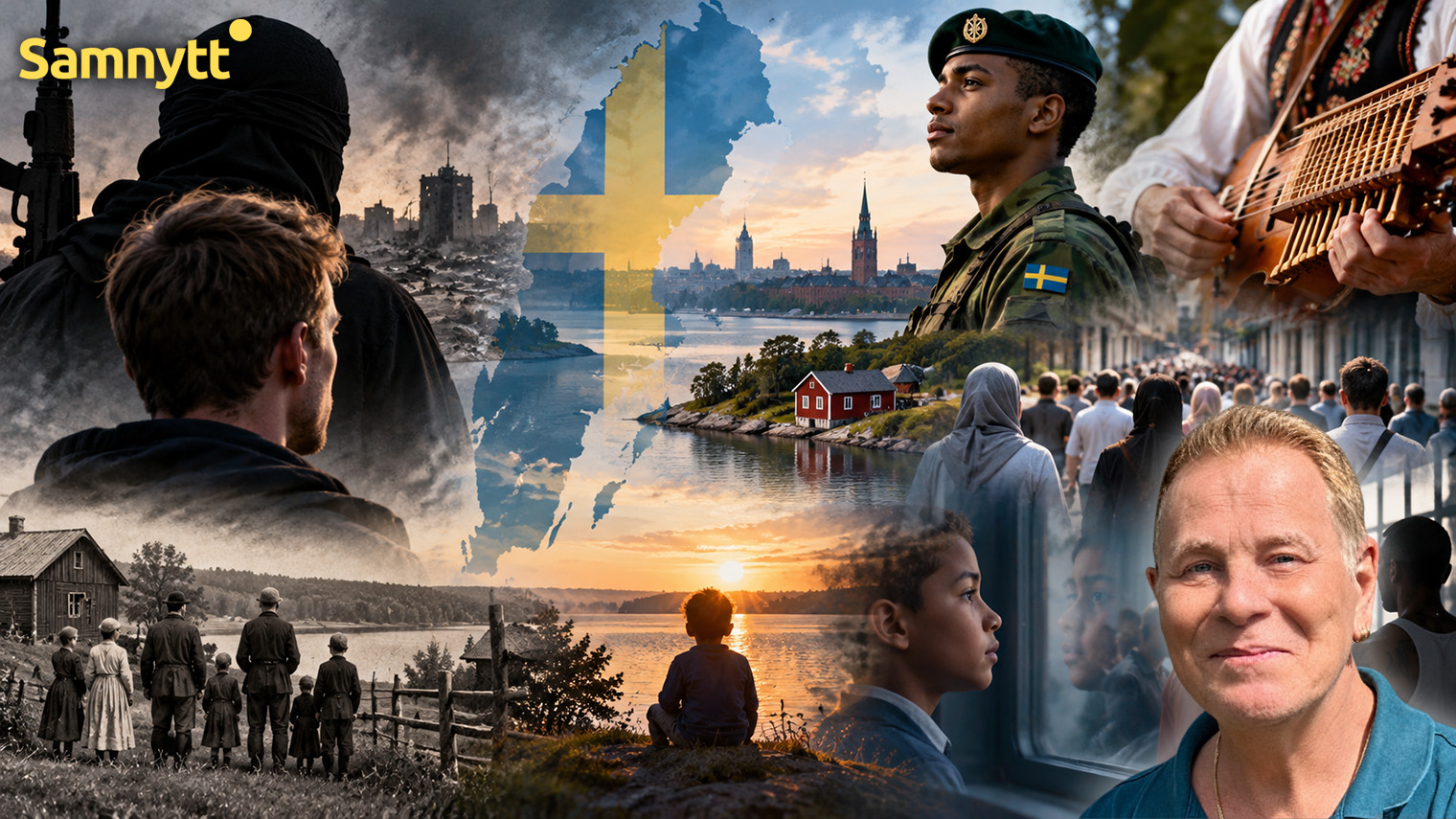
EDITORIAL • Is a Swedish-born Islamist terrorist less Swedish than a dark-skinned adopted officer who plays nyckelharpa? With this provocative comparison, the Sweden Democrats’ chief ideologue Mattias Karlsson aims to show why cultural nationalism is superior to ethnic nationalism. But his reasoning raises more questions than it answers. A people is not just a collection of individuals behaving a certain way. It is also a historical community where ancestry, identity, and continuity matter. And the uncomfortable question of what happens when this community is fundamentally changed does not go away simply by juxtaposing two extreme destinies and rambling about nyckelharpas.
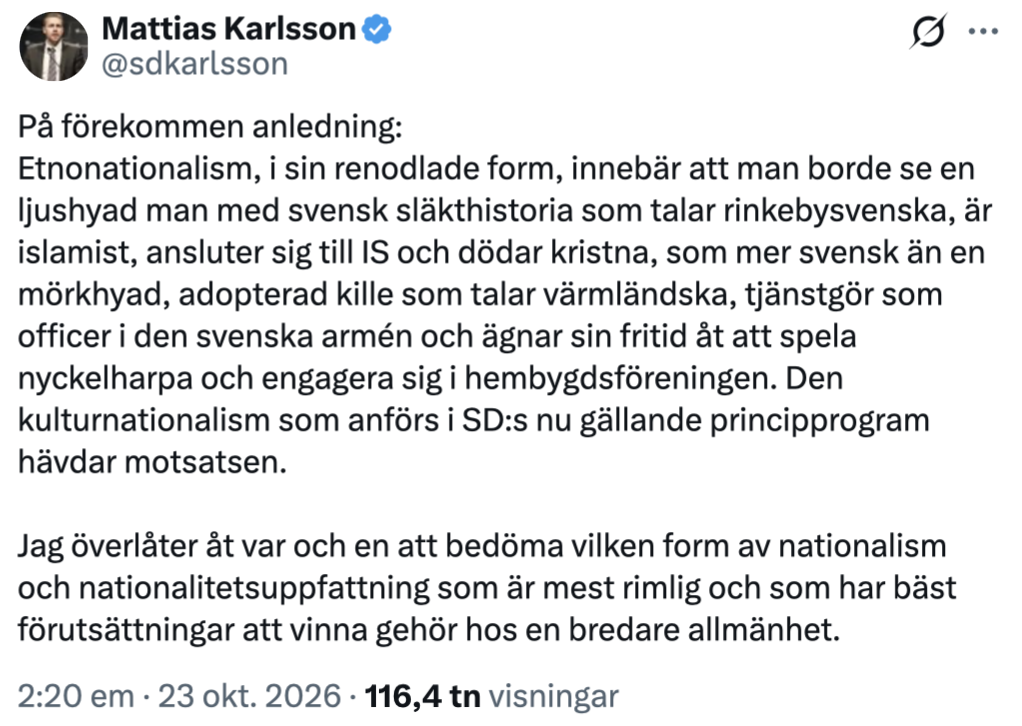
The Sweden Democrats’ ideological grandee Mattias Karlsson has entered the heated debate on Swedishness, ethnicity, and nationalism. On X he writes:
“Ethnonationalism, in its pure form, means that one should consider a light-skinned man with Swedish ancestry who speaks Rinkeby Swedish, is an Islamist, joins ISIS and kills Christians as more Swedish than a dark-skinned, adopted guy who speaks Värmland dialect, serves as an officer in the Swedish army and spends his free time playing nyckelharpa and engaging in the local heritage association.”
Karlsson goes on to explain that the cultural nationalism advocated by the Sweden Democrats claims the opposite. He then lets the reader determine which nationalism is more reasonable and more likely to win voters’ approval.
It’s a clever rhetorical trick. Who wants to defend an Islamist terrorist over a homeland-loving officer? But it’s also a convenient way to avoid discussing the real issue.
Karlsson chooses two individuals who are each other’s polar opposites. One has Swedish ancestry but has rejected almost everything associated with Swedish culture and social community. The other lacks Swedish biological heritage but has adopted Swedish culture, language, and national loyalty.
Karlsson then lets the comparison decide which view of the nation is most reasonable. The problem is that he conflates several different things.
To be ethnically Swedish is not the same as being a good Swedish citizen. Belonging to a nation is also not the same as being a good person.
A Swede can be a traitor, terrorist, or murderer without his ancestry ceasing to exist. A person of foreign descent can simultaneously be an exemplary Swedish citizen, a patriot, and an asset to the country. One does not exclude the other.
Karlsson is of course correct that there are radical ethnonationalists who make biological ancestry an absolute criterium for national belonging. But that’s not the only possible view of the significance of ethnicity, nor is it the most honest to put forward as supposedly representative.
Between the view that “Swedishness is in the blood” and the view that it can be wholly acquired through certain behavior, there is a vast area Karlsson chooses not to explore. That’s where the interesting discussion lies.
A People Is Not a Citizen Register
Let’s start with the word “nation” itself. It comes from the Latin natio, related to nasci, to be born. Originally, then, there was a clear connection between nation, birth, and ancestry.
Over time, the concept has acquired several meanings. In modern political theory, there is often a distinction between the ethnic nation and the civic nation. The former emphasizes historical origin, language, culture, and shared identity. The latter is primarily based on citizenship, political institutions, and shared rights and obligations.
In reality, nations are seldom pure examples of one or the other. Sweden is no exception. We have a Swedish state with Swedish citizens. But we also have a historic Swedish nation that existed long before today’s citizenship laws, personal identity numbers, and passport authorities.
In addition, we recognize that there are other historic folk identities within the Swedish state. The Sami are the clearest example. They are seen as a distinct people and Indigenous group, with a history, culture, language, and identity that doesn’t cease to exist simply because they are also Swedish citizens.
People speak about the Sami nation in a more original sense of the word. But if we can recognize the Sami as a historic people, why would it be fundamentally impossible to talk about ethnic Swedes as a historic people? To differentiate the Sami nation, one must reasonably admit that there is a Swedish nation of a similar kind to differ from.
The question becomes particularly interesting because Sami identity, in certain legal contexts, is also linked to previous generations. According to the Sami Parliament Act, being covered by the law’s definition requires, among other things, that one considers oneself Sami and can plausibly show that oneself, a parent, or a grandparent spoke Sami at home. Alternatively, a parent’s prior inclusion in the Sami Parliament’s electoral roll can be the basis for belonging.
It is not an absolute demand for biological purity or DNA tests. But it touches on this by recognizing that historical and familial continuity matters for folk identity.
The Sami’s special status as Indigenous people of course has its own legal and historical foundation. It cannot simply be transferred to the Swedish majority. But the example shows that ancestry and continuity are not foreign concepts in Swedish law and politics. The Sami, on an ethnic basis with a biological component strongly emphasized, have been granted special rights that exclude other Swedish citizens.
So, we accept that a people can be something more than the sum of the people who currently live within a certain geographical area. Why should it be different when we talk about the Swedes? The Sami ethnic nation spans multiple states. So too, for example, does the Kurdish nation, where talking about ethnicity with an emphasis on origin is not taboo.
Ethnicity Is More Than Skin Color – but Skin Color Is Not Invisible
Karlsson’s first example is of a light-skinned man with Swedish ancestry. His second is a dark-skinned adopted man. Even here he has narrowed the discussion.
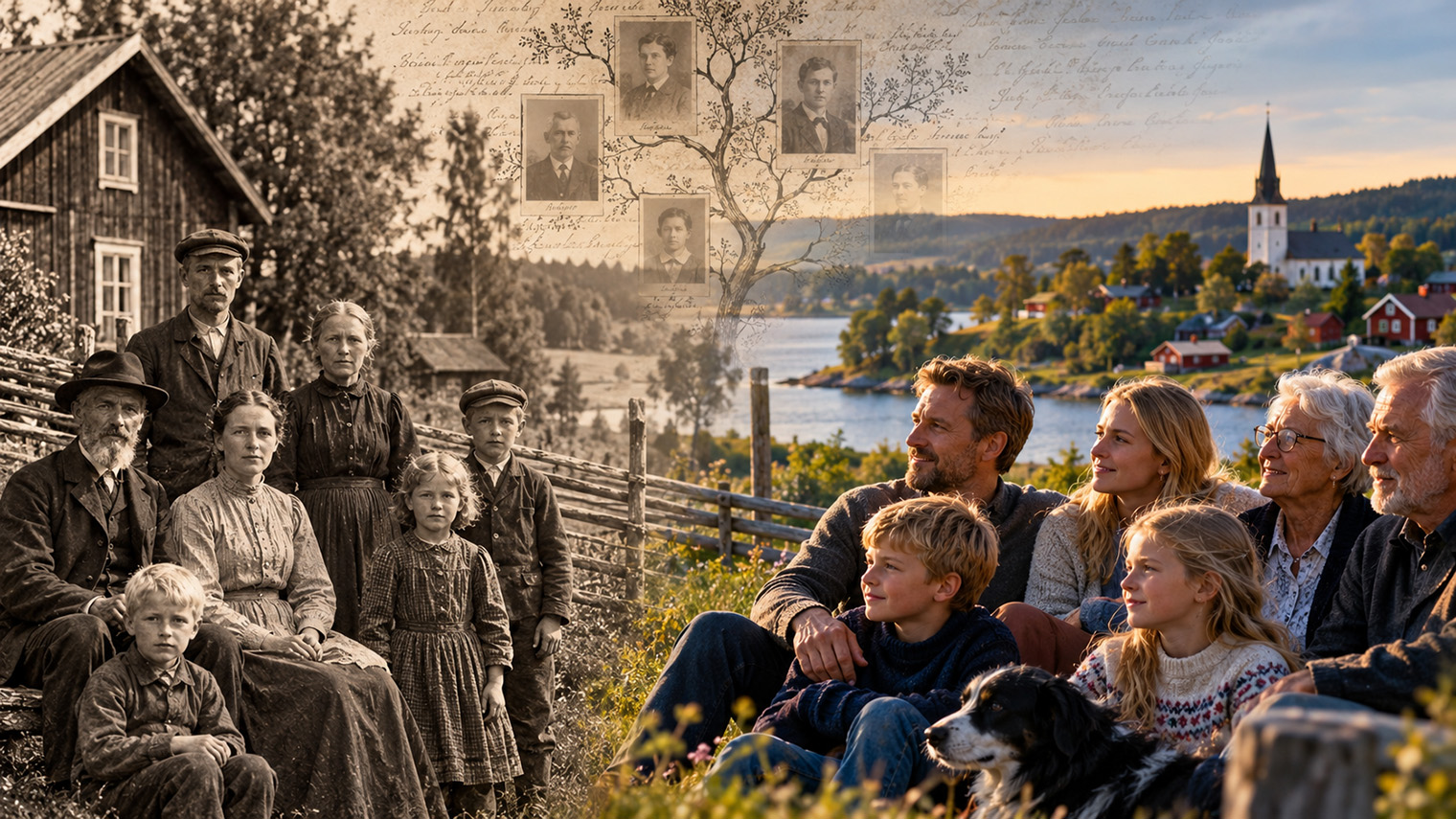
Ethnicity is not synonymous with skin color. It includes, among other things, shared history, language, culture, traditions, social norms, collective experiences, and perceptions of shared origin. But ancestry is also a component.
The Swedish people have emerged through a long historical process. People have lived in the Nordic region since the glaciers retreated. The population has changed somewhat through migration, mixing, and cultural development, but over long periods there has also been significant continuity.
The people who, over the centuries, came to identify as Swedes developed a shared history, language, and culture. They also shared, to a considerable extent, a family history. This is no racialist theory—it’s a factual description of how historical ethnic formations can arise and how evolution adapts people for greater survival potential in the areas where they reside.
Humankind’s long evolutionary history has contributed to populations in different parts of the world getting somewhat different physical characteristics. Differences in, for example, skin pigmentation have a biological history. But biological differences and ethnic identities are not the same thing. The former is part of the latter, which is further shaped by history, language, society, and people’s perceptions of belonging.
This, however, does not mean that appearance is unimportant for how people perceive themselves and others. We recognize people by their faces. We notice family resemblances. We notice things that can signal geographical origin and kinship. It would be strange, wrong, and a politically correct lie to claim that these observations are meaningless for people’s identity.
At the same time, we must distinguish between noting that people can experience solidarity through shared appearance and asserting with certainty that this sense of belonging is entirely genetically predetermined—though we should assume it is to some extent. But it is enough to state the first as a human experience worthy of taking seriously. The latter is a much more far-reaching scientific claim, interesting depending on context.
That it is more important that these things exist than knowing exactly why, as long as we avoid allegations that it can be reduced to racist notions. In the political debate, even the first is sometimes treated as morally suspect, as if people are obliged to be completely indifferent to all changes in the population and environment where they and their ancestors have lived.
The Uncomfortable Must Also Have a Place
This brings us to something that Karlsson’s constructed examples entirely overlook. People do not only have rational and deliberately chosen identities. We also carry feelings of belonging, recognition, and community that can be hard to articulate and even harder to change through political decisions.
A Swede who grew up in a community where almost everyone spoke Swedish, shared similar cultural references, and had family roots in Sweden for generations may experience deep anxiety and insecurity when that environment changes in a short time to something completely different.
This does not have to be interpreted as contempt for people from other parts of the world. The person may appreciate individual immigrants, have friends with foreign backgrounds, and still mourn the earlier sense of belonging in a Sweden where it is now not about such details. A country that, in less than 50 years, has gone from being almost ethnically homogeneous—even in terms of ancestry—to now having a migrant proportion of 25–30 percent nationally, cities where immigrants are a majority, and hundreds of residential areas where ethnic Swedes are barely to be found.
In a Sweden projected only a handful of decades into the future, people with multigenerational Swedish ancestry may be a minority and the majority may have recent roots in Africa or the Middle East. After a few more decades, the Swedish minority may have shrunk so much that its influence on Sweden is marginal and its very existence threatened.
Suppose all MENA-migrants speak good Swedish, obey the law, support themselves, and embrace the values Karlsson associates with Swedishness. Would the demographic change then be immaterial to how people experience the country? This is not obvious, not even likely. Most ethnic Swedes would feel that something essential had changed. Some would convince themselves it was unimportant because that is the sanctioned opinion. A handful might truly consider it something positive.
An experience based on ethnic cohesion, where the component of ancestry also matters, cannot be dismissed as an illusion or vilified as racism merely because it doesn’t fit a particular political conception of nationhood. It is dangerous to confuse how people should be with how they actually are.
And how people are seems to be that they can develop new communities across ethnic and cultural boundaries—but only up to a point. Marginal immigration, yes. Mass immigration, no.
Beyond the fact that no assimilation into Swedishness can occur in a Sweden where Swedes are not the obvious and dominant majority, other things happen when societies undergo very extensive changes in a short time—things that don’t fit into the polished political debate.
Swedes who want to live in a Swedish Sweden, not just culturally but also in all aspects of ethnicity. Swedes who feel insecure not only due to gang crime, elderly fraud, humiliating robberies, islamism, or accusations of racism from those generously given refuge in Sweden, but also on a more fundamental ethnic level.
Societal Development Outpaces Human Change
Humans are not just rational beings who choose loyalties after studying various political manifestos. For a very long time we have lived in groups, families, and societies where belonging and cooperation were crucial for survival and have been hard-wired into us as inherited traits.
There is research on people’s tendency to identify with their own group and, under certain circumstances, to favor it over others. Such groups need not be biologically defined, but they can be. People can develop strong group loyalties around language, religion, political opinions, hometowns, or even quite arbitrary group memberships. But coming together around ethnicity, with an emphasis on ancestry, is also common.
Aggression, competition, fear, and group loyalty are not inventions of the modern nation state. They have followed humanity through history and conferred evolutionary advantages. We have also developed the ability to cooperate with strangers, create institutions, and expand our communities far beyond the immediate family and group.
The history of civilization is, to a large extent, about managing these contradictory human conditions. But civilization is relatively modern. The older instincts run deeper.
We should not embrace every impulse that may have evolutionary roots. That would be a primitive way to organize a modern society. But nor do we make humanity easier to understand by denying that such impulses exist or stigmatizing them as always unacceptable.
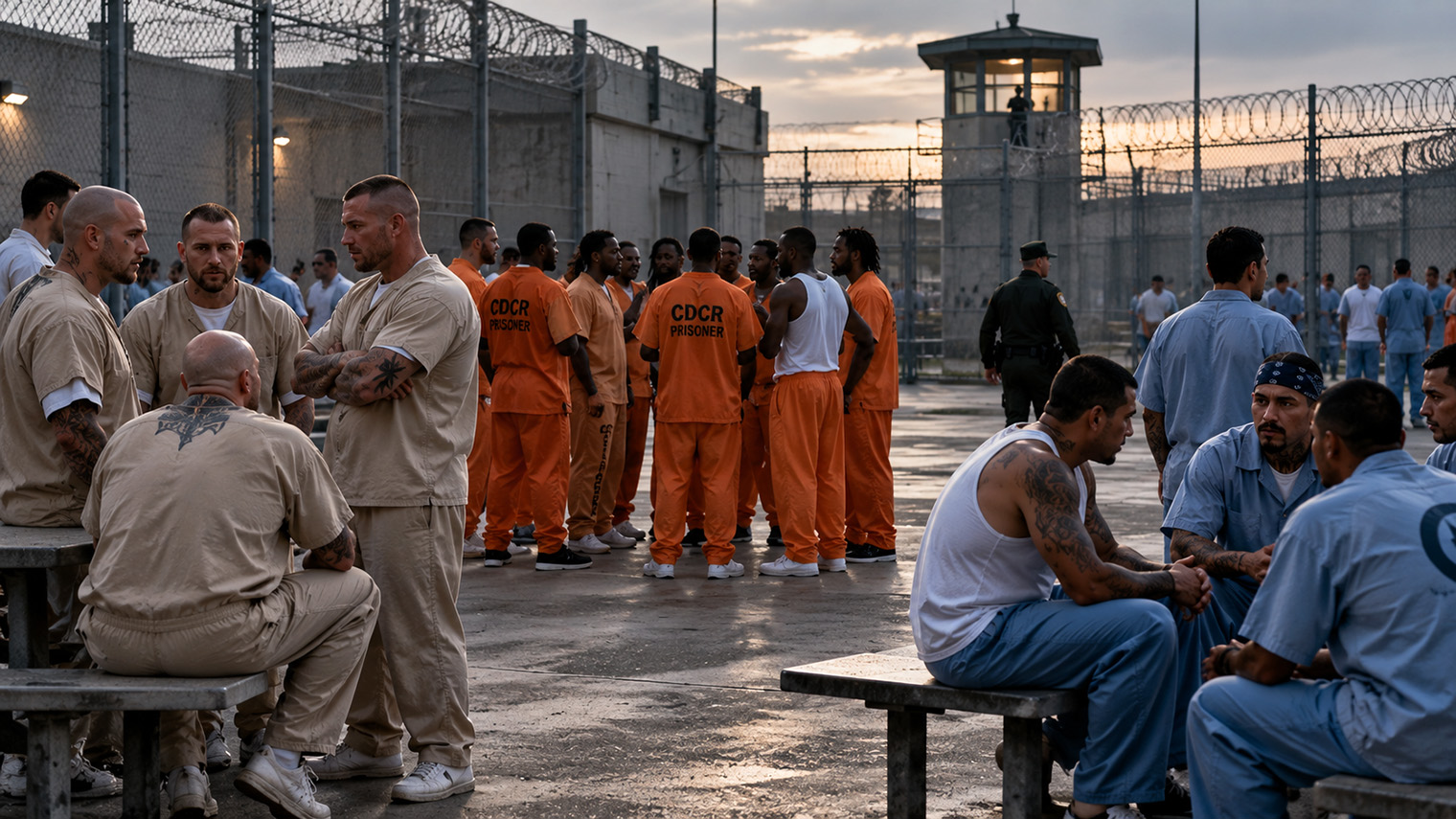
The American prison environment offers an illustrative example of how strong ethnic and racial group affiliations can become under extreme circumstances. In many prisons, inmates have organized into groups based on categories such as whites, blacks, and Hispanics. There are environments in which such divides strongly influence who one spends time with, seeks protection from, and is expected to be loyal to.
The special power structures of prisons and the informal rules of gangs of course play a part. But it does not change the fact that ethnic and racialized group affiliation can take on major significance. Exactly what this says about human nature is debatable. What is interesting is that the phenomenon exists even in a modern society that has long tried to counter such divides.
We can wish for a world where people pay no attention to others’ appearance or origin. But we cannot assume that people already function that way. Nor should we confuse the moral ambition to treat people equally with the empirical claim that ancestry never matters for how people perceive community.
An Adopted Officer with a Nyckelharpa Doesn’t Solve the Problem
Let’s return to Karlsson’s example of the adopted officer. Suppose he came to Sweden as an infant, grew up with Swedish parents in Värmland, learned Swedish as his mother tongue, and never felt any country but Sweden as his own.
Why should he not be able to feel Swedish? And why should his fellow Swedes not perceive him as Swedish, even if he doesn’t look traditionally Swedish?
But there is another dimension. People adopted from other parts of the world may sometimes feel the need to seek their biological roots, even though they grew up in another culture and identify with it. Anyone wanting to understand this need only consider the popularity of genealogy.
Or take the popular TV program Allt för Sverige, where Americans with Swedish ancestors trace their way back to a country they themselves often have never visited before. Sometimes they do, but usually do not, speak Swedish. They have grown up in a different society and have been shaped by a different culture. Yet the encounter with their ancestors’ homeland can provoke strong feelings. Many cry openly upon arriving in the area where their Swedish ancestors lived before emigrating to America and hearing their life stories.
Where do these feelings come from? Hardly from a Swedish citizenship they have never had. Nor from learning to play the nyckelharpa, though some have kept up their cultural Swedish heritage through generations. It is about family history, perceptions of origin, and a sense of continuity between generations. Such feelings need not make anyone more Swedish than anyone else. But they do demonstrate that origin cannot be dismissed as an insignificant detail.
Assimilation Requires Something to Assimilate Into
Karlsson’s example has an additional weakness. He compares an adopted child who grows up in a Swedish family with someone who has abandoned their Swedish cultural background. That comparison says nothing about the conditions for assimilation in a society with extensive immigration.
A child adopted into a Swedish family has immediate access to the Swedish language, Swedish cultural references, and a social environment where Swedishness is self-evident. An adult who migrates to Sweden has already been shaped by another society. She has a different mother tongue, other religious beliefs, different social norms, and a strong emotional connection to her homeland.
She does not have to be completely unable to become part of Sweden. But it is something entirely different from being adopted as a newborn. We cannot expect a grown migrant to replace everything she was before arriving in Sweden.
How Swedish she becomes is also greatly influenced by the environment she arrives in. If an immigrant settles in an area where almost everyone speaks Swedish and where the Swedish majority culture is obvious, there are good conditions for that culture to have a large impact.
If the same person settles in an area where most inhabitants are from other countries, where other languages dominate, and where contact with the Swedish majority culture is limited, the conditions become much worse.
In such areas, we can instead observe a reverse effect on the few ethnic Swedes who remain. Children with multigenerational Swedish backgrounds are influenced by the culture that now dominates their schools and neighborhoods. This can mean that they adopt language usage, norms, and identities that differ from their parents’ Swedish, coming from other countries and cultures.
Assimilation of individuals cannot be used as an argument that extensive demographic changes are insignificant. Open Swedishness is an offer that can be made to a few on the margins in an otherwise ethnically homogeneous Sweden, not to hundreds of thousands of newly arrived per year in an ethnically segregated country.
When Does Sweden Become Something Else?
Throughout most of its history, Sweden has had a population with significant linguistic, cultural, and historical cohesion. The country was not totally homogeneous but almost, even with regard to ancestry. There have been regional differences, minorities, migration, and conflicts, but these have been marginal compared to many other countries.
The demographic transformation over recent decades is unprecedented in Sweden’s thousand-year history. It has affected the country in many ways. Some changes can be perceived as positive, but the overwhelming majority must be seen as negative, many even extremely negative.
Despite the efforts for a long time from the left-liberal side—and now partly also from Sweden Democrats like Mattias Karlsson—it is simply factually incorrect to claim that these changes are insignificant for national identity or can be remedied by a contract of “open Swedishness.” Small Swedish municipalities like Uppvidinge, where Karlsson lives, with a few thousand inhabitants, have over decades seen such a changed population profile as to create major problems in their town centers.
During the asylum crisis of 2015 and just after, record numbers of newcomers were received, but as a share of residents, this translated on paper to relatively modest numbers, 6–7 percent. That was enough to fundamentally disrupt order in the Småland idyll, making integration and assimilation impossible. I know people who lived there and can attest to the chaos, even before the record years around 2015.
Given all this, it’s not hard to imagine what could happen if the Swedish majority in Uppvidinge becomes a minority. New languages, religious traditions, and cultural references become prominent in everyday life. The local Sweden Democrats do what they can to assimilate newcomers by offering open Swedishness but fail as thoroughly as the integration efforts by the other seven parliamentary parties over decades.
Uppvidinge remains in Sweden. Its residents are covered by the same laws. The municipal building still stands and the Swedish flag maybe, but not necessarily, still flies outside. Will Mattias Karlsson take responsibility for his cultural nationalism project if it fails? Will he demonize his Swedish neighbors as he does on X when they suggest a bit more ethnonationalism might have helped? Will he still barbecue with them on weekends? Does he even still live there? Will he keep repeating the mantra that the adopted child who plays nyckelharpa is more Swedish than the ethnic Swede who joins ISIS? Will anyone consider it relevant?
The only guarantee for Karlsson’s cultural nationalism to work is that there is an underlying ethnonationalism ensuring a dominant ethnic Swedish majority able to carry and convey the cultural nationalist values. Anything else is naive. The last thing we need is a reprise of Stefan Löfven’s 2015. Especially not from the Sweden Democrats, who have always claimed they saw it coming.
Swedishness Is Not a Moral Reward
Karlsson’s reasoning also leads to a strange consequence when taken to the extreme. If Swedishness is primarily determined by behavior, values, and loyalty, what happens to the Swede who doesn’t live up to the ideals? A Swede who despises his country? A Swede who detests Swedish culture? A Swede who commits serious crimes? Is he less Swedish?
Of course, one can claim that he has broken with Swedish cultural community. But his historical and family belonging does not disappear because of that. Swedishness cannot only be a moral reward for good behavior.
Similarly, a person of foreign ancestry can be a good human being, a loyal citizen, and a valued member of Swedish society without necessarily seeing himself as ethnically Swedish or being regarded as such by ethnic Swedes.
A Swedish citizen can be ethnically Swedish but also Kurdish, Sami, Assyrian, or belong to any other historical folk group. That needn’t be a problem—if it is a marginal demographic feature. But immigration to Sweden has been everything but marginal.
Karlsson’s cultural nationalism turns Swedishness not only into a kind of approval granted to those who meet a set of ideological and cultural criteria. It also ignores that national identity for an entire people is far more complicated than that. It cannot be implemented in millions of new Swedish citizens through political manifestos.
The Forgotten Inherited Essence
There is an understandable ambition behind the Sweden Democrats’ open Swedishness. The party, once stigmatized as racist, but now both in the Parliament and government orbit, having received a setback in the form of an unfavorable election result, feels pressured to more clearly than ever defend the idea that people with foreign backgrounds can become part of Sweden. Without acknowledging what until 2019 was stated in their own manifesto about the significance of ethnicity, including ancestry—that there is an “inherited essence” in every human that cannot be completely suppressed.
That is, of course, much easier to suppress in a handful of young adopted children than in a million migrants who grew up and solidified their identity in a different ethnic context before arrival in Sweden—whether it’s about cultivating an interest in playing nyckelharpa or feeling stronger loyalty for the Swedish defense than for Hamas’ armed militia.
Karlsson ought to admit that the identity of a people is not determined solely by which cultural activities individuals engage in at a given moment. It is also built on history and continuity, and that the vast majority receive this from birth; they are not expected to change identity in adulthood from something very distant from Swedishness, Nordic, European or Western in most respects.
The Question Karlsson Still Needs to Answer
If Sweden, in a hundred years, has a population where those of multigenerational Swedish ancestry are a small minority, where the vast majority instead are recently immigrated people from Africa and the Middle East but where everyone speaks Swedish, obeys the law, and sufficiently follows the values and customs that Karlsson links with Swedishness—has the Swedish nation then essentially been preserved? Or is there something lost that cultural nationalism cannot or will not put into words?
This is the question many Swedes, and even some immigrants, who have criticized Karlsson on X, wish he would dare answer. Are all Swedes who want to live in an essentially ethnically Swedish Sweden no longer welcome in the Sweden Democrats? Must they feel as if they are lumped together with neo-Nazis?
Karlsson has the right to prefer cultural nationalism. He also has the right to advocate open Swedishness. But he must recognize its quantitative limitations and that the Sweden Democrats’ core electorate put more into the concept of Swedishness than Karlsson now dares to do in order to seem presentable. In fact, most Swedes, hand on heart, likely hold a less liberal view of what it means to be Swedish than the one Karlsson propagates and perhaps do not talk about much because the oikophobic opinion corridor has taught us it is taboo.
Instead, Karlsson meets his core voters’ objections with contempt, juxtaposing two virtual caricatures. Yes, we have had Michael Skråmo and probably somewhere in our elongated country there’s an adoptee who plays nyckelharpa. But these are ridiculous bases for a serious and broad discussion about immigration and Swedishness.
Karlsson does not need to make biological origin the absolute criterion for national belonging to admit that the Swedish people has a history stretching far beyond the current citizenship register and that it is a vital part of what it means to be Swedish. He does not need to pretend that people’s feelings of belonging must follow the political ideals currently deemed most enlightened.
Humans are more complicated than that. Or more primitive, perhaps. Yet, there is a historic Swedish nation. It changed only at the margins for nearly a thousand years. Now it’s been upended in less than 50. Sweden is not in a situation where the question is about the door into Swedishness for immigrants. The real question is how to reverse decades of irresponsible mass immigration and repatriate a million immigrants or more who demonstrably have not joined, or even want to join, anything resembling Swedishness.
In that context, it is actually infuriating when the chief ideologue of a party that promised in the election campaign to “Make Sweden Sweden Again” harps on about something as irrelevant as an adopted officer with a nyckelharpa in hand being more Swedish in cultural terms than an ethnic Swede who has converted into an Islamist terrorist.
We want to know how the Sweden Democrats intend to fulfill their promise to restore the country. After recent statements from Karlsson and a few other heavy thinkers in or around the party, we also want to know if SD still acknowledges the existence of a Swedish people in an ethnic sense, just as there are Sami, Jews, and Kurds. In this fateful hour for Sweden, we really have no patience for rambling about nyckelharpas.